


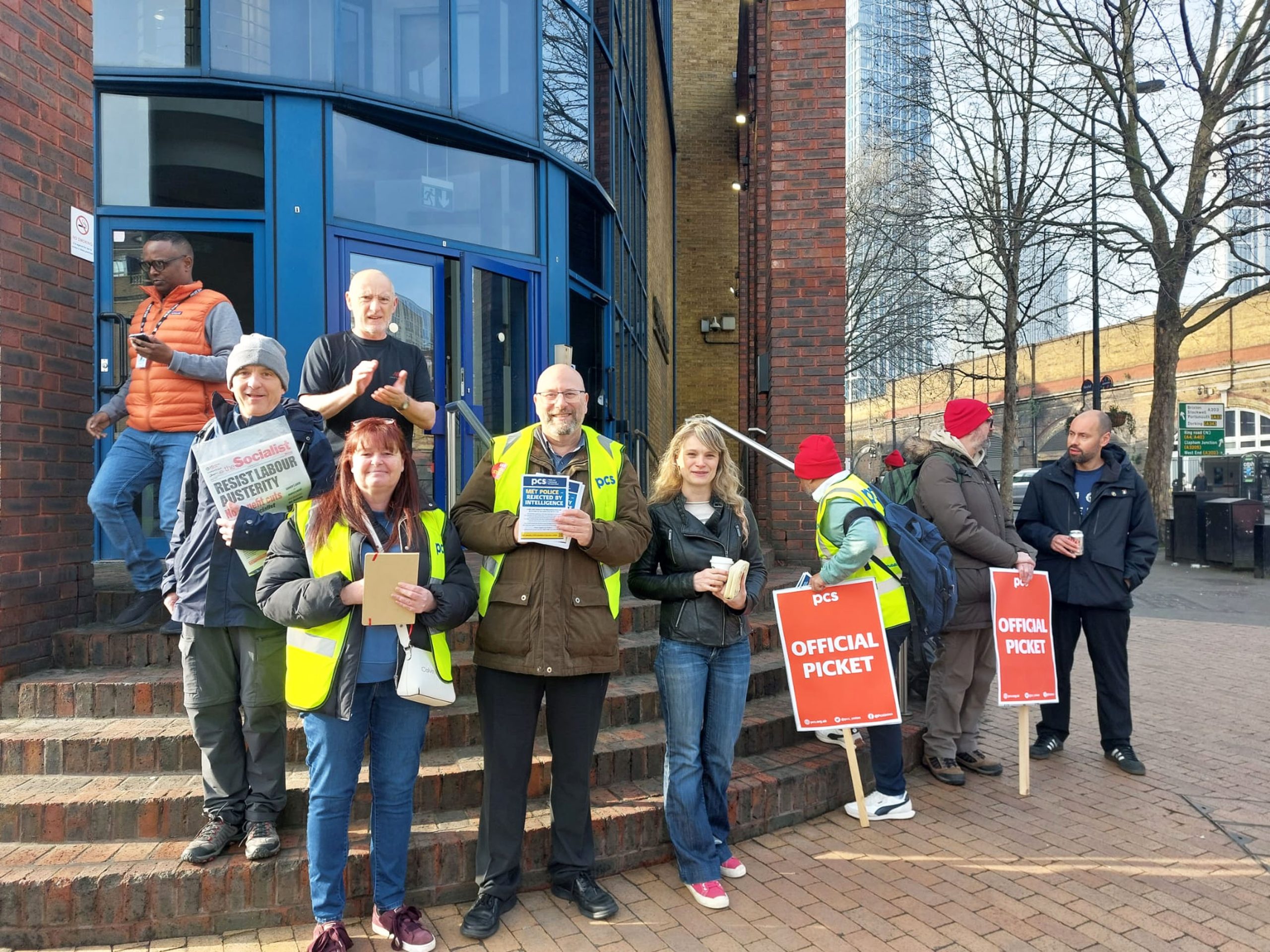
But new leadership already backtracking
Fiona Brittle, PCS NEC, personal capacity
The first meeting of the newly elected PCS National Executive Committee (NEC) took place on Thursday 29 May to discuss the union’s response to the Labour government’s pay remit of 3.25% (plus 0.5% to ‘tackle low pay’). This was announced as the PCS Annual Delegate Conference (ADC) closed. It goes nowhere near the union’s pay claim of 10%, and does nothing to address chronic levels of low pay, or the impact of years of pay freezes and caps.
The NEC meeting should have agreed details to implement the fighting strategy carried overwhelmingly at the ADC only days previously. Instead, a paper from the general secretary Fran Heathcote was put, which rejected the pay remit but did not put forward plans to build a campaign to defend members against the onslaught of attacks by the government. The union needs to fight on funding as well as pay. There are reports of anything between 50,000 to 80,000 potential job losses!
A lot at stake
PCS members have a lot at stake. But already the newly dominant (and misnamed) ‘Left Unity’ leadership grouping are showing they are not up for the fight. The proposals set out by the leadership will disarm members in the face of Starmer and Reeves’s attacks.
Proposals suggested a ‘ballot-ready strategy’, but precisely what this means has been deferred to the NEC ‘Organising and Education’ sub-committee, which hasn’t even been established yet, and won’t be until the end of June!
The general secretary calls for immediate engagement in delegated pay talks (ie employer by employer) “to secure the maximum monies available” – but without demanding national talks. Experience already tells us that delegated talks in the context of an overall 3.25% remit will mean average pay rises – apart from very exceptional occasions – of 3.25%.
Agreed demands being described as “aspirations”, and a failure to set out the campaign required to rebuild confidence and trust after the botched 2023 experience, are a recipe for confusing members.
But it will be all too clear to Starmer and senior civil service management that this is a leadership that doesn’t want to fight.
Left motion detailed campaign
In contrast, NEC members from the left coalition (including the Broad Left Network, in which Socialist Party members participate) put forward a motion which set out in precise detail the type of campaign required.
It called for an immediate rejection of 3.25%, linking up with members employed by Scottish Government, whose remit is 3% every year for three years. It called for urgent demands to be placed on government to protect jobs, pay and conditions, including attacks on hybrid working and the threatened removal of 12,000 jobs out of London. Crucially, it set out the steps required to build the confidence of members and prepare for a likely strike ballot in September.
Uncharacteristically, national president Martin Cavanagh allowed both motions to be heard. He spent the last year ruling out all motions from the left coalition that contradicted the general secretary, because last year the left coalition held a majority on the NEC and he knew our motions would be passed. Funny how democracy is applied differently once the balance of forces changes. Both motions from the left coalition were lost and the paper from the general secretary was carried.
This NEC meeting makes it crystal clear that there are two trends within PCS – those who want to fight, and those, including the Left Unity leadership, who don’t.
Left Unity may have regained a majority on the NEC but this isn’t an endorsement of their strategy or record. The determination of conference delegates to vote for a militant strategy is a sign of the real fighting mood (see ‘PCS conference saddles up for battle against Labour austerity’).
Join the fight of the Broad Left Network to help fight for the strategy that members need: bln.org.uk