


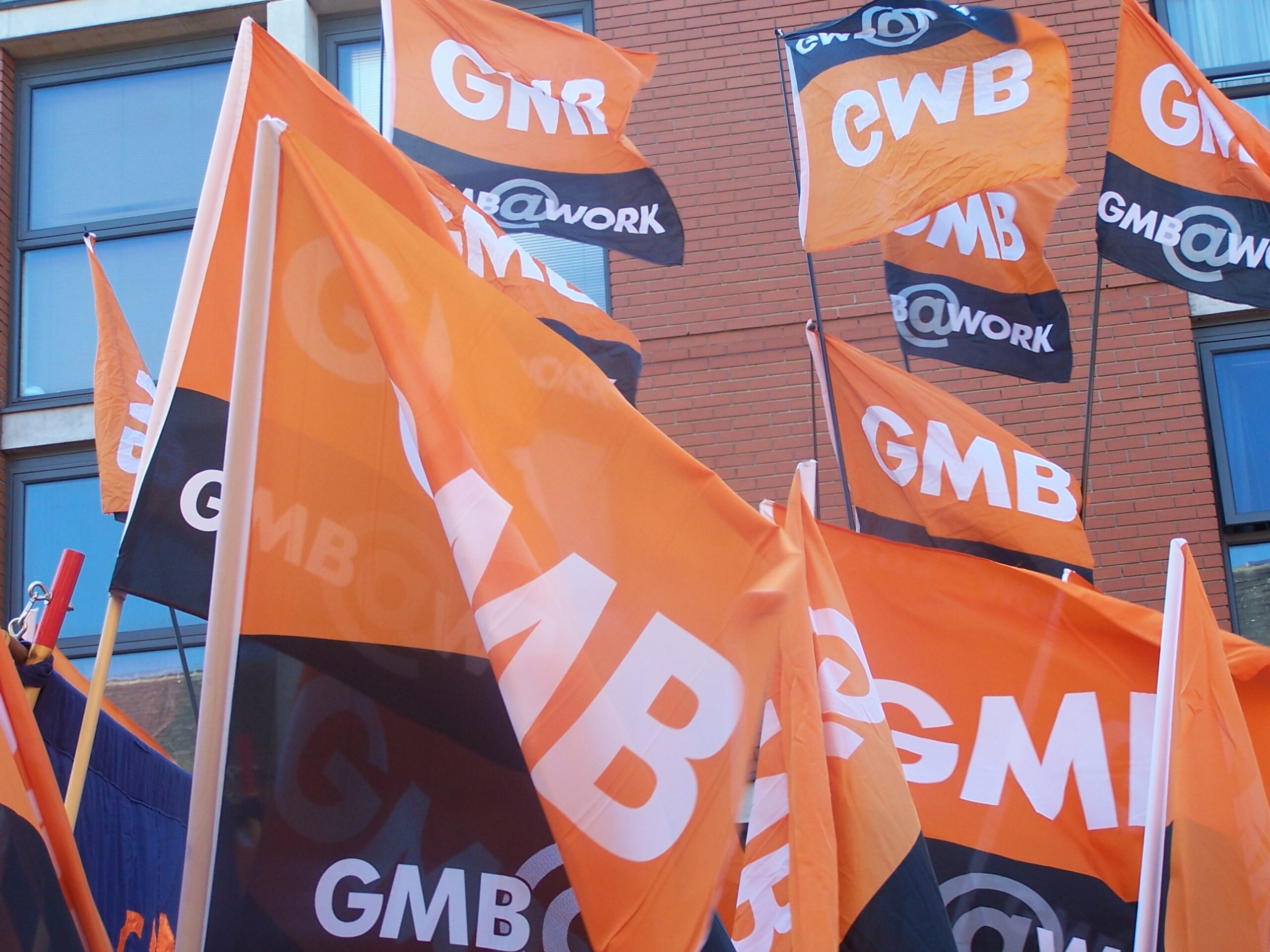
Socialist Party members in GMB
Over 300 delegates gathered in Brighton on 7 June for general union GMB’s annual decision-making congress.
Taking place during the first 12 months of a Labour government, the congress agenda didn’t look much different from agendas under the Tory government. Delegates were still debating motions opposing public sector cuts and anti-strike legislation, condemning anti-migrant policies and benefit cuts, and demanding the government tax the obscene levels of wealth in our society.
But perhaps because it is still in the early stages of the Labour government, overall there was less anger expressed at these attacks compared to some previous congresses. That is the tone set by the Starmer-supporting leadership. There was a high number of first-time delegates and a lack of debate, and many motions were withdrawn in favour of ‘special reports’ from the Central Executive Committee (CEC).
Congress opened with a report from general secretary Gary Smith. He started with his usual emphasis on how he has turned GMB from failing into a “campaigning” and “growing” union.
As one of the UK’s two main ‘general’ unions, GMB has members across both private and public sectors, from NHS, school support staff and local councils, to retail sector, gig platform workers, and workers in the defence, nuclear and energy sectors. Smith highlighted some of the many wins and campaigns across these sectors.
He welcomed Labour’s Employment Rights Bill – “the most positive worker legislation in 50 years” – and boasted of the central role that GMB has played in delivering it. This despite the fact that the Tory anti-trade union legislation – including the draconian ballot turnout thresholds – is still in place!
But the mood of members meant that even Smith had to acknowledge Labour attacks on the working class, and said that “Labour don’t always make it easy to rally to their banner. We have to recognise that mistakes have been made”.
But the only political alternative to Labour in the GMB leadership’s eyes is Reform. And Reform was in some ways the spectre haunting congress, with emergency motions on defending the local government pension scheme against attacks from newly elected Reform councillors, and a national strategy passed on fighting racism and the far right.
But the leadership’s only solution to Labour’s attacks on workers and the rise of Reform is to demand of Starmer and Reeves, “You have to listen to us, because not listening to us leads to Reform”. The general secretary said, “We need to fight to get workers’ voices at the heart of decision-making” in the coming period. But no clear plan was set out as to how to achieve this. Socialist Party material argued that the unions need to launch a new party to represent workers’ interests.
There were harsh criticisms of Labour from a handful of delegates. A Southern region delegate was cheered when he said the Labour government was “on warning” and that the CEC report didn’t reflect the anger towards Labour from many Southern region delegates. Before congress they had debated a motion to disaffiliate from Labour.
Smith’s focus was on “rebuilding the economy” and “bringing good jobs home”, and this theme was continued by Labour chancellor Rachel Reeves when she addressed congress, ahead of her Spending Review announcements.
GMB is one of the safest union congresses for a Labour minister, and she received a standing ovation from the majority of delegates. In fact, two Labour Party members expressed surprise (and relief!) that she hadn’t been heckled.
A lot of this positive reception was down to Reeves highlighting the £113 billion investment in the Spending Review. Much of this investment is in areas where GMB has members. The anxiety and misery of GMB members, especially in previous industrial heartlands, was powerfully articulated by delegates throughout the week. It was to this desperation for secure, well-paid jobs in demoralised communities that Reeves’s announcements were designed to appeal.
In particular, she focused on defence, shipbuilding and aerospace industries: “Investing in the defence of our UK, with good union jobs”. She also announced the “biggest roll out of nuclear energy since 1988”, with 10,000 jobs and 1,500 apprentices. GMB members in these sectors applauded enthusiastically.
A motion supported by Socialist Party members to fight for a just transition to climate jobs was withdrawn by the region in favour of yet another CEC report, but it is notable that in recent years there is a growing number of motions supporting a just transition. It is only through fighting for socialist nationalisation and democratic control that members’ fears about jobs in these sectors can be answered.
Despite the applause for Reeves and the pro-Labour message from the top of the union, the coming year will face GMB members with unprecedented challenges – not least in Brighton itself. During the congress, hundreds of members marched through Brighton in support of a £30 million equal pay claim against the Labour council.
The Socialist Party held a meeting which attracted a small number of left GMB activists and we had an excellent discussion about how we can build a fighting GMB. Socialist Party members in GMB will continue to push for a democratic, socialist broad left to hold the leadership to account and campaign for a fighting union with a clear national strategy to defeat Starmer’s austerity.