


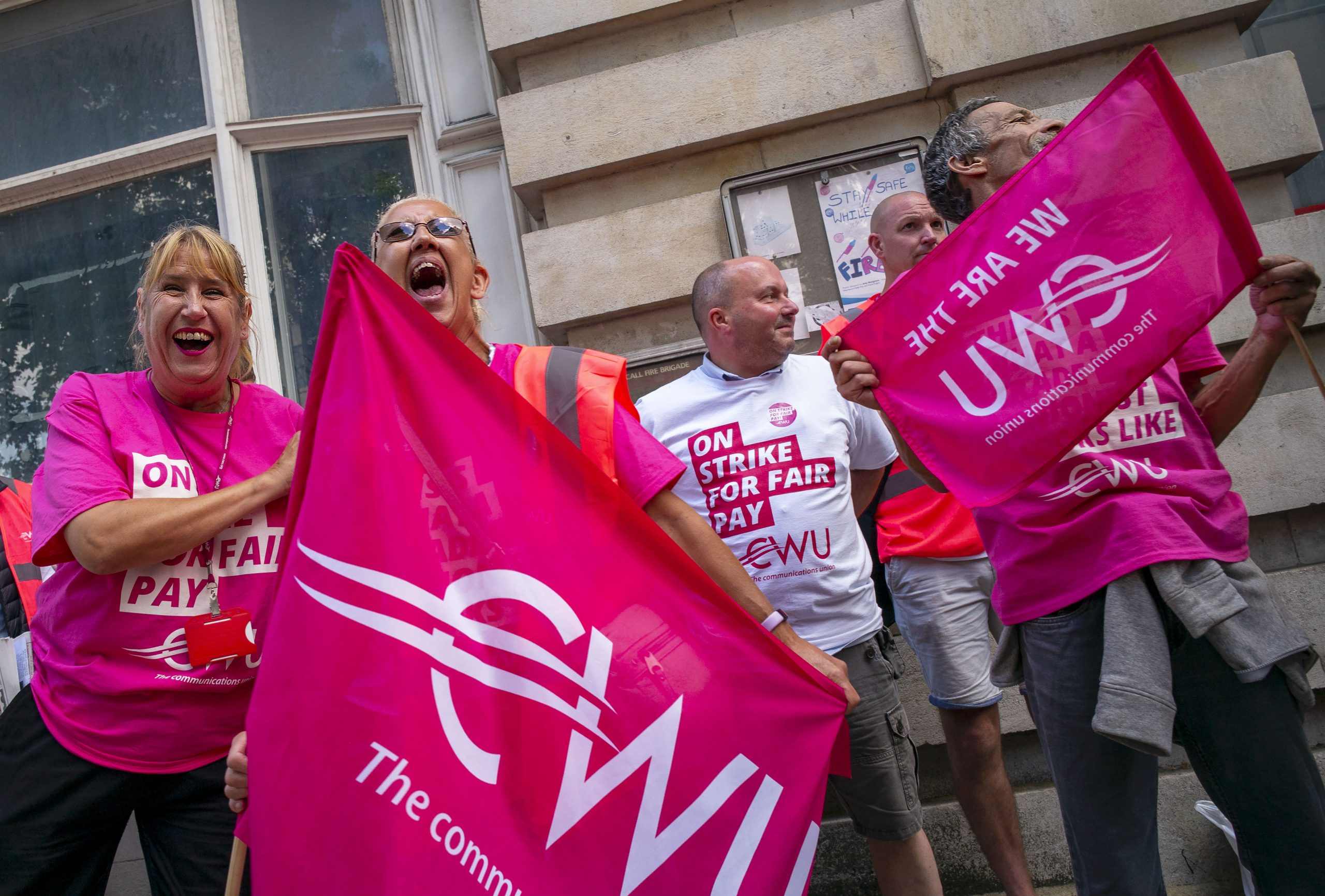
Socialist Party members in CWU
The leadership of the Communication Workers Union (CWU) has called a Special Restructuring Conference. At this stage, this is the only national CWU conference this year. Last year there was a rules conference, and industrial sector conferences. That means that there hasn’t been a general conference of the union for over three years, despite it being an annual conference by rule.
Yet this has arguably been one of the most intensive and dynamic periods experienced by the CWU, at all levels. This period has included the strike wave, which saw the union fight on three fronts: Royal Mail, BT and the Post Office; the end of the Tories, when they tried to bring in more anti-union legislation; the election of the Starmer Labour government; and the takeover of Royal Mail.
In reality, this conference flows on from the 2024 rules conference, and represents the next stage in what can appear to reps and members as a continuous process of restructuring, reorganisation, and – most worryingly – retrenchment.
Socialist Party members in the CWU recognise that this is a pivotal moment for the union. But a discussion on assessing the resources of the union can’t be separated from a debate about the terrain facing us, and the industrial and political approach and programme needed.
A major contraction of membership will open up the consideration of a merger with another union, but the CWU can continue and even grow as an independent stand-alone union.
We aren’t opposed to temporary measures to marshal our forces, on condition that it is used to prioritise resources to build the union and grow the membership. But this must not be at the expense of lay member democracy and control. In fact, this is crucial in galvanising members to go forward. It is why we will oppose measures to cut lay democracy, such as moving to two-yearly conferences. Debate and discussion are essential in developing union activists.
And this must include winning reps and members to a fighting industrial approach and open up a real discussion on our political orientation. Otherwise, this conference will be followed by others, on a downward curve to amalgamation.
The CWU is vulnerable because it is overwhelmingly based on three major employers – Royal Mail, BT and the Post Office – all of which have continued to face management and government policies of privatisation, outsourcing, closures and redundancies.
But at critical times, notwithstanding recent disputes, the CWU leadership, both nationally and at sectoral levels, have not sufficiently challenged these attacks.
At the height of the brutal Royal Mail struggle under the Tories, when management threatened to take the company into administration, clearly raising the stakes during the dispute, the union leadership refused to raise the demand of returning the company to public ownership.
Incredibly, this mistake has been repeated in the Kretinsky takeover under the new Labour government. This is despite renationalisation not only being CWU policy, but also Labour Party policy after the union won the position at the 2022 Labour conference.
By fighting for this demand, backed up by action, it could have put pressure on Keir Starmer – who is now starting to be forced to U-turn on such failed policies as the cut to Winter Fuel Allowance – and it might have been possible to win some important gains. And at the very least, it would have appealed to the significant and growing layer of non-union members in Royal Mail.
This shows the need to link a militant industrial approach to a review and discussion over our political strategy. Socialist Party members have long argued that, given Starmer’s pro-big business policies, the CWU and the rest of the union movement must launch a new workers’ party that supports our members, our strikes and our policies. At the very least, the union must open up its political strategy so that we can support and stand pro-worker candidates, and build up a bloc of MPs (whether Labour or independent) that fight for our policies in parliament.
There is a future for the CWU, both in our legacy companies and others in the communications sector. But that means prioritising an organising strategy in companies where we already have a foothold as a base to move into others. The GMB general union is not always known for its militancy, but it has pioneered organising in Amazon, on the back of being prepared to strike against low pay. There is no reason why CWU, especially with its fighting tradition, can’t do the same or more.
There is a future for the CWU – join us in the struggle for a fighting, democratic union.
