


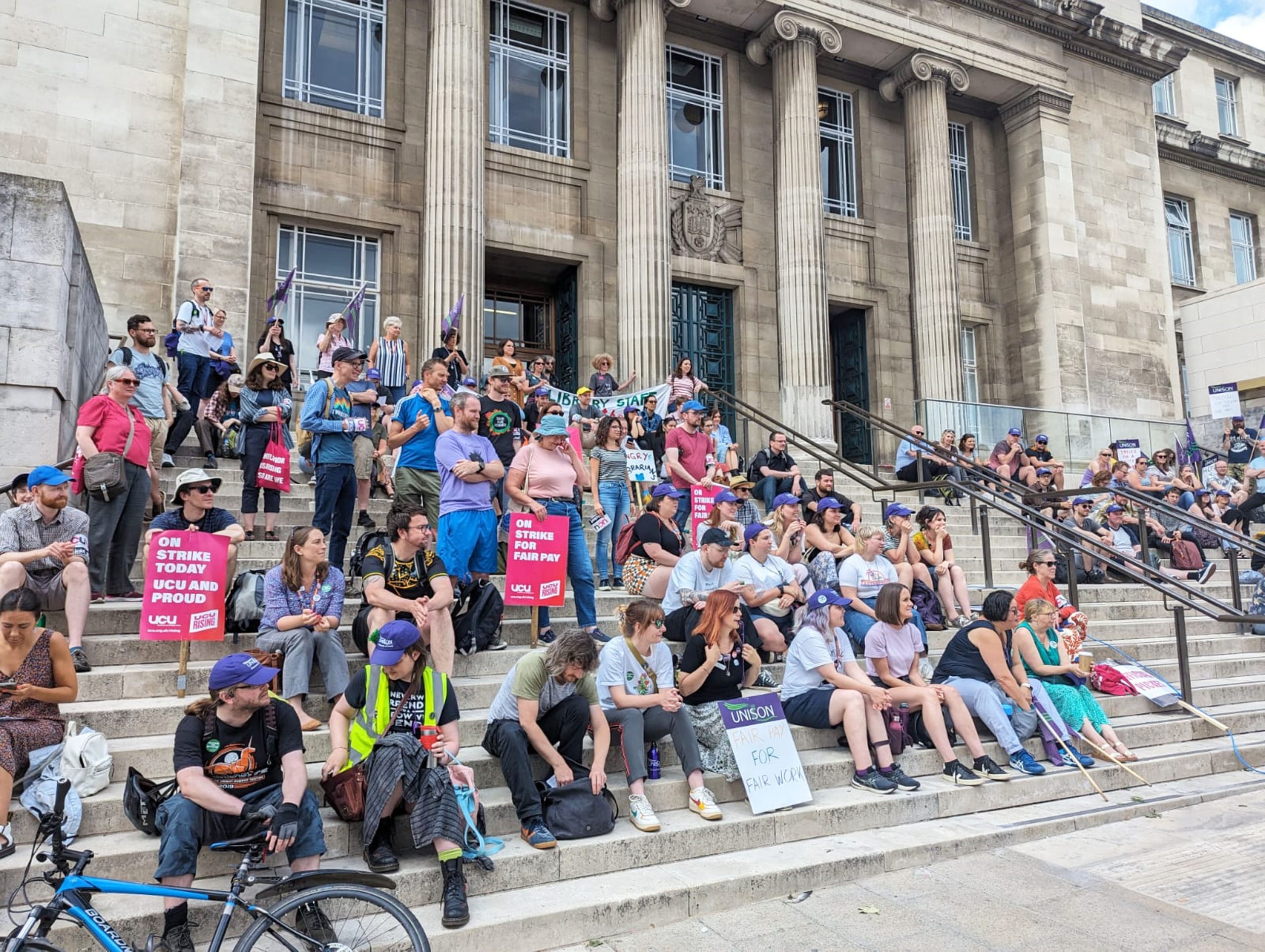
Bea Gardner, UCU member
Four university unions have announced they will be coordinating an industrial action ballot of their members in Higher Education (HE). The stated aim is that any strike action agreed will be organised jointly.
All five unions that participate in collective pay negotiations with the university employers’ association are in dispute over this year’s pay claim of just 1.4%. Members have already resoundingly rejected the offer in a series of consultative ballots. In Unite, 89% of members voted to reject the pay offer and 86% voted in favour of strike action.
Now the University and College Union (UCU), Unison, Unite and EIS in Scotland have announced they will be coordinating a ballot for industrial action from 20 October to 28 November. No doubt members of GMB will be wanting to participate in the action too.
This is the first time in recent years that an industrial action campaign has been coordinated between the main campus unions. It is something that Socialist Party members have been campaigning for. Combined, the unions have over 120,000 members, representing university workers in a range of academic, technical, research-based, administrative and maintenance roles. If members vote ‘yes’ and beat the 50% turnout thresholds, then the whole university sector could be brought to a halt, with entire campuses shut down. This has the potential to significantly strengthen the impact of industrial action.
For that to happen, however, there needs to be a serious campaign to prepare members to vote ‘yes’ and to back the action. Given the dire health of university finances and the mass redundancies that took place last year, members need to see how the fight for pay is linked to the fight for full funding and job protection.
Pressure on Starmer
UCU members in further education are also balloting at the same time. Keir Starmer’s government may attempt to distance itself from the disputes, arguing these are disputes with the education bosses, not the government. But the reality is that Starmer is facing the prospect of a post-16 education sector strike before the year is out. That is something he will not be able to ignore when, quite clearly, the funding of post-16 education is a government matter; the government’s delayed university funding reforms are set to be announced as part of November’s Budget!
There is also the potential to build solidarity between staff and students, who are also angry about fee hikes while courses and staff are being cut.
The coordination of the unions this time will be a boost, particularly to UCU members who have often fought alone in recent years, but also to Unison members who have taken action on a branch-by-branch basis largely separate from action taken in UCU.
But that confidence is at risk of being undermined by splits within the leadership, particularly within UCU, the union with the most members in Higher Education. 20 Higher Education Committee members voted to ballot but 19 voted against, including those organised in the ‘UCU Commons’ faction who are general secretary Jo Grady’s closest supporters. Having lost the vote, they are already saying that the six-week ballot window is not enough to pass the 50% turnout threshold, attempting to demobilise the campaign before it’s even got started.
It is therefore more important than ever that all those who want to fight for full funding, job protection and pay come together and put maximum pressure on the leadership to back the action, while building for the action from below. Union members must have democratic control of their disputes, and we need representatives prepared to implement our decisions.
