

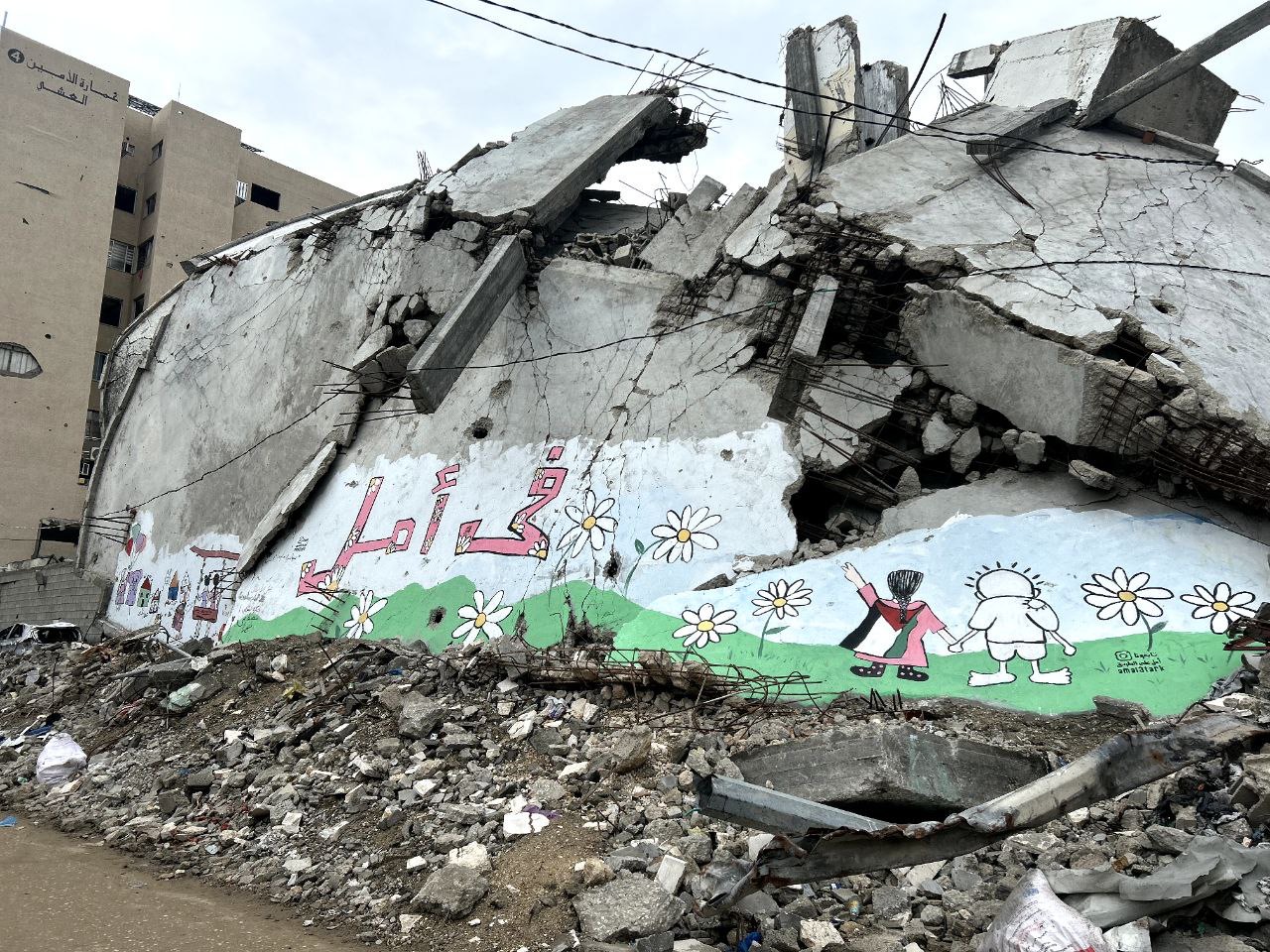
More than half a year since Netanyahu’s ultra-right government collapsed the previous ceasefire, a new ceasefire came into effect on Friday 10 October. It sparked a wave of relief and cautious hope that the two-year-long war of extermination may be nearing its end, accompanied by an agreement for the release of hostages and prisoners. Tens of thousands of surviving residents in Gaza began marching northwards from the makeshift displacement camps in the south, with cries of joy.
The previous ceasefire collapsed within two months, when the occupation government refused to proceed to ‘Phase B’. The Trump administration now offers ‘guarantees’ that this ceasefire will lead to an end to the war, which Trump typically hails as progress toward ‘regional peace’. Simultaneously, the same administration threatens to back a renewed Israeli offensive in Gaza should Hamas allegedly violate the framework’s terms.
In line with the framework, Israeli occupation forces have withdrawn to the ‘Yellow Line’ – the deployment line as of 14 August, the date of the assault on Gaza City. Occupation forces continue to directly control over 50% of the Strip and will maintain the siege policy.
Although the ceasefire is expected to increase the entry of ‘aid’ in the form of essential goods and basic equipment, including materials needed for infrastructure rebuilding, the Israeli military can easily obstruct the transfer of supplies, especially in the vast areas under its direct control.
At an undefined date, the Israeli army is supposed to withdraw to the ‘Red Line’. This is conditional on replacing the Hamas administration with a ‘technocratic’ government under Trump’s direct control – a ‘temporary’ colonial administration backed by an ‘International Stabilisation Force’, a policing and occupation force directed by US imperialism and regional regimes. Further withdrawal is supposedly contingent on ‘demilitarisation of the Strip’, with full withdrawal expected after an undefined number of years. The Hamas leadership has already clarified that its movement will not disarm.
Instability
This ceasefire is built on very unstable ground, creating high uncertainty about the coming months. There is concrete potential for collapse scenarios, as well as, as occurred with the previous ceasefire, military escalation in other arenas – including an attack on Iran that could ignite another war cycle.
Netanyahu’s government has been forced to cooperate with ‘Phase A’ of the framework due to mounting pressure from Washington, which in turn reflected increased pressure from Arab and Muslim regimes in the region, and from governments within the Western imperialist bloc. Israel’s arrogant bombing of Qatar’s capital on 9 September, a US ally, prompted an unprecedented US declaration of commitment to defend Qatar and likely triggered the new attempt at a stabilising exit strategy from the Gaza crisis.
Mass protest strikes in Italy against the genocidal war marked a new level of international working-class intervention and highlighted the radicalisation potential of the prolonged historical crisis, which has shaken mass consciousness worldwide. The mass movements, although not sufficiently developed to directly compel the halting of the war machine, are undoubtedly a significant background factor in the dynamic. This includes the highly contradictory protest movement within Israeli society, where dominant forces have been establishment-aligned and only belatedly adopted a clear demand to end the war, yet objectively exerted pressure that somewhat constrained Netanyahu’s government – albeit to a much too limited degree.
The concentrated aspirations of Netanyahu’s government to erase the existence of the Palestinian people – currently pursued primarily through efforts to continue displacement from the territories of historic Palestine – are not going away. In particular, the West Bank remains in the crosshairs of Netanyahu’s government, which seeks to deepen the colonial settlement enterprise and advance annexation measures.
Palestinian state
Netanyahu has not even paid lip service to hypothetical recognition of a Palestinian state, and Trump’s framework will not reach the implementation of ‘Point 19’, which suggests that at some unknown future time, conditions might ripen for realising the Palestinian people’s national aspiration for statehood. Trump’s framework is not intended to pave the way for a solution based on freedom and equality for the Palestinian people and all peoples of the region, but rather to re-advance the normalisation of the occupation in the service of US, Arab, and Israeli capital. Such a plan will inevitably lead to further bloodshed and even more extreme deterioration.
Further demonstrations and strikes are needed, both locally and internationally – as well as intensified organised actions among Israelis to refuse to participate in military aggression. But there is also a need for a struggle for an alternative.
Without a fundamental, socialist solution that includes ending the occupation and achieving freedom, equality, personal security, and social justice for Palestinians, as well as for Israelis and all peoples of the region, the path is paved for even more catastrophic bloodshed.
Yes to ending the war of extermination. No to the plans of Trump and Netanyahu. Overthrow the death government. There is no solution without a struggle to end the occupation and for social justice.
