


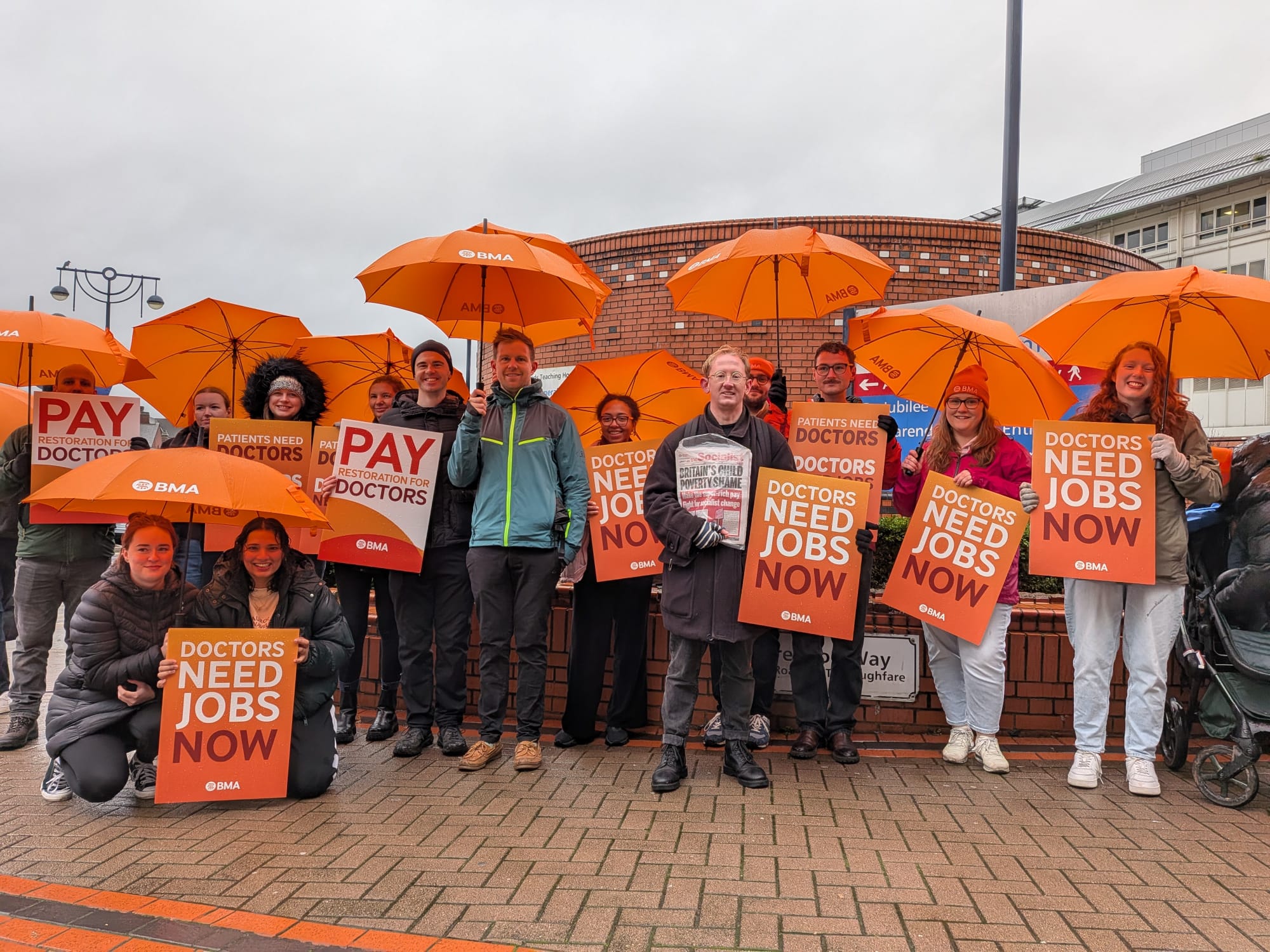
A Resident doctor in Sheffield
The media has been vociferous in their anger at the BMA, as resident doctors (formerly known as junior doctors) undertook a week of strike action.
The Guardian released an editorial on the eve of the strike asking Labour health secretary Wes Streeting to stay firm. Streeting has stated: the BMA “threatens the future of the NHS”.
This strike action came soon after a deal was struck that gave us a ‘pay rise’. The cost-of-living crisis is worsening and many people are feeling this harder than resident doctors. Some colleagues, who I respect, have told me they ‘don’t know why we’re striking this time’ and the BMA are not ‘reading the room’.
Given this political climate and the actual climate – grey, cold, teeming with rain – as I walked to the grass bank outside the Sheffield Royal Hallamshire Hospital, the BMA picket line location, I was expecting to find no colleagues and hostile passers-by.
Thankfully, this wasn’t the case. Approximately 30 resident doctors, plus Socialist Party members who came out to support, were on the bank by the time the picket ended. More surprisingly, not only did no one come up to criticise the strike, but multiple people beeped their horns in support.
Maybe the public understands something the government has missed.
Despite legitimate questions about the BMA’s strategy, the fact remains that the previous deal does not achieve pay restoration – resident doctors are still 21% off the 2008-09 wage, when adjusted for inflation.
Crucially, this is not the only pillar of the strike. The major issue facing resident doctors is specialty training numbers.
On the picket line, one of my striking FY1 colleagues (ie in the first year as a doctor) described the situation as “terrifying”. According to a BMA survey, 52% of FY2s don’t have substantive regular work lined up for when their foundation programme ends.
After five years at university, resident doctors complete two years of foundation training before re-applying for broad specialty training. That training lasts two to three years and then the vast majority need to apply again for specialty training. This lasts for generally five years and they then apply for a consultant post.
At every stage, jobs are no longer guaranteed and the competition ratios are spiralling, leaving thousands without posts, looking for ad-hoc shifts. The country’s most educated, most wasted, zero-hour contract workers! These should be our future consultants. If Streeting truly cares about the future of the NHS, he must listen to the resident doctors who will help make it.
Tom Baldwin reports from Bristol
A chorus of honking cars and applauding pedestrians showed the doctors they still had significant public support, despite the aggressive denunciations from the government and press.
Streeting claimed that they were threatening the future of the NHS but pickets were clear it’s the other way round. “It’s all the money he’s giving to private health companies that’s threatening the future of the NHS. It’s hard to believe this is coming from a Labour government.”
Pickets described how doctors weren’t able to find full-time work and so were driving for Uber or picking up shifts at Tesco to make ends meet.
One said: “I never expected I’d be a trade unionist, none of us want to be doing this, but when negotiations don’t work you need to be prepared to strike.”
