


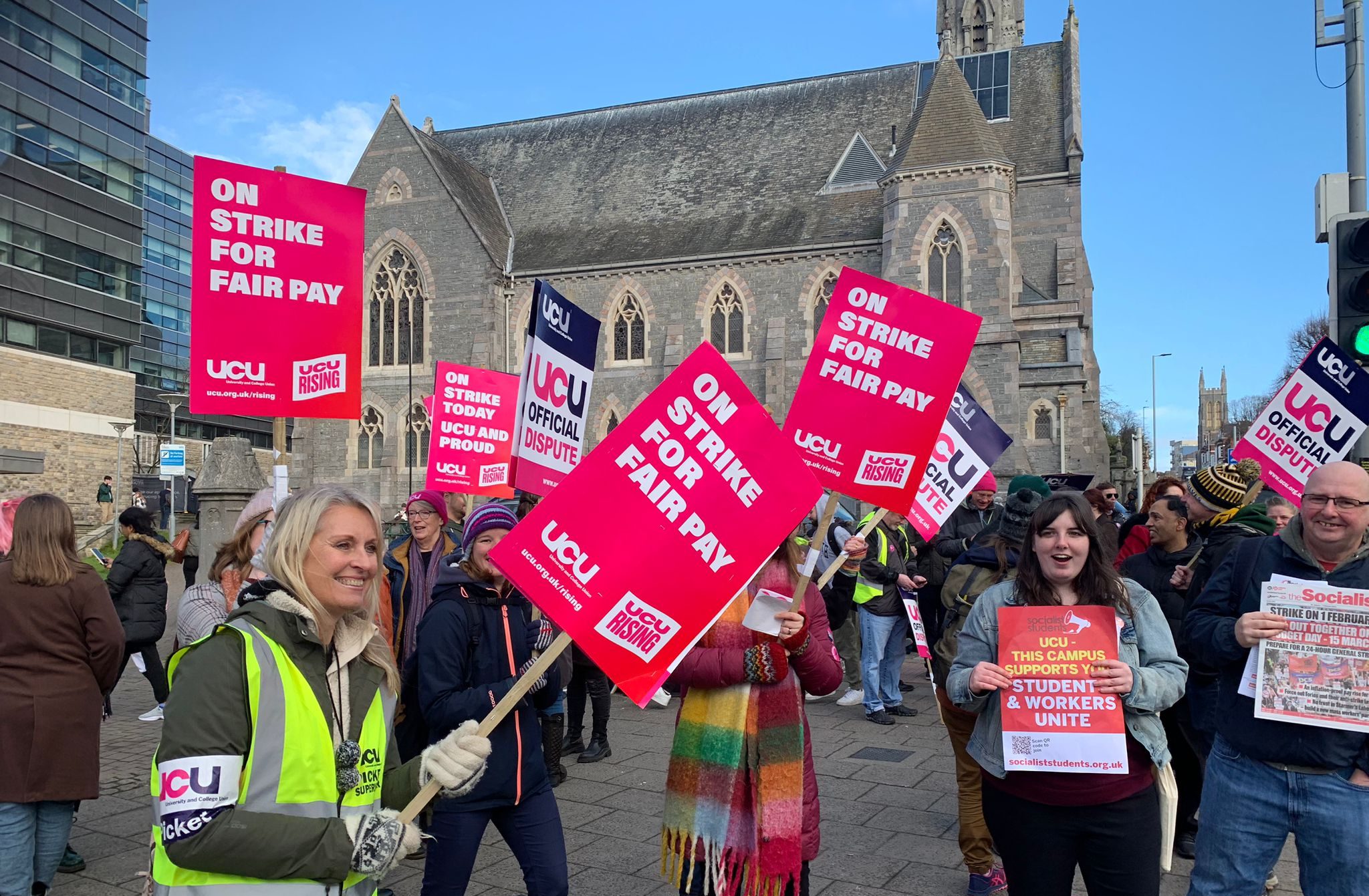
But are defeated by anti-union laws kept in place by Starmer
Bea Gardner, UCU member
Workers across the university sector have sent a strong message that they are prepared to take strike action for pay and improved working conditions. In the University and College Union (UCU) 69.69% of members voted in favour of industrial action consisting of strike action, and 82.89% in favour of action short of a strike.
However, the turnout was not enough to overcome the 50% thresholds shamefully still in place despite the Labour government pledging to scrap these within their first 100 days in office. The results of the parallel ballots in other higher education unions, Unison, Unite, and EIS in Scotland, have not been released at the time of writing.
Since the Labour government came into office 18 months ago, the onslaught of course closures and redundancies has intensified across the sector. The number of branches in local disputes has rocketed. Labour has done nothing to resolve the crisis of university funding, which is exacerbated by a market model resting on exploitative student fees.
It was in this context that the UCU Higher Education conference in May voted overwhelmingly to return to a strategy of national strike action. It was very significant that for the first time, the four main UK campus unions coordinated their industrial action ballots. These were organised on a disaggregated basis in Unite and Unison.
With 32 Further Education colleges also voting to take strike action, and dates set for January, Starmer faced the prospect of an unprecedented post-16 education strike.
Not the final word
The UCU result is therefore disappointing, and at this stage, a sector-wide strike is on hold. However, this will not be the final word. University workers are being made to pay the price for a failed marketised funding system, which is also having a big impact on student experiences. Local branches continue to boldly fight against imposed attacks and redundancies. More university workers are drawing the conclusion that we need to have a collective fightback.
One obstacle to achieving this in UCU is the leadership of Jo Grady and her supporters on the NEC who have consistently presided over delays and retreats. As we warned in our article (see ‘University workers across four unions to ballot for industrial action’) this risks undermining members’ confidence.
Union members must have democratic control of their disputes, and we need representatives prepared to implement our decisions.
It is therefore more important than ever that the left wins a majority in the upcoming National Executive Committee elections so that UCU members have a democratic, fighting leadership.
Why we voted for action
Ivan Petkov, PhD student and UCU member at University of Manchester
UK-wide university strike ballots for University and College Union (UCU) members closed on 28 November. Over 65,000 members across 137 universities were balloted after the UCU and other education unions rejected a derisory 1.4% pay offer from the University and Colleges Employers Association (UCEA).
The reality is that, over the last ten years, workers have seen a real-terms pay loss of 25%, which cannot be rectified under the status-quo education system and will require strike action to push for fairer pay. Further to this, but equally important, are the threats of programme cuts and redundancies across the sector; university employers have tried to axe over 15,000 jobs.
At the University of Manchester, there is a state of perpetual review and cancellation of degree programmes in the School of Arts, Languages and Culture, which will eventually reduce student recruitment and lead to redundancies.
Socialist Students has organised a joint meeting of students and staff for 5 December on collective organisation. Students and workers ultimately face the same crisis: the underfunding and commercialisation of our universities. Staff keep the universities running, and students fund it – our interests are fundamentally aligned.
When we organise together, and when students support the action of union members, we are better able to resist redundancies, pay cuts and to fight back against student poverty and exploitation. The Socialist Students meeting follows a UCU staff-student meeting on making the university sustainable.
Members hoped this ballot could be the start of a serious national fight – and we must still campaign. What is clear is that university workers cannot be expected to pay for the huge university funding crisis with insulting well-below-inflation pay rises. We fight for full funding and an end to the marketisation of post-16 education.
