Rob Williams, Unite member and Socialist Party trade union and workplace organiser
As we reach the last weeks of 2025, Unite, one the biggest and most influential unions, with over one million members, nears vital elections in which the industrial and political approach of the union is at stake, and its status as a militant union is on the line.
The elections will take place as the pro-capitalist character of Keir Starmer’s Labour government becomes ever clearer, with a new wave of anti-working class austerity in the offing.
In the first four months of 2026, the Executive Council (EC), the lay-member leadership of Unite, will be elected. After that, there will be the election for general secretary, where Sharon Graham, who will be standing for re-election, is opposed by International Officer Simon Dubbins.
Workers Unite slate
In the new year, branches will be able to nominate candidates for the EC. Socialist Party members are standing on the left ‘Workers Unite’ slate that supports the manifesto on which Sharon was elected in 2021. The slate includes fellow supporters of the Unite Broad Left.
We supported Sharon’s candidature in the 2021 general secretary election because her programme best ensured that Unite would maintain itself as a militant industrial union. This has been borne out by events. Sharon was previously Unite’s head of organising, effectively the lead officer responsible for the union’s industrial action strategy. As general secretary, this has been taken to an even greater level, on a systematic scale.
Since Sharon became general secretary, Unite has called over 1,500 disputes, winning 83%. Those disputes have won £605 million for members.
United Left in political retreat
The Socialist Party had been a part of the United Left (UL) group since Unite was formed in 2007. The UL had been the main broad left in Unite, playing the lead role in the union, supporting the previous general secretary, Len McCluskey.
But in the run-up to the 2021 general secretary election, it was clear that UL was in political retreat, tying itself to Starmer’s New Labour mark II and cutting Labour councillors. In response, Socialist Party members played a key role in the setting up of a new left in Unite – the Unite Broad Left.
The shift to the right by UL was graphically shown during the 2021 election, when UL candidate Steve Turner criticised the union’s Organising Department, headed by Sharon, for publicly demanding that Manchester Labour mayor Andy Burnham intervene in a Unite bus strike during the mayoral election.
In contrast, at the first Unite Policy Conference under Sharon’s leadership, in September 2021, a motion was passed that was initiated and long-campaigned for by Socialist Party members, calling on Labour councils to refuse to pass on the cuts of central government, then the Tories and now Starmer’s Labour.
Since then, in the run-up to Labour’s victory at the 2024 general election and in the first phase of Starmer’s reign, the UL has attempted to pass motions at conferences to effectively reverse this policy.
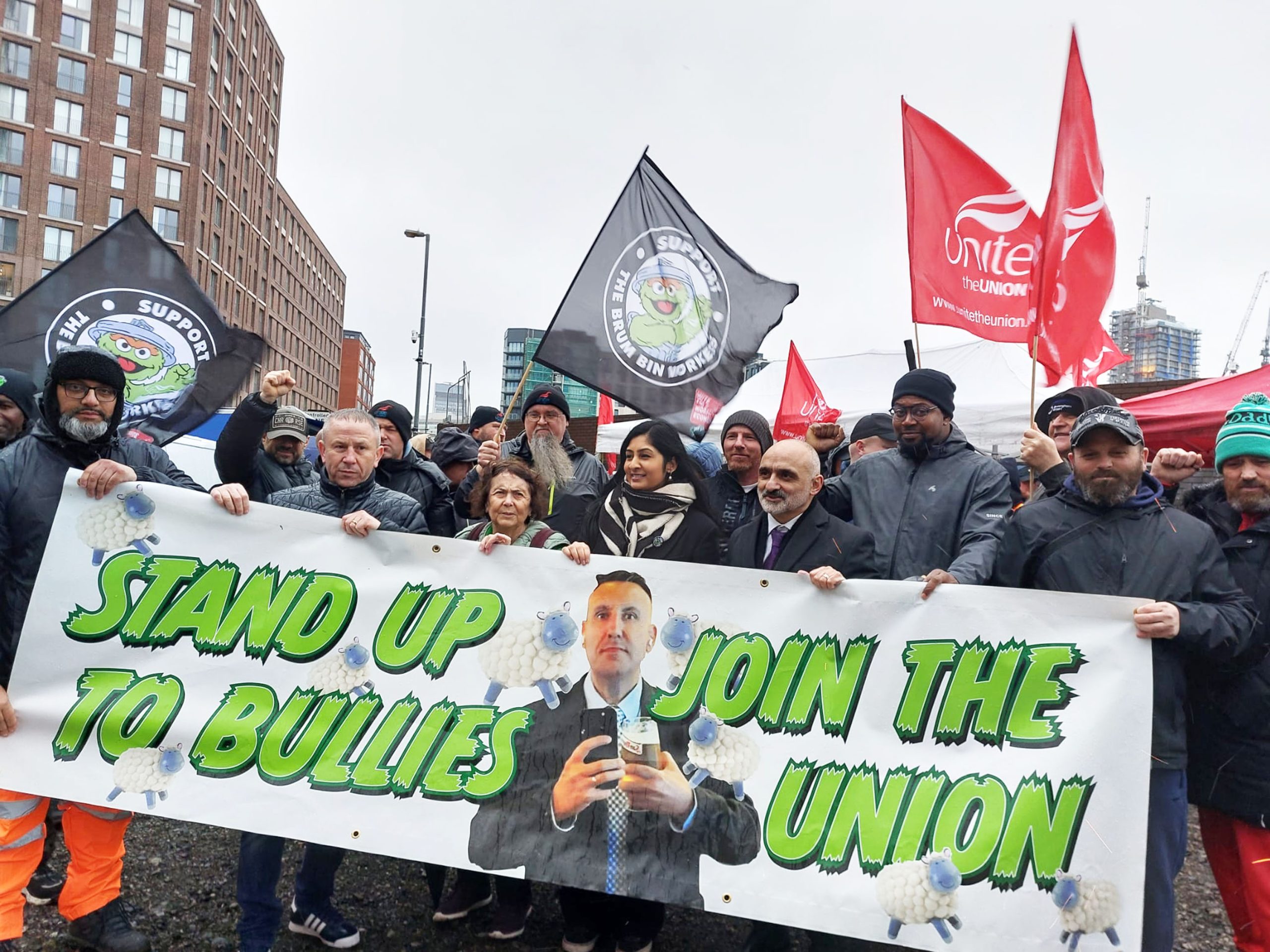
However, because of the experience of Starmer’s pro-big business, anti-worker policies, this has proved impossible. This reality crystallised around this year’s long-running Birmingham bins dispute, where a brutal Labour council has looked to fire and rehire bin workers, slashing their wages by up to £8,000. Worse still, this and the council’s vicious anti-union strike-breaking operations have been backed to the hilt by Starmer’s Labour government, which has still not delivered on its manifesto pledge to scrap the Tory 50% strike ballot thresholds.
Unite’s relationship with Labour
It actually came to a head during this year’s Unite Policy Conference in July, as the council launched its fire-and-rehire attack on the bin workers. Socialist Party members and close allies on the conference floor drafted an emergency motion in support of the bin workers, suspending from Unite membership cutting Birmingham Labour councillors and the then deputy leader Angela Rayner. It also committed the union to opening up a debate about Unite’s relationship with Labour. It was virtually unanimously passed, with only a handful of UL-aligned delegates not supporting it.
Socialist Party members in Unite are campaigning for that debate to start, and for a special rules conference that would free up the ability of Unite to support candidates outside of Labour who support Unite members and policies. It is essential that these steps, including Labour disaffiliation, do not mean Unite moving in a non-political direction. Instead, Unite should take the lead in creating a political voice for workers that fights on a socialist programme.
This need has been further amplified by the recent retreat by Starmer’s government on workers’ employment rights from day one, despite being elected on a 160+ seat majority. Sharon has been one of the few union leaders to condemn this U-turn.
Without this, the political vacuum created by Starmer’s policies will only widen, giving the opportunity for Farage’s Reform to try and fill it with his divisive poison.
Socialist Party’s programme
The Socialist Party stands on the left slate with our own political and industrial programme. Not all those who stand with us support this position. But a victory for UL in the EC and general secretary elections would strengthen those in Unite who want to move closer to Starmer’s Labour, whether in Westminster, Cardiff, Edinburgh, or the council chambers. It would also, therefore, blunt and compromise the union’s industrial muscle, especially where it comes up against these Labour-controlled employers.
The elections in Unite form the most immediate battleground in the fight for militant trade unionism in this polarised period of brutal capitalism. It is essential that left reps, activists and members join the fight against this attempt to push Unite into reverse, retreat, and partnership.
We are supporting the ‘Workers Unite’ slate of candidates:
Regional constituencies
- Adrian Sawyer, East Midlands
- Alison Cleaton, Wales
- Bridie McCreesh, Ireland
- Collin Pedley, West Midlands
- Daniel Taylor, West Midlands
- David Agbley, London & Eastern
- Jacqueline Wilson, North West
- Jane McGuire, London & Eastern
- Jed Ellis, South West
- Julie Cowin, Scotland
- Karen Daniels, North East, Yorkshire & the Humber
- Kerry Owens, Wales
- Len Hockey, London & Eastern
- Lisa Allan, North East, Yorkshire & the Humber
- Mark Bowcock, North West
- Max O’Donnell Savage, South East
- Megan De Meo, South East
- Nadia Elliott, East Midlands
- Patrick Gough, London & Eastern
- Ray Morell, Scotland
- Suzanne Muna, South West
- Tomas O’Curraoin, Ireland
- Vanessa Williams, West Midlands
Industrial constituencies
- Amanda Antoniades, Food Drink & Agriculture
- Andy Green, Docks, Rail, Ferries & Waterways
- Andy Rafferty, Road Transport Commercial, Warehousing & Logistics
- Chris Cadman, Government, Defence, Prisons & Contractors
- Chris Mort, Passenger
- Dave Walsh, Unite Construction, Allied Trades & Technicians
- David Cowieson, Local Authorities
- Emily Perdue, Education
- Fernando Parra, Health
- Gabriela Peczek, Service Industries
- Ian Williams, Engineering, Manufacturing & Steel
- Janine Lee, Health
- Jason Powell, Automotive
- Jordan Velvett, Road Transport Commercial, Warehousing & Logistics
- Kathy Smith, Local Authorities
- Kenny Dinsdale, Unite Construction, Allied Trades & Technicians
- Lee Clowes, Graphical, Paper, Media & Information Technology
- Malcolm West, Chemicals, Pharmaceuticals, Process & Textiles
- Mansoor Ahmed, Passenger
- Marina Gunn, Finance & Legal
- Mark Barnes, Service Industries
- Neil Keutenius, Energy & Utilities
- Simon Crew, Finance & Legal
- Steve McGuinness, Aerospace & Shipbuilding
- Suzanne Abachor, Health
- Tanis Belsham-Wray, Community, Youth Workers & Not for Profit
- Terry Butcher, Automotive
- Tom Bell, Food, Drink & Agriculture
National Equalities constituencies
- Faith Coker-Jarra, Women’s seat
- John Williams, LGBT+ seat
- Martyn Gwyther, National disabled members’ seat
- Monica Taylor, National Retired members’ seat
- Oisin Mulholland, Young Members seat
- Susan Matthews, National Black and Asian ethnic minority seat
See all candidates on the slate: backtotheworkplace.org/executive-council-candidates/