


Caspar Loettgers and Chiara Stenger, Sol Executive Committee, CWI Germany
While a new military conscription law was being voted on in the German Bundestag on the morning of 5 December, school students across Germany took to the streets. A total of 55,000 people are said to have protested in over 90 cities.
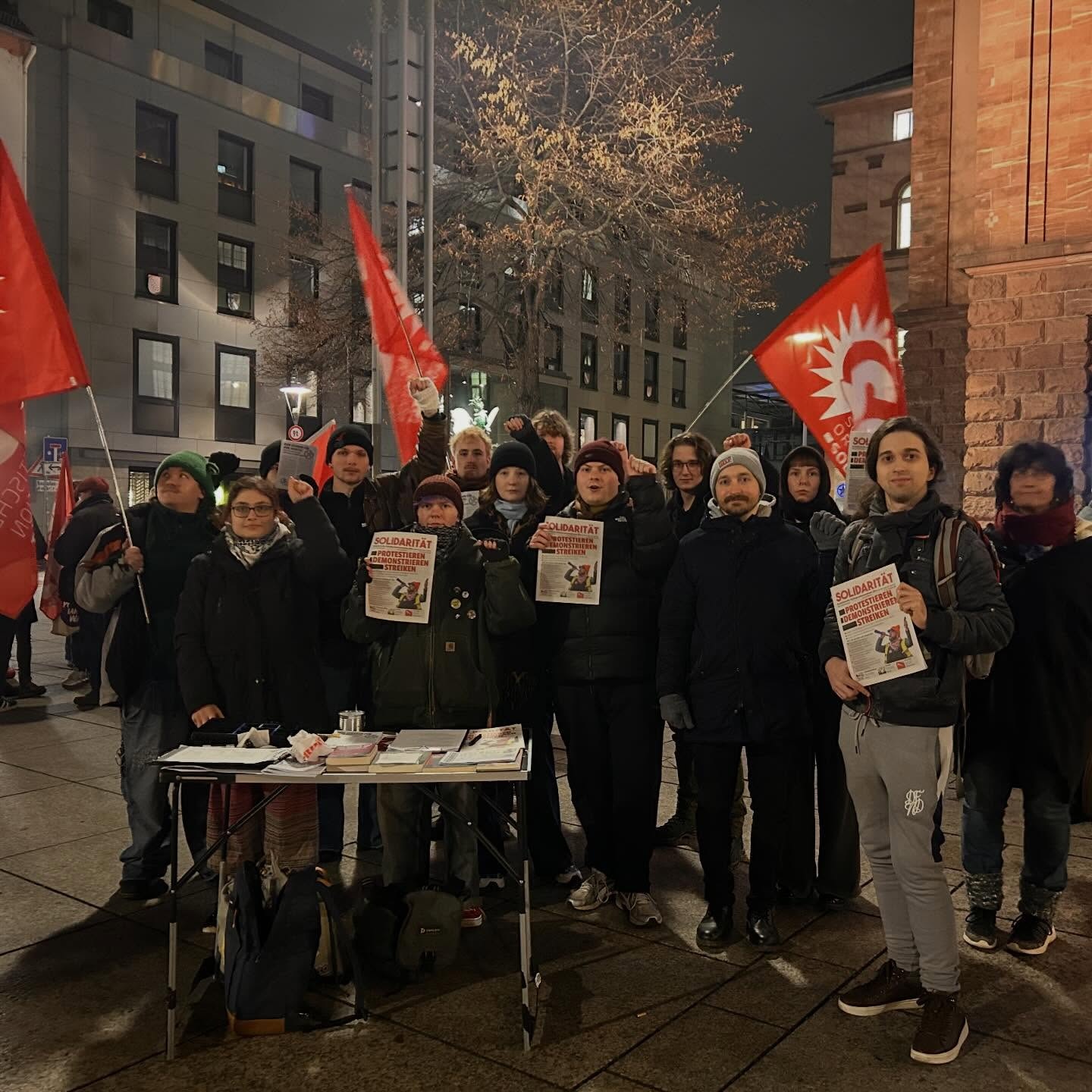
Sol members co-organised or supported protests and school strikes in many places and intervened in the protests. We made suggestions on how to further build the movement and how defence minister Boris Pistorius’s plans are linked to general rearmament and the crisis of capitalism.
Even though the new military conscription law has been passed, the battle will continue in the new year. For the time being, all 18-year-old men will be required to fill out a questionnaire asking if they are interested and willing to join the military, and an increasing number will be medically examined to determine whether fit to serve. If not enough volunteers come forward, a vote will be held on “conscription based on need.” Currently, all polls indicate that not enough ‘volunteers’ will be found.
The federal government is therefore already trying to convince young people with material arguments, in addition to a propaganda offensive in the form of classroom visits, YouTube mini-series, and posters. For example, the monthly pay for recruits has been increased to 2,700 euros (previously 1,800 to 2,200 euros). In addition, a subsidy of 3,500 euros will be provided for driver’s licences.
This makes it all the more important that, in the future, the fight against conscription is linked to the fight for social justice, good training places and remuneration, and investment in our schools and universities. Every euro that goes to the German Armed Forces is missing elsewhere.
Even though the school strikes were smaller than in the past (e.g., Fridays for Future 2019 or against the Iraq War 2003), the local spread (in over 90 cities) shows how many school classes discussed the issue and how much uncertainty there is.
What next?
It would therefore be good if pupils and students now organised themselves in local groups against conscription, planned discussion and information events, wrote educational material, and prepared protests: for example, for youth clubs instead of recruitment centres and barracks, or against armed forces advertising in schools and public spaces.
A nationwide conference would be helpful for networking local groups, where they could discuss how to continue resisting militarisation and compulsory military service, as well as social cuts and austerity measures. Based on this, further nationwide protests could take place and a campaign against the implementation of “needs-based conscription” could be prepared. This campaign should highlight the direct link between militarisation and social cuts in order to reach those who are still uncertain or sceptical, thereby increasing the scale of the protest.
Some of the local reports:
Aachen
A demonstration with several speeches was registered in Aachen, including one from Sol. Around 200 people were there, most of them students. We also got to know someone who wants to continue discussing with us. The mood was very combative, critical, and anti-capitalist.
Joshua, student and Sol member
Freiburg
In Freiburg, around 800 demonstrators and strikers took to the streets. According to the speakers, significantly more students than expected turned up. Many younger students, but also families with children, as well as some older people took part. The speeches and the mood at the rally were combative. After the demonstration, there was also a strike café where people could exchange views on the demonstration and political experiences. A few good conversations took place and I was also able to sell a few copies of our newspaper.
Pia, student and Sol member
Hamm
In Hamm, about 50 people took part in the school strike, many of them striking students. Our members’ speech addressed capitalism as the cause of wars and emphasised that we have no interest in dying for the profits of the rich. In addition, the local branch of the Left Party gave a speech, alongside a number of spontaneous contributions at the open mic.
Merlin, Sol member and activist in Linksjugend (youth organisation close to Die Linke) Hamm
Kassel
Over 1,200 students and anti-militarists gathered in Kassel to demonstrate against the reintroduction of compulsory military service.
We were also involved in planning and mobilising for the strike and worked to ensure that capitalism was named as the cause of war and compulsory military service. In a speech at a feeder demonstration, one of our comrades emphasised that the fight against this must be linked to the fight against budget cuts, because these budget cuts cannot be separated from the billions spent on the armed forces.
Max, Sol member and activist in the Linksjugend Kassel
Mainz
The nationwide momentum to organise school strikes also had an impact on Mainz. Initially, there was no school strike planned, but rather a demonstration in the evening. However, just under a week before, students contacted the ‘Mainz Against Conscription Alliance’ expressing their interest in organising a school strike in Mainz as well. As a result, school strikes took place at lunchtime with over 150 students participating, and several hundred people demonstrated in the evening.
Laurens, Sol member and activist in the Linksjugend Mainz
Stuttgart
Around 1,000 striking students attended the rally at Kronprinzplatz. We were able to reach many people with flyers and newspapers, and generally encountered openness to anti-capitalist ideas. We organised an event to discuss the ongoing struggle against militarisation and capitalism, which we were able to mobilise support for.
Leo, Sol member
Rostock
According to the organisers, around 500 people, mainly young people, took part in the demonstration in Rostock at its peak. We were represented as Sol with a stand and also had the opportunity to give a speech.
Julian, student, Sol member, and activist in Youth for Socialism Rostock
