


Tom Baldwin, Socialist Party National Committee
“We will break the shackles of poverty and hardship” promised Green Party leader Zack Polanski at their conference in October. He has repeatedly talked of taxing the rich in order to help ordinary people. With the Labour government doing the exact opposite, increasing numbers of people are looking to the Green Party as a left-wing political alternative.
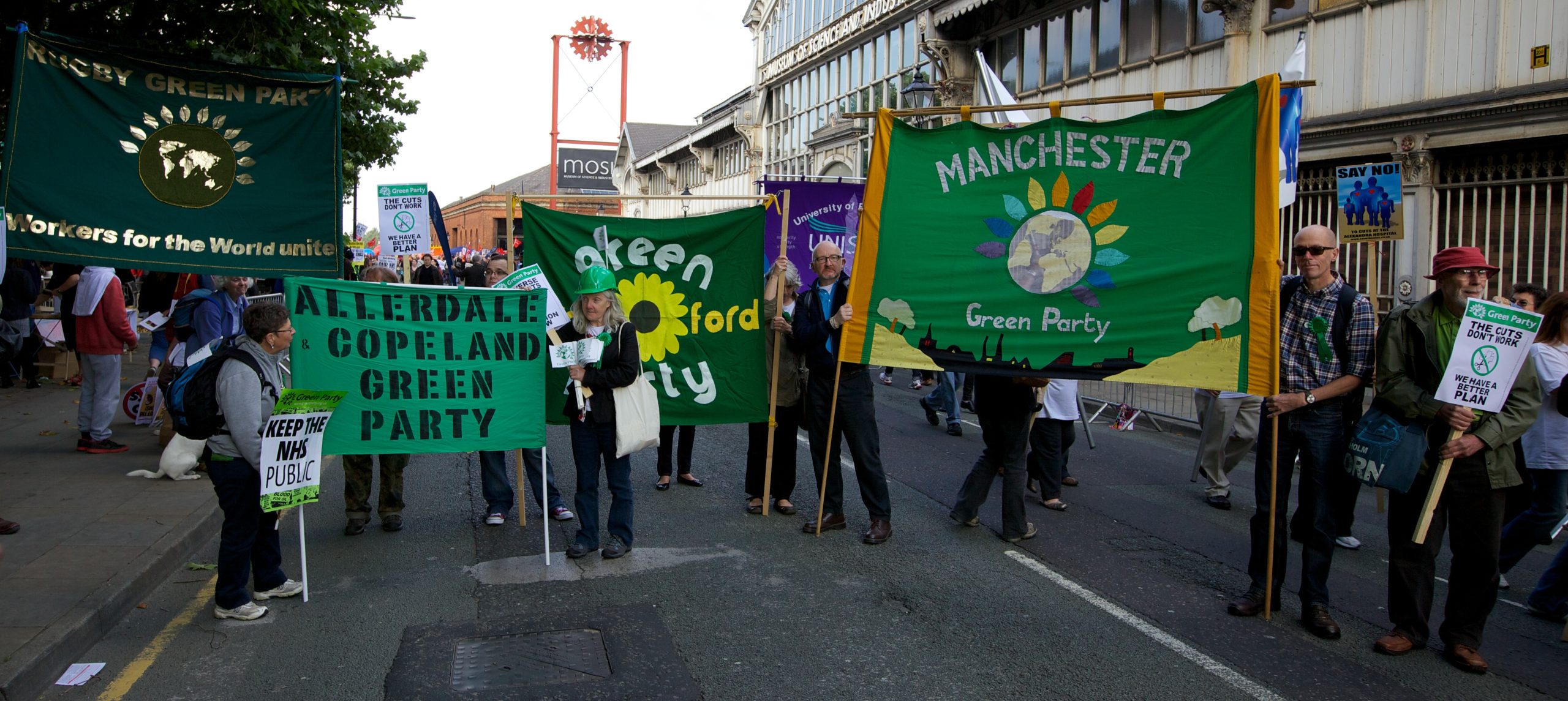
That has accelerated under the leadership of Polanski (right), a self-styled ‘eco-populist’ from the left of the party. Since his election in September the party membership has grown by 100,000. Opinion polls show support for them at 15%, more than double their vote at the last general election. They are easily the most popular party among 18 to 24-year-olds, with support from 36% of this age group.
But a party cannot be judged by its leader’s words alone. So what actually is the record of Green parties in power, in English councils, in Scottish government, and across Europe?
Local councils
The Green Party of England and Wales has over 800 local councillors, participating in the leadership of 41 different local authorities. It has governed in coalitions or agreements with every establishment party, with the exception of Reform UK.
Councils have faced year after year of funding cuts from Westminster governments, first under the Tories and continuing under Labour. Unfortunately, so far Green councils have made the same decisions as all other parties – to work within the spending constraints imposed rather than try to fight them. This can only mean implementing the austerity that many Greens claim to oppose, with the working class made to pay the price.
They have carried out cuts in two separate stints running Brighton and Hove as a minority administration, provoking strikes on both occasions. In 2013, bin workers were forced to take strike action against plans to implement £4,000 pay cuts. There are clear parallels between the actions of the Greens then and the Labour council in Birmingham today. This anti-working class policy earned them the description at the time of being “Tories on bikes”.
The Green Party currently leads Bristol City Council as the largest party within a committee system. In February, they passed the largest budget ever set by a Green-led administration. With £50 million of service cuts it was a seamless continuation of the austerity implemented by the previous Labour mayor.
More than half of this came from children’s care services. The frequency of bin collections was reduced. Domestic violence and mental health services also saw cuts, as did many other areas. Council tax was raised by the maximum permitted amount of 5% while the council tax reduction scheme which assists the least well off to pay was cut. Working-class people are once again expected to pay more for less.
Green councillors didn’t even make a pretence of contrition for their role in these attacks. Both the Green leader of the council and the leader of the Green group spoke of their “pride” in the budget and its passing was greeted with applause.
Many Greens try to distinguish themselves from other parties by claiming they will implement austerity in a ‘nicer’ way. But there is no nice way of making cuts on this scale, especially when services have already been cut to the bone over the last decade. In fact, many of the proposals passed by the Bristol Greens were identical to those previously put forward by Labour but dropped under pressure from campaigners. No doubt council officers kept the paperwork in a drawer to be dusted off as the financial situation continued to worsen. The Greens in Bristol have now carried out cuts that Labour failed to.
The thousands of new Green members, many of them young people, have joined enthused by Zack Polanski’s criticism of austerity and inequality. However, in local authorities across the country, Green councillors repeat the arguments made by other establishment politicians that councils must make cuts or the government will ‘send in commissioners’ to do it for them. Unfortunately, responding to a question from a Socialist Party member about whether or not he would support Green councillors supporting a no-cuts stand, Polanski fell back on the same line.
But it is not true that councils cannot defy government austerity. Councils still have room for manoeuvre and could use reserves, borrowing powers and other measures to produce a legally ‘balanced budget’ with no cuts and improved services. In fact, Bristol City Council put money into reserves at the same time as cutting services!
By building council homes and reopening services, an anti-austerity council would get mass support. It could mobilise a movement to make it impossible for government commissioners to operate. Instead the fragile Starmer government could be forced to cough up!
Two centuries of experience of the working-class movement shows there can be no progress without struggle. The role of fighting, anti-austerity councillors should be to help to lead and develop those struggles.
Scottish parliament
The Scottish Greens have also been involved in carrying out cuts in Glasgow, Scotland’s largest local authority. But it’s in the Scottish parliament that they’ve been tested on their biggest stage in the UK so far. Between 2021 and 2024 they were effectively coalition partners in the government of the Scottish National Party (SNP) with members becoming ministers in a deal known as the Bute House Agreement.
During that time, the Scottish government repeatedly passed on Westminster cuts. In 2022 it delivered budgets totalling £1.2 billion of cuts coming just eight weeks apart, in addition to the usual annual budget. This was the largest package of cuts ever implemented by the Scottish government, with devasting consequences for areas such as the NHS and social care. Workers across the public sector were handed real-terms pay cuts and given angry warnings not to strike. A five-year spending review unveiled tens of thousands of additional job cuts.
Large areas of the Crown Estate were handed to energy multinationals and investment funds to profit from through entirely privately-owned projects. For all their talk of a “greener, fairer Scotland” the Greens were hand in glove with the SNP in carrying out these anti-working class policies.
The Green leadership dismissed opposition within their own party as an ‘obsession with purity’, saying: “The central faction of the Scottish Greens are broadly liberals and progressives who want to play nice with the other parties in Holyrood [the seat of the Scottish Parliament]”.
They were happy to work with the out and out pro-big business parties who represent interests that are completely opposed to the vast majority of people in society. ‘Playing nice’ only applied to the other Holyrood parties though, not to the millions hurt by their policies. Attacks on the working class were seen as a price worth paying to maintain their seat at the table of power.
Despite growing discontent within the Greens, it was SNP First Minister Humza Yousaf that eventually dissolved the Bute House Agreement. As they struggle to regain popularity lost in this episode, the Scottish Greens elected new joint leaders this year, with less than 1,000 people voting. The new leaders claim to be on the left but one of them, Ross Greer, was the architect of Bute House and has defended cuts with the well-worn excuse of making “tough decisions.”
Three Glasgow councillors have since defected to Your Party, saying: “We felt we could no longer be complicit in decisions which do not align with our socialist values.” Pressure must be kept up within Your Party to ensure that the “bold anti-austerity stand” agreed at its conference applies in deeds as well as words.
Ireland, Germany and France
Elsewhere in Europe, the Greens sister parties have also participated in capitalist governments. And with the same results – that they help implement anti-working class policies, their ‘radical’ image is tarnished, and their popularity undermined.
In Ireland, the Green Party joined a coalition government between 2007 and 2011, helping make the working class pay for the Great Recession, a sin repaid by electoral wipeout in the Dáil (Irish Parliament). They eventually clawed back popularity as people searched for alternatives that appeared to be against the establishment. Once again they joined a ‘grand coalition’ with the two main capitalist parties, Fiánna Fail and Fine Gael, between 2020 and 2024. Again they were hammered electorally.
In Germany, the Greens first participated in a coalition government with the German SPD, the equivalent of the British Labour Party, from 1998 to 2005, implementing an austerity programme of tax cuts for business and social cuts for the working class. Then, after 16 years in opposition, the Greens joined the federal government in 2021 alongside the SDP and FDP (equivalent to the Lib Dems). This was known as the ‘traffic light coalition’ for the parties’ colours.
They entered government riding a wave of popularity, appearing to offer something different to the more established political parties in their call for “social-ecological transformation”. But again, the traffic light coalition carried out huge cuts to public services and pensions, while money was found to increase military spending. The coalition oversaw real-terms falls in workers’ incomes. Environmental policies centred on green taxes and charges, ultimately making the working class pay for the climate crimes of big business. The Green energy minister, Robert Habeck, even oversaw the reopening of coal-fired power plants.
This jarring contrast between promise and delivery meant the Greens lost over one million votes in the 2025 federal elections. At the same time, the far-right Alternative for Germany (AfD) doubled its vote share as people looked elsewhere to punish the main parties.
In France, the government continues in its state of crisis. President Macron’s latest prime minister, Sébastien Lecornu, cannot form a stable collection of parties in the national assembly to easily carry through his austerity policies. In December, he relied on the abstention of 26 Green MPs to allow benefit attacks to remain in the government’s austerity budget. The Green leader in parliament said, “If I listened to my heart and my gut, I would vote against this text”, but argued the Greens’ abstention from voting against the government had “avoided disaster”. Disaster for who? The capitalist class, or workers facing attacks on welfare benefits?
A socialist alternative
Thousands have joined the Green Party looking to support a radical political alternative, attracted to Zack Polanski’s left-wing rhetoric. Many will see themselves as joining ‘Polanski’s party’, not a party of cuts and austerity.
Socialist Party members are playing a central role helping to organise people’s budget meetings locally – bringing together trade unions, community organisations, anti-cuts activists and socialists to draw up council budgets to meet the needs of our communities.
Young people enthused by Zack Polanski are invited to attend to discuss how we can fight austerity. Green councillors will be invited too!
In May’s elections, the working class needs political representatives prepared to resist austerity, helping to mobilise working-class struggle to demand money from the bosses. It is because Green parties have no vision of a systemic alternative to the system of capitalism – based on exploitation – that means they end up following the capitalist logic and attacking the working class.
Getting workers’ candidates elected, fighting for a socialist alternative based on nationalisation and working-class democratic control, would be the first step to achieving the mass working-class party we need.
