


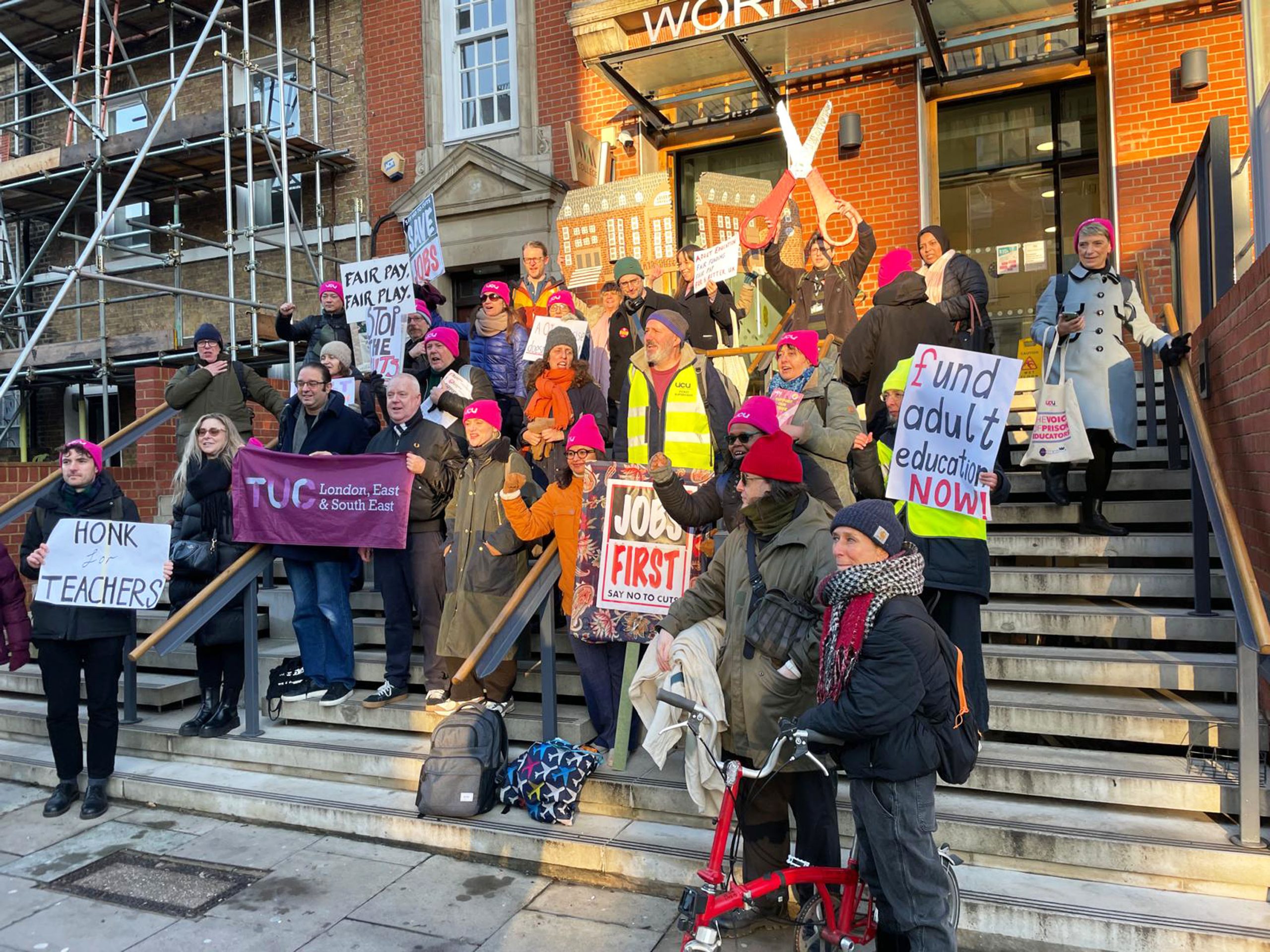
Members of the University and College Union (UCU) at 17 colleges took part in nationwide strike action from 14-16 January, fighting over pay, funding and for national bargaining.
WM College, London: ‘0% does not add up’
On the first day of the strike, around 40 people joined the picket line at WM College, an adult education college. We have been offered no pay rise, and face funding cuts. We were visited by Unison and Unite members and UCU general secretary Jo Grady.
Members decided to picket from 8-11am, so that those who could only get along later could join in. We set up a WhatsApp group so that we could exchange ideas on what slogans we were going to shout, to share lyrics for trade union songs we would sing, and to organise who was bringing cakes and coffee!
Loads of members brought their homemade placards, including ‘A 0% pay rise does not add up’ and ‘£und adult education now’. One member had painstakingly made a replica of the front of our college building and a huge pair of scissors out of cardboard, to highlight how funding had been cut.
We recruited new members to the union. No new pay proposal has yet been made by the college, and there are no announcements to reconsider funding from the government. Members know that we will need to take further action to win our demands.
David Kaplan, UCU rep, personal capacity
Liverpool City College: Working conditions ‘unsustainable’
Members on the picket line at Liverpool City College told us that their pay and conditions as a minimum should be brought up to those in education like schoolteachers. There is also a key issue of workload, where there is an increase in student numbers but no increase in teaching staff.
Restrictions on taking leave was also an issue. Members mentioned about being brought in over the holiday period to cover, in some cases, non-teaching work.
Some members also have to monitor student absenteeism and are asked to contact pupils at home, which many felt was not appropriate for a teaching role.
They are all dedicated staff and want to do their best but are restricted by the increased pressures they are being put under. One striker described working conditions as “unsustainable” and workloads as “unmanageable”, resulting in a negative impact on students’ experiences, especially for students with special learning needs.
Thomas Butler, Liverpool South Socialist Party
City of Portsmouth College: Pay cuts while bosses give themselves bonuses
“Management here say they are ‘aspirational’. We want a work-life balance where we don’t use food banks, worry about paying our bills, or supporting our kids. We care about what we do and we want fair pay and decent working conditions, not aspirations!”
These were the angry words of a striking National Education Union (NEU) member at Portsmouth Sixth Form College on day three of their successful strike against an imposed pay deal.
Action was being taken alongside UCU members at Highbury College and North Harbour Construction Training College.
Trades lecturers are now doing their own admin, after jobs were cut. UCU strikers spoke of how members were joining the union, angry at the refusal of management to enter into negotiations.
Students gave their backing to the strike, which raised the morale of everyone taking action.
Nick Chaffey, Socialist Party Southern and South East region
Windsor College: Insulting pay offer
The CEO had the nerve to request that the strikers move their picket away from the front of the building, which they quite rightly refused to do!
I spoke to one of the pickets who pointed out some of the problems they are facing, while enduring year- on-year pay erosion. They were originally offered an insulting pay rise of 0.84%, which was then increased to an equally inadequate 1.7%.
Extra pressures come from increased class sizes while, at the same time, there is a lack of support staff due to vacancies not being filled.
Neil Adams, reading Socialist Party
Truro: ‘Privatisation means it’s dog eat dog, and we’re left with the scraps’
At Truro and Penwith College, science support worker Michelle Franklin told us that, armed with a chemistry degree, she started eleven years ago. “When I started, I was paid £4,000 more than minimum wage. Then pay scales started to be squeezed, and now we’re at minimum wage.” A 2% imposed pay increase will take her marginally above minimum wage.
“How can we talk to students about career opportunities and making their way, when they see how we’re treated?”
Ian Hyland, chair of the UCU branch, said that in the 1990s, “they effectively privatised the colleges. Then it was dog eat dog, with colleges competing, and we were left with the scraps.”
He also pointed out that the college spends millions on “shiny new buildings” but can’t pay staff a decent wage. “When I started in 2010, the pay gap with schoolteachers was £2,000. Now it’s £10,000.”
Seventy staff were made redundant at the end of the last summer term.
Rob Rooney, Cornwall Socialist Party
New College Swindon: Concessions won
At New College Swindon, we received a last-minute offer from management the Friday before strike action was due to take place.
In September, a member of the Senior Leadership Team quite literally laughed at us for suggesting caps on class sizes, evening and weekend working etc. Yet, by January, the threat of strike action had won these things.
However, there was still no movement on pay, with the 3% offer being below even what the bosses’ Association of Colleges recommends for this academic year.
The offer was well-timed by management to give us little chance to discuss. There were mixed feelings. 62% voted to accept the offer, with the remainder still wanting to go out on strike.
Although I and a significant minority still thought we could have won more through striking, we should celebrate these concessions. Our task now is to use this victory to build the branch in preparation for further battles in the not-too-distant future.
Scott Hunter, Swindon UCU, personal capacity
Keep fighting – but build for national action to win on funding and national pay bargaining
Socialist Party members in UCU
We welcome the national coordinated strike action across the FE sector and that UCU has put demands on Starmer’s government, including for national bargaining.
However, we have to recognise that this action was not on the scale it could have been, and it is large-scale national action that is required to win the demands of the union’s ‘New Deal for FE’ campaign.
The leadership grouping around general secretary Jo Grady and her supporters on the Further Education Committee (FEC), who currently hold a majority, have repeatedly undermined the campaign. They delayed the ballot until November and action until January, then voted against a motion from Socialist Party member Duncan Moore to reballot those branches who were close to meeting the turnout thresholds.
This created a long period in which branches could settle with their individual employers and drop out of the national coordinated action. While we celebrate the wins made by these branches, and recognise the potential of even the threat of strike action to win concessions from employers, we also have to recognise that winning national bargaining and beginning to challenge the sector-wide erosion in pay and funding requires serious national action.
What next
We must support those 17 branches still on strike to win the best possible settlements for this academic year. The current timeline put forward by the leadership – first a consultative ballot on whether to continue and then waiting for an FEC meeting on 6 February – is unacceptable. The union must call further strike dates urgently and present a serious strategy to win these disputes. If the leadership will not act, then those branches still out should discuss naming their own strike dates in maximum coordination with each other.
For the next pay round, Socialist Party members will argue for an aggregated national ballot of FE colleges with a view to balloting in June and being strike-ready in September.
The current disaggregated ballot overcame the undemocratic 50% turnout threshold on a national basis. This can be done again, if there is a serious lead from the top.
We need a fighting leadership – Re-elect Duncan Moore
This will be stronger if we also campaign for a serious, fighting leadership of the union in the National Executive Committee elections that open on 30 January, and a left majority on the FEC, to replace endless delays and piecemeal action with a coordinated national fightback. That includes re-electing Duncan Moore to a UK-elected FE seat.
