


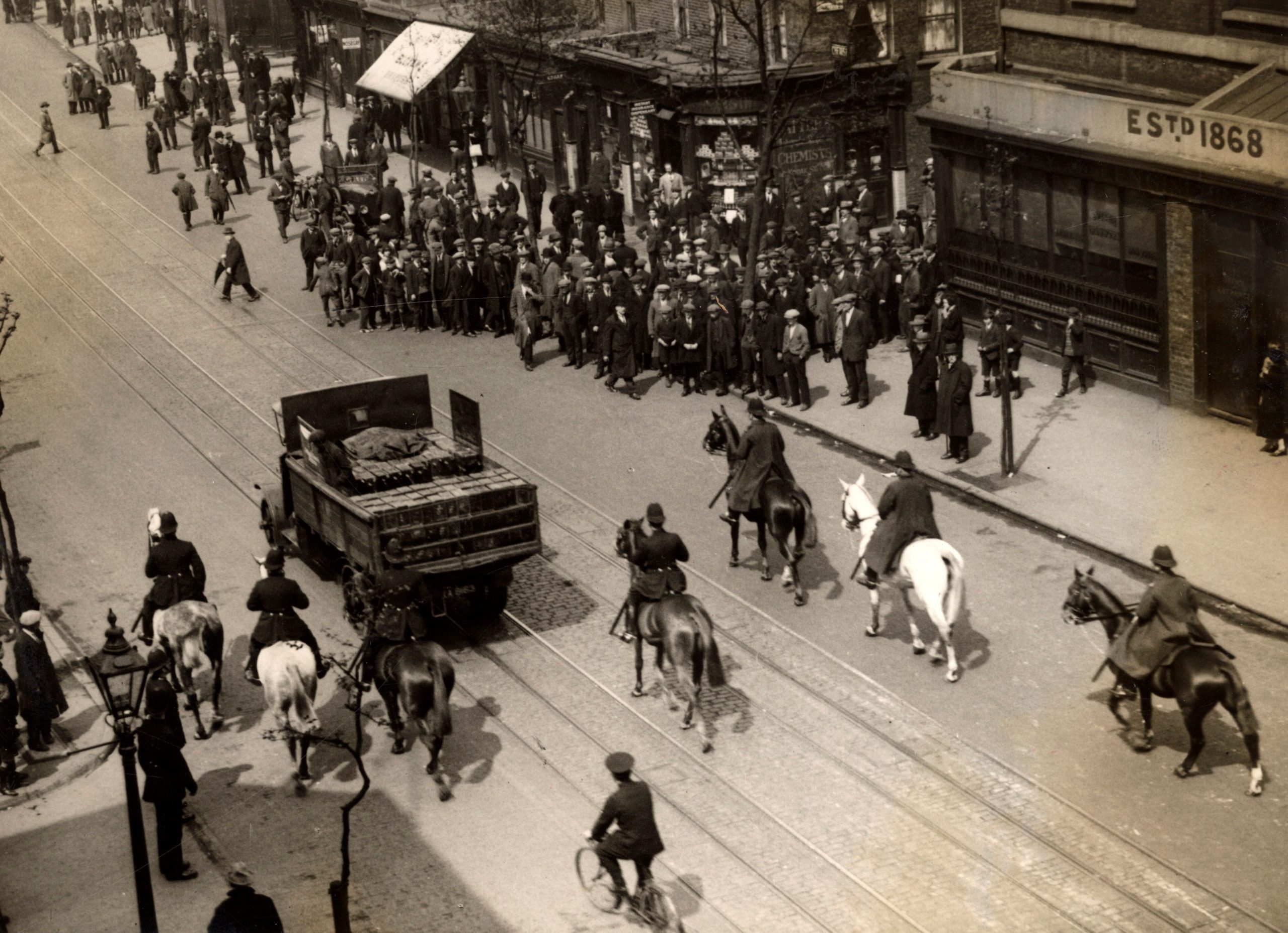
In the first of a series of articles to mark the centenary of the British General Strike, Socialist Party National Committee member Alistair Tice looks at the events leading up to the strike.
The General Strike in 1926 did not come out of the blue. In fact, it could have come earlier. Britain was on the verge of a general strike in 1911, 1919, 1921 and 1925.
Even before the First World War, the ‘Great Unrest’ of 1910-14 saw a doubling of trade union membership and a series of mass strikes of miners, railway, dock, and transport workers, and even schoolchildren.
Despite defeating Germany militarily, British capitalism emerged from the war in a much weaker economic position, especially relative to US imperialism.
Although Liberal Coalition Prime Minister Lloyd George promised millions of demobilised soldiers “A land fit for heroes” in the 1918 ‘Khaki election’ campaign, the ruling class was determined to drive down the living standards of all workers to try to restore the profits of British capitalism.
But they were also fearful that the example of the 1917 Russian revolutions, and that the mutinies and uprisings that ended Germany’s war would spread to Britain. And with good reason.
Faced with the threat of unemployment and rising prices, 1919 was a year of mass strikes and civil disorder. Workers went on the offensive for shorter hours and higher pay. In total, 2.4 million workers took 35 million days of strike action. The Triple Alliance (of miners, rail and transport unions) was revived, although not brought into action.
Soldiers and tanks were on the streets of Glasgow against striking engineering workers, and warships moored in the River Mersey, when even the police went on strike. Lloyd George was later to say: “This country was nearer Bolshevism than at any time since”. But unfortunately, the trade union leaders, both moderate and more left-wing, baulked at the prospect of overthrowing the government.
Miners did win concessions on pay and hours, but their demand for nationalisation of the coal industry was stalled by the government’s Sankey Commission.
With revolution averted, and the severe post-war slump creating three million unemployed, the employers, backed by the government, went on the offensive.
In 1921, the mines were returned to the private coal owners, who immediately proposed massive wage cuts. Miners were then locked out for refusing to accept them and invoked the Triple Alliance for rail and transport union solidarity action.
The government declared a state of emergency and sent troops to the coalfields, including posting machine guns at pitheads. Faced with a government prepared for civil war, the union leaders capitulated on what become known as ‘Black Friday’, leaving the miners to strike on their own for three months before being starved back to work with huge wage cuts.
By the end of the year, employers throughout industry had imposed wage cuts averaging six shillings a week (approximately £19 today) on six million workers, and trade union membership fell by over two million due to mass unemployment.
Faced with a revitalised German coal industry after the ending of the French occupation of the Ruhr, and the restoration of the Gold Standard with an overvalued pound in 1925 making exports more expensive, the coal owners proposed more drastic cuts of between 10% and 25% in wages and conditions. Tory Prime Minister Baldwin told the union leaders: “All the workers of this country have to take wage reductions to help put industry back on its feet.”
This time, the rail and transport workers agreed to refuse to move any coal and the trade unions threatened a general strike.
An unprepared Conservative government bought time by conceding a nine-month coal subsidy while the Samuel Commission into the industry reported.
‘Red Friday’
This retreat, which temporarily stopped the miners’ wage cuts, was heralded as ‘Red Friday’ by the unions. Whilst it was revenge for the defeat of Black Friday, it missed the opportunity for an offensive struggle and possibly a general strike. Baldwin later admitted “We (the government and ruling class) were not ready.”
The government then used the nine months to prepare to defeat a general strike once the subsidy ran out. Ten government-appointed Regional Commissioners were given powers to control road transport, food and fuel supplies, and recruit special constables. Churchill set up the Organisation for the Maintenance of Supplies (OMS) to be a scab army to strike-break. And there was increased repression against the labour movement. 12 Communist Party leaders were charged with sedition and imprisoned. 167 striking South Wales anthracite miners were tried with 50 sentenced to prison terms.
But the Trades Union Congress (TUC) made no preparation or plans for a general strike until 27 April, just six days before it began. Unsurprisingly, the Samuel Commission rejected nationalisation of the mines and proposed reorganisation of the coal industry at some future date, but that there be an immediate reduction in miners’ pay on the ending of the subsidy on 30 April. The right-wing trade union leaders wanted to accept the Samuel proposals, and Jimmy Thomas, the right-wing NUR railworkers’ leader, admitted going begging to the government.
But the pressure of the miners and the working class forced a special conference of trade union executives on 29 April to make the call for a general strike from 4 May, with even Thomas’s NUR executive voting for the strike. But it also agreed that the right-wing dominated General Council take over the running of the miners’ dispute. And despite the near unanimous vote for a general strike, the right-wing TUC and Labour Party leaders still tried to negotiate a sell-out with the government right up to the final hour.
The question of political power
Marxists explain that an all out general strike poses the question of power. Who runs the country? The bosses or the workers? In a general strike, there is dual power or two contending powers. The state power of the ruling capitalist class or the emergent power of the working class and its organisations which could take over the running of society?
The ruling class understands this as well. In 1919 Lloyd George declared to the trade union leaders: “If you carry out your threat and strike, then you will defeat us. But if you do so… have you weighed the consequences? For, if a force arises in the state which is stronger than the state itself, then it must be ready to take on the functions of the state, or withdraw and accept the authority of the state. Gentlemen… have you considered and if you have, are you ready?” Moderate miners’ leader at the time Robert Smillie reacted, “From that moment on we were beaten and knew we were.”
Communist Party
This question of power faced the most left-wing trade union leaders like Arthur J. Cook (a figure like Arthur Scargill, leader of the 1984-85 miners strike) who was elected leader of the Miners Federation of Great Britain in 1924. And it faced the young Communist Party of Great Britain (CP), which was founded in 1920 under the inspiration of the victorious socialist revolution in Russia in October 1917. The CP brought together several smaller ‘Marxist’ organisations, including many of the most militant trade unionists and worker activists. Its membership doubled to around 5,000 by 1925 due to its interventions and initiatives in solidarity with the miners and other strikes.
In particular, they supported the development of the Minority Movement in the Miners Federation which helped get A.J. Cook elected as a left-wing leader of the miners’ union, and the Minority Movements which spread in other unions. The CP then helped initiate the formation of the National Minority Movement with a founding conference in August 1924 of 270 delegates representing 200,000 workers. The Minority Movement was not set up in opposition to existing trade unions but to fight for a more militant policy and leadership.
Its conference prior to the general strike in March 1926 attracted 547 organisations representing nearly one million workers, a quarter of the total trade union membership, so had real influence.
This conference, under CP influence, correctly called for the establishment of pit and factory committees, workers’ defence corps under trade union control, and for trades councils to constitute themselves as ‘councils of action’ by mobilising all the forces of the working class in their localities, effectively a British form of Soviets. Mistakenly though, it also called for “All Power to the General Council” (of the TUC) at a time it was clearly obvious that the TUC leadership was going to betray the miners.
This false policy emanated from the political shifts in the leadership of the young Soviet Union and the recently formed Communist International (Comintern). Increasingly isolated following the defeats of revolutions across Europe, especially in Germany, the Soviet Union was increasingly falling into the hands of a developing bureaucracy headed by Stalin. The Stalinist bureaucracy’s priority was to defend its own position, as opposed to seeing the future of socialism in the Soviet Union being dependent on successful workers’ revolutions elsewhere. (Read more: ‘The Collapse of Stalinism – its Causes and Consequences’)
In 1925, under the guidance of the Comintern, the Anglo-Soviet Trade Union Committee was set up with the participation of leading left-wing trade union leaders like Arthur Purcell (Furniture trades union) and George Hicks (building workers trade union). This gave these left but still reformist trade union leaders an undeserved revolutionary authority, sowing illusions in them amongst worker militants and even Communist Party leaders.
But with the sharpening of the class struggle, these erstwhile Lefts had no real alternative to the right-wing Labour and trade union leaders that dominated the TUC General Council, in whom ‘all power’ had been invested. This left the Communist Party members and through them the National Minority Movement politically disarmed.
The 1926 General Strike began on 4 May, propelled by the willingness of the working class to struggle. As with all struggles, it put the all the leaders of the workers’ organisations to test. 100 years on, the General Strike remains the most important event in the history of the British working class.
1926 General Strike Workers Taste Power
- By Peter Taaffe with additional writings by Leon Trotsky £14.99
- On the centenary of the 1926 General Strike, this thoroughly researched and inspiring history of what its author, Peter Taaffe describes as “the most important event in the history of the British working class.” Originally published to mark its 80th anniversary, this book provides a vivid account of those historic nine days. It also incudes additional material first carried in a 1970s pamphlet, including articles written by Leon Trotsky.
- Buy at www.leftbooks.co.uk
