

Tom Young, Chester Socialist Party
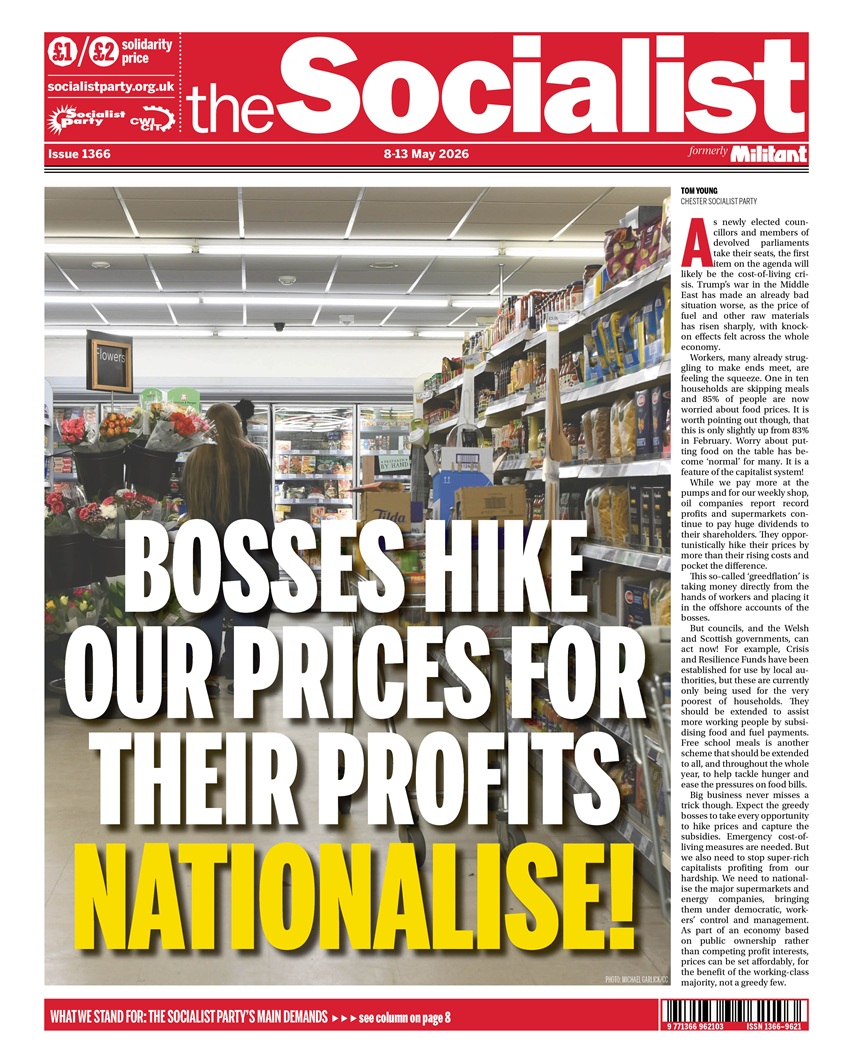
As newly elected councillors and members of devolved parliaments take their seats, the first item on the agenda will likely be the cost-of-living crisis. Trump’s war in the Middle East has made an already bad situation worse, as the price of fuel and other raw materials has risen sharply, with knock-on effects felt across the whole economy.
Workers, many already struggling to make ends meet, are feeling the squeeze. One in ten households are skipping meals and 85% of people are now worried about food prices. It is worth pointing out though, that this is only slightly up from 83% in February. Worry about putting food on the table has become ‘normal’ for many. It is a feature of the capitalist system!
While we pay more at the pumps and for our weekly shop, oil companies report record profits and supermarkets continue to pay huge dividends to their shareholders. They opportunistically hike their prices by more than their rising costs and pocket the difference.
This so-called ‘greedflation’ is taking money directly from the hands of workers and placing it in the offshore accounts of the bosses.
But councils, and the Welsh and Scottish governments, can act now! For example, Crisis and Resilience Funds have been established for use by local authorities, but these are currently only being used for the very poorest of households. They should be extended to assist more working people by subsidising food and fuel payments. Free school meals is another scheme that should be extended to all, and throughout the whole year, to help tackle hunger and ease the pressures on food bills.
Big business never misses a trick though. Expect the greedy bosses to take every opportunity to hike prices and capture the subsidies. Emergency cost-of-living measures are needed. But we also need to stop super-rich capitalists profiting from our hardship. We need to nationalise the major supermarkets and energy companies, bringing them under democratic, workers’ control and management. As part of an economy based on public ownership rather than competing profit interests, prices can be set affordably, for the benefit of the working-class majority, not a greedy few.
