


Dave Nellist, Coventry Socialist Party
“The field of battle is no longer transport but news” (Winston Churchill, Tory Chancellor of the Exchequer, 5 May 1926, as he commandeered the Morning Post building, the production base for the government’s British Gazette).
The 1926 General Strike, in support of 1.2 million miners who had already seen their wages cut in half and now faced a further 40% cut, has been outlined in recent editions of the Socialist.
One of the key lessons from the 100-year anniversary of the General Strike, and other class conflicts since, is not simply that the capitalist media is often hostile, but that, in a crisis, communications become part of the struggle itself.
The final collapse of negotiations between the miners and the mine owners happened on 30 April 1926. Two days later, print workers at the Daily Mail refused to print an editorial which described the looming TUC strike as a “revolutionary movement… intended to inflict suffering upon the great mass of innocent persons”.
Tory Prime Minister Stanley Baldwin seized upon this incident as a “gross interference with the freedom of the press” and an “overt act” of rebellion, using it as a pretext to terminate all discussions with the Trades Union Congress (TUC).
The TUC leadership was horrified by this. They sent a delegation to Downing Street to repudiate the printers’ actions, only to find the building dark and the prime minister in bed.
In fact, the official TUC leadership desired a ‘gentlemanly’ industrial dispute. Thomas Jones, Baldwin’s private secretary, recognised this and described to Churchill that the TUC chairman Arthur Pugh and railway union leader Jimmy Thomas were “as loyal as you are to the state”.
At the start of the General Strike, the state had already laid plans for internal security and strike-breaking, including establishing the Organisation for the Maintenance of Supplies (OMS), a semi-official militia that recruited middle-class volunteers and ‘patriots’ to maintain services.
The state and the employers already possessed most of the established channels of mass communication; the government had emergency powers, an official newspaper and decisive influence over radio. The trade union movement had to improvise.
When the strike began, most newspapers ceased publication. The government requisitioned the offices and printing presses of the then main conservative daily, the Morning Post, chosen because its site was physically difficult to blockade.
From this location, Churchill directed the government’s main propaganda effort. Churchill viewed news as a weapon of war and approached the General Strike as if it were the foretaste of a revolution; with the Russian Revolution only nine years earlier, many in the establishment no doubt shared his fears.
The first edition of the British Gazette had two of the four pages blank. It went into circulation at 200,000 copies, reaching two million by the end of the strike.
Some other newspapers continued production, but without many of their printing staff. The Sunday Times (3 May 2026) described how the ruling class rallied round The Times after a fire broke out in the machine room.
The proprietor, Major John Astor MP, “had already dragooned his domestic staff into helping, but suddenly came the proprietor’s friends from the House of Commons including the future Tory prime minister Harold Macmillan, they were joined by young naval officers, students from Westminster School and Oxford colleges, as well as barristers of Gray’s Inn, members of London clubs, directors of banks and public companies, an earl, and at least two duchesses (of Westminster and of Sutherland) who drove lorries.”
Churchill wanted the BBC taken over. It had an estimated audience (sharing radio sets) of between five and ten million listeners (in a population of 40 million).
In fact, while nominally independent, the BBC served the government’s interests during the strike. John Reith, the managing director, argued that since the government was “acting for the people”, the BBC should be “for the government in the crisis”.
The BBC routinely broadcast inaccurate reports of workers returning to work to demoralise those still on strike. It carried regular government appeals for ‘volunteers’ and refused the Labour leader, MacDonald, a right of reply. It refused to allow the Archbishop of Canterbury, Randall Davidson, to broadcast a peace appeal on 7 May aimed at settling the dispute, while carrying the government’s message to the armed forces that any action taken to aid the civil power would receive the state’s full support.
Reith later wrote in his diary: “They [the government] know they can trust us not to be really impartial.”
TUC
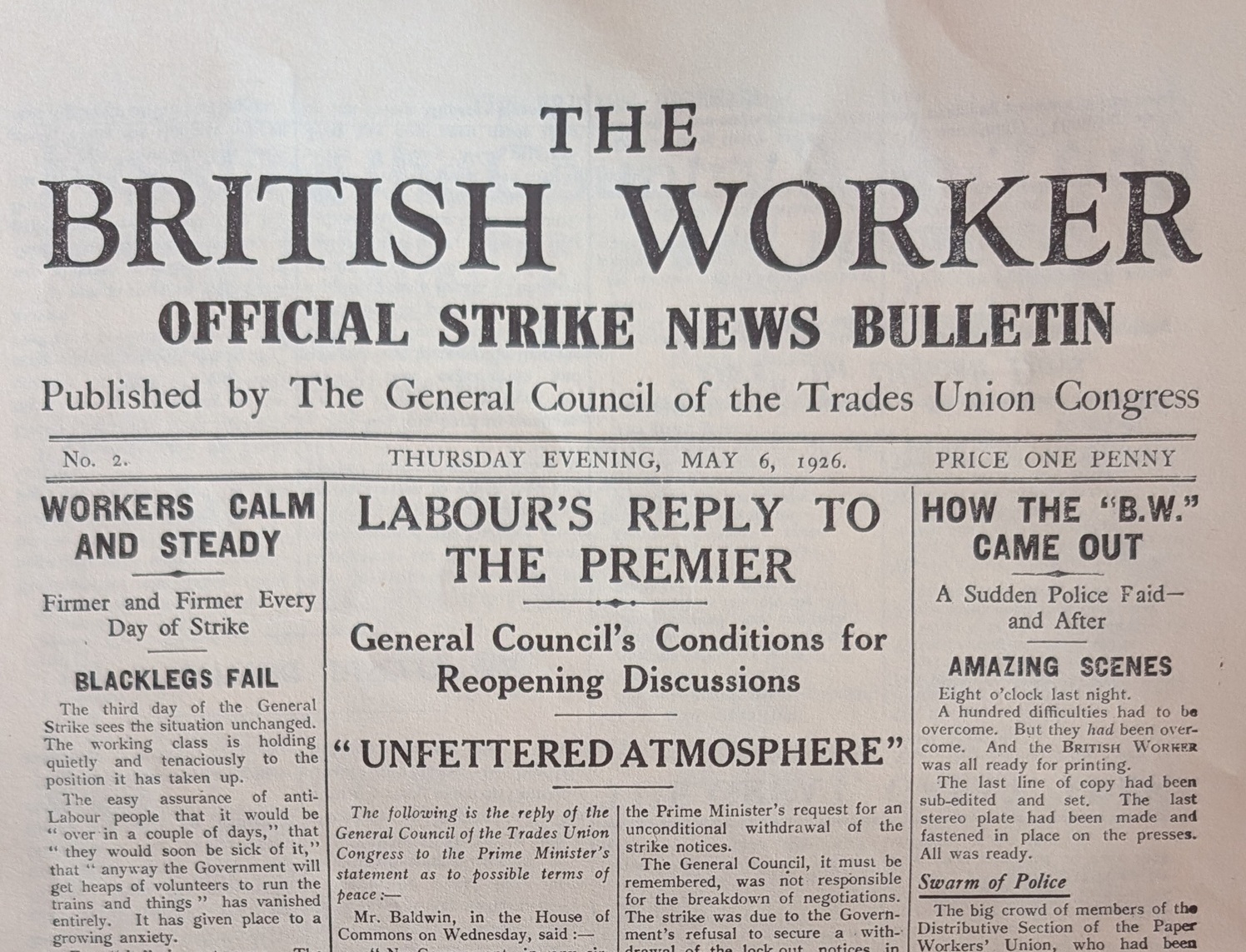
The TUC launched the British Worker on 6 May from the offices of The Daily Herald. On the first night, the paper was raided by plain-clothes police who delayed production by demanding copies for submission to the Police Commissioner.
Terrified of being seen as ‘revolutionary’, the TUC leadership vetted the paper. The editor, Hamilton Fyfe, recalled: “Our chief aim is to keep strikers steady and quiet… our line is to be dignified, calm in our own strength; to make our statements forcibly, but with moderation of language”. Four of the seven issues printed before the strike was called off carried an identical declaration from the TUC that the strike was only industrial, not political or constitutional.
For strikers with time on their hands, the second issue listed seven suggestions. “Do all you can to keep everybody smiling; the way to do this is to smile yourself. Do your best to discountenance any ideas of violent or disorderly conduct. Do the thing that’s nearest: this will occupy you and will steady your nerves, if they get shaky. Do any odd jobs that want doing about the house. Do a little to interest and amuse the kiddies now you have the chance. Do what you can to improve your health: a good walk every day will keep you fit. Do something. Hanging about and swapping rumours is bad every way”.
The British Worker produced between 320,000 and 700,000 copies a day. But the TUC leadership saw the strike as leverage for negotiation, not as a struggle in which workers might need to assume wider authority over transport, food, information, and local order.
On the ground
The true power of the strike resided in local strike committees and councils of action. In many industrial areas, the strike rate was 100%, meaning no trains, buses, or newspapers operated without a permit from the workers.
Local bulletins were produced by trades councils, councils of action, local unions and groups such as the Communist Party. Most active towns and industrial districts had at least one daily bulletin. There were probably up to 500 different local bulletins per day. Few had access to proper printing facilities; instead, they relied on duplicators or small presses.
Many were not only read locally but also distributed to surrounding areas – for example, Liverpool supplied bulletins to Bootle, Ormskirk, and others. Coventry’s council of action produced a daily strike bulletin, and 2,000 copies of each edition were circulated. In some places, output reached up to 10,000 copies a day, and demand often exceeded supply.
The bulletins filled a crucial gap. Local bulletins gave workers what they really needed day to day: local strike news, which workplaces were solid, meeting notices, rebuttals of hostile press stories, humour, cartoons, and morale-boosting material, with reporters attached to strike committees and union branches. These were almost a miniature workers’ news agency rooted in the strike organisation.
The strongest bulletins portrayed the strike as a class struggle. They countered the government’s British Gazette, attacked rumours, mocked volunteers and blacklegs, and tried to keep up morale.
Some estimates say that half of the 9,000 arrested under the Emergency Powers Act during the strike were in connection with the production and distribution of local strike bulletins. A significant portion of these arrests were for “acts calculated to cause sedition or disaffection,” a broad charge used against those producing and distributing strike bulletins.
Simply possessing a stack of bulletins for distribution was enough to lead to a summary conviction and hard labour.
Today
The press and broadcast media have proportionally fewer users than a generation ago. More people now get their news online, but in a national conflict the government would seek to use the press again. That rise in online media as a source of news for many/most people would not be immune.
After the killing in custody of Jina Mahsa Amini in Iran in 2022, the Iranian authorities sought to limit telecommunications. Following the December 2025/January 2026 protests there, an internet blackout was imposed. Activists had to adapt, using technical workarounds, offline methods and older communication channels.
This is the digital-age equivalent of what 1926 teaches: when rulers fear mass action, they move to close or control the channels through which workers can coordinate.
When the struggle deepens, communication is never a neutral terrain. Workers need their own press and communication networks, and the earlier they are developed, the stronger they will be.
