


Capitalism offers no future – join the fight for socialist change
Editorial of the Socialist – issue 1370
‘Where have you lot been?’ That’s what many young people will be asking, watching on as a legion of establishment politicians, CEOs, journalists and thinktank execs seemingly woke up last week to the bleak prospects on offer to young adults in Britain today.
Horror stories of applying for hundreds of jobs without success or even a reply from a human; competing with as many as one thousand other applicants for a single job opening; being forced to rely on inadequate benefits while rent and bills continue to soar; suffering from anxiety and other mental health issues, as society convinces you there isn’t a place for you. None of that will be much news for the almost one million 16 to 24-year-olds who are currently not in employment, education or training (NEET).
Still, the publication of an interim report on so-called ‘NEETs’ by the former privatising health secretary under Blair, Alan Milburn, has opened the floodgates to a torrent of news items and policy documents outlining what various defenders of capitalism think should be done.
These voices have included prime minister Keir Starmer, who told the BBC that he has “been really worried about young people”. But how ‘worried’ for young people was Starmer when his Labour government decided to raise university tuition fees last year – the first increase in a decade? Has he been worried about the devastating effects of local councils, many controlled by his party, continuing to make cuts to schools, libraries, youth clubs and all public services?
This is a Labour government that since 2024 has sought to rule in the interests of flatlining British capitalism, attempting to restore the capitalists’ ability to make profits by driving down the living standards of the working class and young people. For all the representatives of capitalism, inside or outside the Labour Party, any ‘solution’ to the NEET scandal will seek to make young people and the working class pay.
Swipe at young people
Milburn’s report takes special aim at government spending on benefits, which above all he links to more young people either not working or studying as a result of health conditions. The Guardian newspaper has since reported that Milburn has “urged Labour not to shy away from a fresh attempt” at cutting benefits spending, referring to Labour’s previously failed plans to cut £4.8 billion by introducing tighter regulations on Personal Independence Payments (PIP).
Starmer was ultimately forced into a humiliating partial U-turn on those plans to cut disability benefits, faced with a rebellion by over 120 of his own MPs, themselves under huge working-class anger from below.
As a result, the government was forced to postpone attacks on PIP eligibility until the completion of a review by disability minister Stephen Timms, due also to be published this autumn. Clearly both reviews will be used together to try and ‘finish the job’ on benefits cuts – with the job of the Milburn review being to make the ‘compassionate case’ for forcing young people off benefits in the name of ‘realising their potential’.
Work for free
The day after Milburn’s interim report was published, the government announced plans for 300,000 new work experience and training placements, known as Sector-based Work Academy Programmes (SWAPs). These funnel young people on Universal Credit into work placements of up to six weeks while they still receive only benefits: free, publicly subsidised labour for the bosses, and poverty ‘wages’ for the young! Moreover, these schemes come with no guarantee of a job at the end, as less than half of SWAP participants move onto sustained employment within six months.
The bottom line is that providing long-term jobs, training and education for 1 million young people would require levels of immediate investment that neither big business nor the government is prepared to concede in an era of stagnating growth, rising inflation, and historically high levels of public and private debt.
In a bid to maximise short-term profits, some capitalists have argued that there would be jobs, if only young people were prepared to accept lower wages. Last week, Labour ministers all but unveiled plans to postpone the scrapping discriminatory pay rates for 18 to 20-year-olds until after the next general election.
What do we say?
The capitalists’ spokespeople have used Milburn’s interim report to go on the offensive in setting out their solution to the crisis facing young people. Our side, the working class, has to do the same – pointing to the enormous wealth, resources and technology that exist in Britain and internationally, and fighting for that to be in our hands so that we could democratically develop a socialist plan to provide a decent future for all young people.
During the strike wave in 2022-23, workers in Britain took strike action through their trade unions at a level not seen for three decades, forcing money into workers’ pockets that the Tories – and behind them, the capitalists – said was not there.
As rising inflation once again threatens to further erode the conditions of all workers, there is an urgent need for united trade union action that links the fight against the cost-of-living crisis to the fight for good jobs, apprenticeships and education for all.
As part of that struggle, the Socialist Party calls for mass trade union action for the immediate implementation of the TUC demand of a £15-an-hour minimum wage, as a step towards a real living wage, without exemptions. By also sharing out the work across the economy, with a maximum working week of 32 hours and no loss of pay, it would be possible to ensure decent jobs for all, alongside living benefits for all those who need it.
Our alternative
Together with a major programme of increased government investment in public services and socially useful jobs, this would help eliminate unemployment as well as underemployment. Part of that mass public investment should include the creation of high-quality training schemes and apprenticeships with trade union pay and conditions, and a guaranteed job at the end.
Clearly the capitalist bosses, who claim they can’t even afford to pay the minimum wage, will not commit to such a transformative programme, although they could be forced to make some temporary concessions if a combative trade union-led movement was built. But the fight for lasting good jobs, education and training for all and a decent future for young people can only be guaranteed through a struggle for a socialist alternative, involving a democratic plan of production to meet the needs of all, not the short-term profit interests of the bosses.
Just like the Tories in the strike wave, this Labour government is crumbling in office. However, some of New Labour’s cheerleaders hope that the government’s youth strategy could transform the party’s fortunes.
Guardian columnist Polly Toynbee, for instance, has raised hopes that Milburn’s report “could be the Beveridge report for our time”, referring to the landmark 1942 report published by Liberal economist Sir William Beveridge, which helped lead to the founding of the National Health Service, among other far-reaching social reforms.
But capitalism is in a completely different era today, reflected in the vastly different content of the Milburn report which, far from expanding, wants to cut the welfare state even further.
What workers have won
Back then, working-class people, determined not to return to the chronic high unemployment and generalised precarity of the 1930s, queued around the block to buy a copy of the Beveridge report. Within two weeks of its publication, nine out of ten adults said they wanted its findings implemented. But that level of support is obviously not going to be found for the final Milburn report!
Infinitely more likely than queues around the block will be new youth movements and revolts in response to the recommendations of the final Milburn report.
Youth clubs, libraries and other ‘third spaces’ for young people have been cut to the bone. The media and capitalist politicians have tried to pin blame for inevitable displays of youth frustration – like so-called ‘link-ups’ seen recently over the school holidays – onto young people themselves.
As a direct result of one of those mass youth meet-ups in Clapham, south London, the Labour Mayor of London, Sadiq Khan, found £30 million to fund a late-night youth club in each London borough. Imagine what more could be won if young people got organised in a mass movement nationally to demand a real future
Pile on pressure
Councils could be pressured into re-opening youth services, restoring the Education Maintenance Allowance (EMA) weekly payments for college and sixth form students, or providing living bursaries for students attending university in the borough. They could use their reserves and borrowing powers to fund services, while building mass campaigns to demand the long-term funding needed from central government.
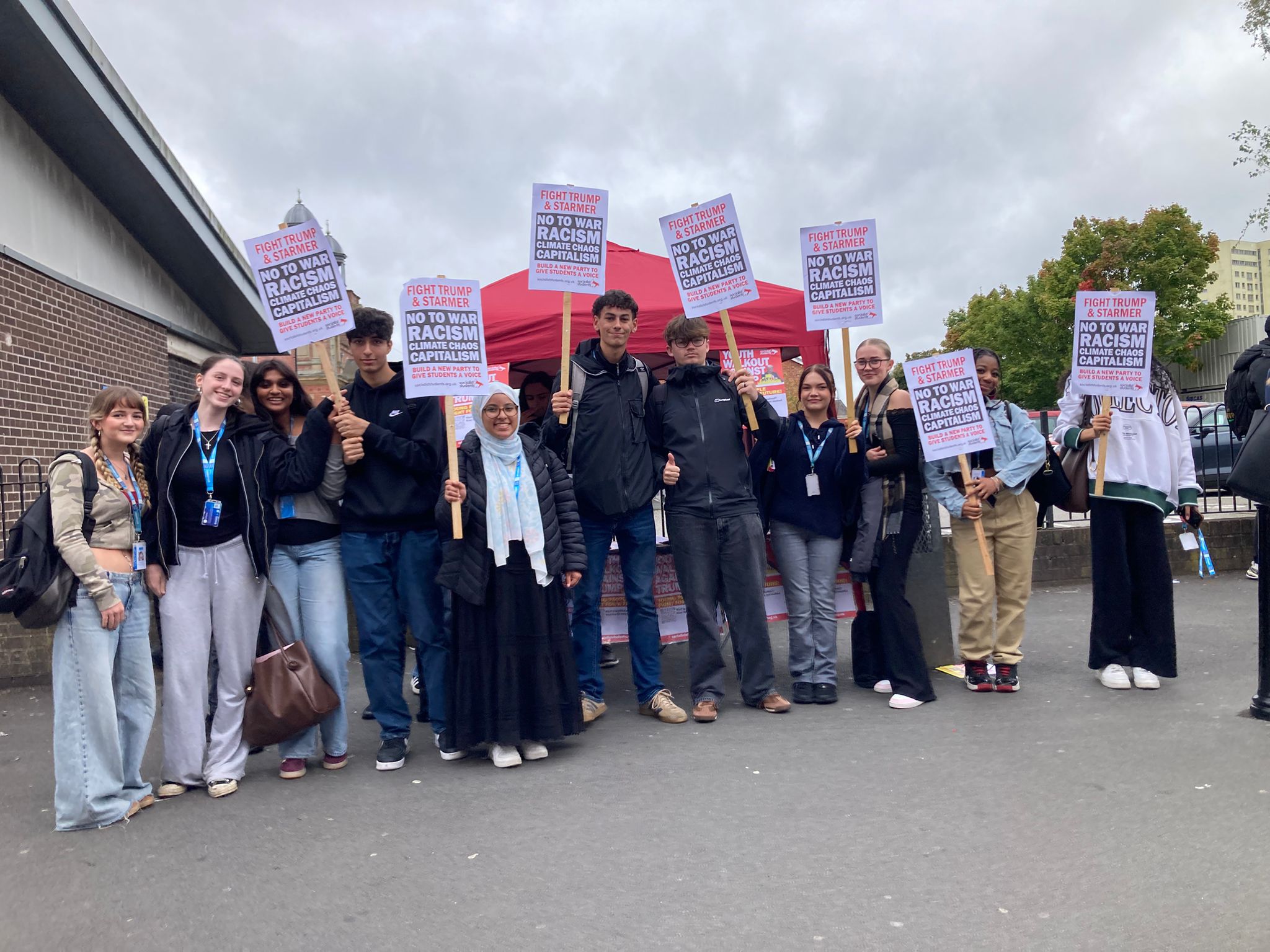
As well as fighting in the trade unions for the action needed to tackle the youth jobs and training crisis, the Socialist Party wants to unite the fightback in schools, colleges and university campuses with Socialist Students, a campaigning, student-led socialist organisation which our members help to build in over forty institutions across the UK.
As part of Socialist Students, Socialist Party members initiated the Youth Walkout Against Trump campaign in September 2025, with the aim of getting young people organised in the fight for a socialist future free of war, austerity, and the constant instability and uncertainty of capitalism. We have also helped to build the national Funding Not Fees campaign for fully funded, free education – not cuts, tuition fees and a lifetime of student debt.
