


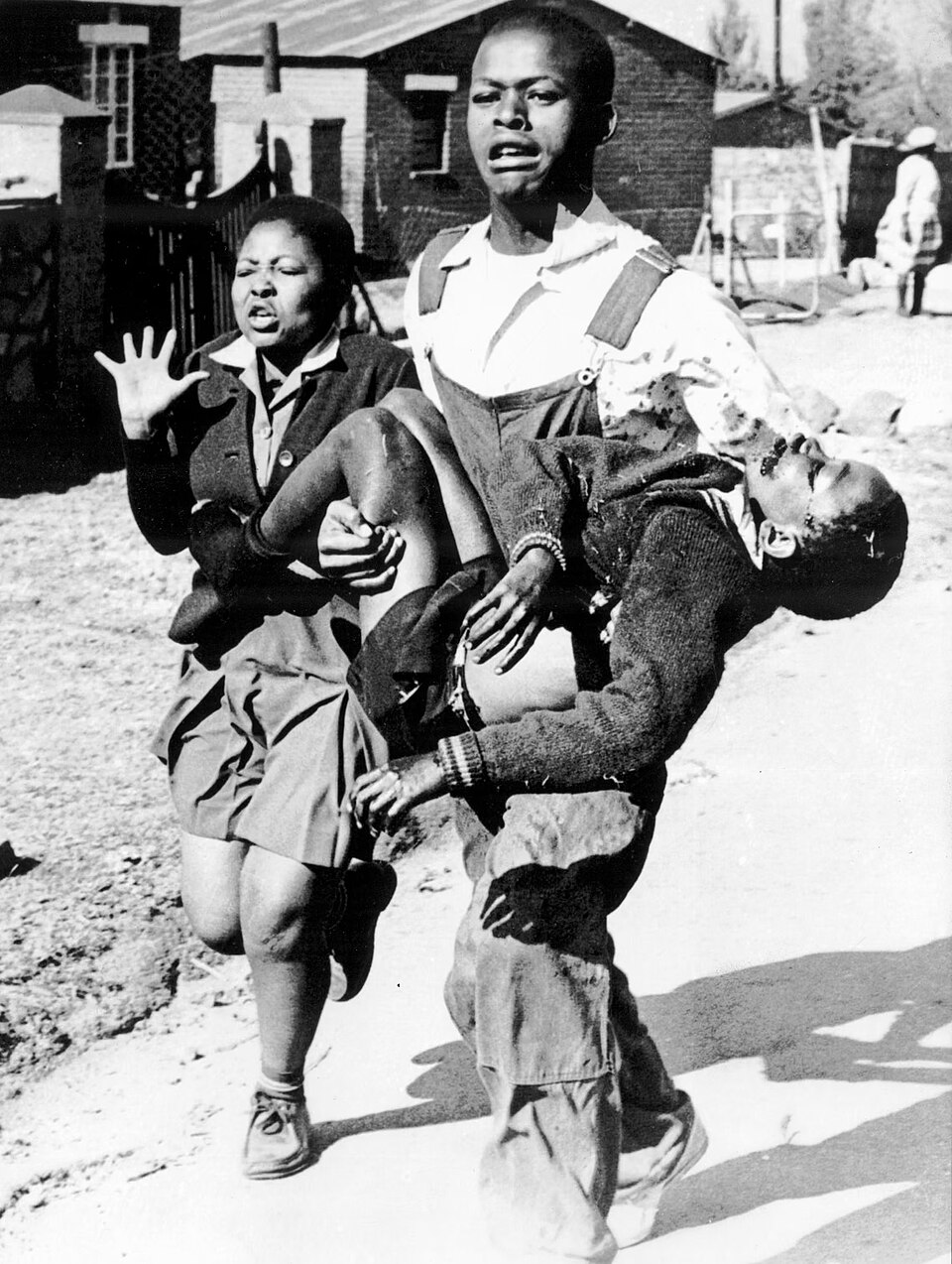
The following is extracts of an article by Weizmann Hamilton, a member of the Committee for a Workers’ International in South Africa. It was originally published in Inqaba Ya Basebenzi (the journal of the Marxist Workers’ Tendency of the African National Congress, the then name of the CWI section) in September 1986.
At about 7am on 16 June 1976, thousands of African school students in Soweto gathered at prearranged assembly points for a demonstration. They launched a movement that began as a local expression of opposition to the imposition of Afrikaans as a medium of instruction in African schools, and developed, over twenty months, into a country wide youth uprising against the apartheid regime.
This movement cost the lives of more than 1,000 youths, shot by the police. But, like an earthquake, it opened up a huge fissure in South African history, separating one era from another. It politicised a whole new generation of youth, and consigned beyond recall the era of defeats in the 1960s. It announced the determination of the youth to end one of the most barbaric examples of modern capitalist slavery.
Since February 1976, anger had been mounting over the attempt by the regime to enforce Afrikaans as a medium of instruction – an anger very rapidly directed against the whole system of Bantu Education. First introduced in 1955, Bantu Education was designed not merely to place every possible obstacle in the way of the intellectual development of black Africans, but consciously to create an enslaved working class exploitable as cheap labour.
Against the background of a general shortage of accommodation, the result was chaos. In 1976 the government expected 149,000 students to enrol for secondary education – but had accommodation for only 38,000. In the event more than 250,000 enrolled!
This state of affairs caused enormous bitterness amongst parents. Many regarded education, despite its deficiencies, as the hoist that would lift their children out of the poverty that seemed the unavoidable lot of the black working class.
In these conditions, the attempted imposition of Afrikaans – the language of the apartheid state – into the schools, added insult to injury. It sparked-off opposition even amongst conservative elements on the school boards created by the state to oversee Bantu Education, who had tried to negotiate with the authorities to mitigate the effects of this measure.
Beginning with the boycott of Afrikaans classes, students rapidly began boycotting all classes. By early June, several thousand pupils from a total of seven schools were on strike.
On 8 June two policemen visited Naledi High School, where the South Africa Students Movement (SASM), which was organising high school students, had written a letter to the South African Student Organisation (SASO – led by Steve Biko), its black university counterpart, asking for assistance in the campaign.
Resentment
The policemen were trapped in the principal’s office, the telephone wires were cut and their car burned when compromising documents were found in it. Reinforcements were fought off by the students although the two police managed to get away. The story of this incident spread like wildfire through Soweto. Like the small stones which roll down a mountainside before an avalanche, it was a sign of the resentment and hatred that was to be launched against the police.
On 13 June, SASM called a meeting at the Donaldson Community Centre in Orlando. 300 to 400 students representing about 55 schools decided to stage a mass demonstration on 16 June. An Action Committee, later known as the Soweto Students Representative Council (SSRC), was elected to lead the campaign. It consisted of two delegates from each school, meeting in secret and using pseudonyms.
On 16 June, columns departed from selected assembly points at a specified time to maintain discipline and to stretch police lines as much as possible. A dozen schools served as rendezvous points, with the final destination Orlando Stadium for a mass rally. Despite brushes with the police en route, most marches managed to reach the last meeting point in Orlando West.
However, as hundreds were still marching into Orlando, a large contingent of police arrived in police vans and spread out in front of the marches in the form of an arc. Defiantly, the students kept on singing freedom songs.
Suddenly a white policeman threw a tear gas canister in front of the students. The students retreated slightly but stood their ground singing and waving their placards, reading “Away with Afrikaans”; “Blacks are not dustbins”; “Afrikaans is a tribal language” etc.
The Uprising
Then a white policeman drew his revolver and shot straight at the unarmed, singing students. Hector Petersen, the first victim of the uprising, fell in front of his comrades. Other police then opened fire.
The students, many of them girls as young as 10 to 12 years old; were stunned at first, and stood looking at the bodies of the dead and wounded. Then their rage and fury erupted. Picking up stones, bricks or any missile they could lay their hands on, they advanced towards the police lines and threw them at the police. As one journalist commented: “What frightened me more than anything was the attitude of the children. Many seemed oblivious of the danger. They continued running towards the police, dodging and ducking, despite the fact that they were armed and continued shooting.”
The Soweto Uprising had begun.
The police retreated, pursued by the youth. All buildings associated in any way with the state were attacked. The youth requisitioned, in the name of the revolution, petrol from garage owners to make petrol bombs and set fire to these buildings. Bottle stores were attacked and the liquor emptied into the streets.
By midday, two army helicopters circled over Orlando West, dropping tear gas. Two special counter-insurgency units from Pretoria and Johannesburg (created only a few months earlier) were brought into action.
Estimates for the death toll of that first day, 16 June, vary from 25 to 100 people. By the second day 1,500 police armed with Sten guns, automatic rifles and hand machine carbines were called into Soweto and army units were placed on standby. The casualties were higher than on the previous days; possibly hundreds dead. Indiscriminate shooting was the order of the day. Raising a clenched fist and shouting the slogan “Amandla!” [power] was sufficient to warrant a bullet in the head.
Parents and workers
Parents had returned home the previous evening to find the townships in flames and their children either dead or missing. Many spontaneously stayed away from work on 17 June. White students at the University of the Witwatersrand staged a demonstration with one of the placards reading: “Don’t start the revolution without us.”
In Soweto itself, the Minister closed schools on Thursday (17 June). By Friday, Soweto was effectively sealed off, saturated with police in armed convoys, firing at any group they saw on the streets.
In the meantime, clashes had broken out in Tembisa, Kagiso and elsewhere along the Witwatersrand. At the universities of Ngoye and Turfloop, there were solidarity boycotts. Turfloop was closed on 18 June.
Thus took place the political baptism – with bullets and tear gas – of a whole new generation of working-class youth in struggle.
After a relatively quiet weekend, the townships near Pretoria joined the struggle. By 22 June over 1,000 workers at the Chrysler (auto) factory had stopped work. This was the first conscious strike action in support of the students.
As in Alexandra, the working class youth of Soweto quickly sensed the need to involve their parents. They also saw that to confine the battlefront against the state to the townships was a limitation. Consequently, the SSRC took on the responsibility of organising simultaneously for 4 August a student march into Johannesburg and the first political general strike in South Africa since 1961 – called for three days.
Such was the mood in the townships that the regime’s concession on the language question on 6 July made absolutely no difference. The revolt was now directed against the government itself. To ensure the success of the stay-away a key signal box was sabotaged, and all Soweto trains came to a standstill. The youth mounted pickets at bus stops and railway stations in many instances, trying to force workers not to go to work. Between 20,000 and 40,000 marched towards Johannesburg, but were dispersed a few kilometres outside of Soweto. The stay-away over all three days was 60% successful.
Encouraged by this, the students prepared to organise a second three-day stay-away, to begin on 23 August.
Meanwhile the revolt spread to students in the Western and Eastern Cape for the first time. The regime tried new tactics: a nationwide clampdown was unleashed against the student leadership with scores placed in indefinite detention.
In the second stay-away there was an 80-90% success rate. Moreover, while the stay-away was confined to Soweto, the second one received support in other areas of the Witwatersrand.
A third stay-away was called, the most successful of all. In the Transvaal, a solid 75%-80% support was sustained over three days. In all, three-quarters of a million workers participated in this near national action.
Increased strike action
The generation of youth who led the 1976-77 revolt displayed an almost unparalleled heroism.
But the Soweto revolt of 1976 did not occur like a bolt from the blue. The militant defiance of the black youth of Soweto – an indispensable ingredient for sustaining the revolt over twenty months – reflected the changes which had taken place in South Africa.
In April 1969, 2,000 dock workers in Durban struck for higher wages. Defeated, they struck again in September-October 1971, and this time achieved a victory. There followed the month-long general strike in Namibia in December-January 1971-72. Though the demands of the workers were not met, it was much discussed in the South Africa townships as a demonstration of the power of the working class.
A strike wave started on 25 January 1973. This strike of 7,000 workers at Frame Group textile factories spread rapidly throughout Natal and to other provinces. In February alone 60 strikes took place involving 40,000 workers. By the end of March, the figure had risen to 60,000 workers in more than 150 firms. Nationally, at least 100,000 workers took strike action. Largely successful, these strikes drew a clear Iine of demarcation between the era of defeat and passivity and a new era of militant defiance.
Thus the volcanic eruption of June 1976 was preceded and prepared by the necessary subterranean shifts that had taken place within the consciousness of the African working class.
Following Soweto, COSAS was born in 1979 – the first national organisation for school students. A 1980 school boycott heralded a new era of struggle among the youth, linked from the start more closely with the workers, preparing and steeling them for the revolutionary upsurge of 1984-86. The outlook of the youth became firmly anti-capitalist, linked to a clear realisation that the main arena of the struggle was in the industrial centres of South Africa.
