


Yasha Marmer, Guest author from Socialist Struggle Movement, Israel-Palestine
The already undermined daily routine of tens of millions of residents in Tehran, Beirut, and in Israel was once again completely disrupted. Benjamin Netanyahu’s Israeli government, with the far right, had consistently pushed for an escalation in military aggression – both in Lebanon and in Iran – out of a transparent desire to torpedo the emerging agreements in the negotiations for a permanent ceasefire between Tehran and Washington.
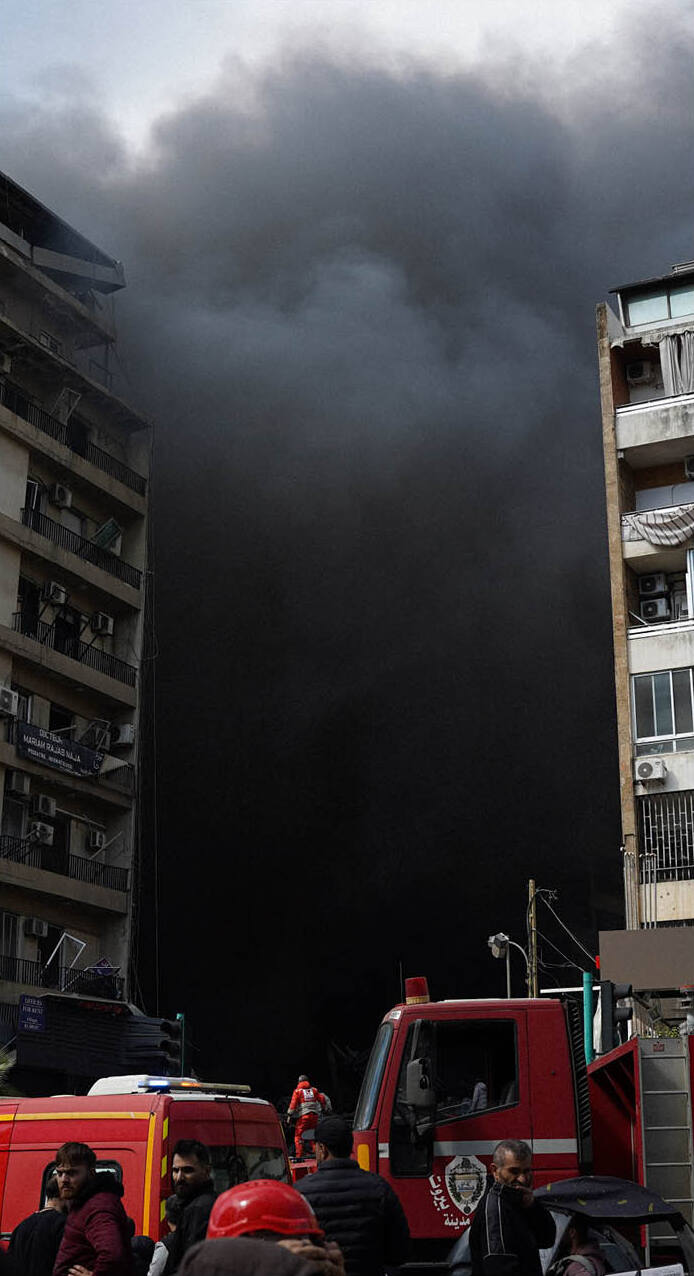
Netanyahu’s threat of a provocative show-strike on the Dahieh suburb of Beirut was finally carried out on 7 June and, as expected, it rapidly dragged the region into a dangerous escalation to the brink of a full renewal of a ‘multi-front’ regional war.
Iran’s counterattack began the following evening. Did Netanyahu, Minister of Defence Israel Katz, and the arrogant generals underestimate the threats of the Iranian regime? It is more reasonable to assume that the provocative strike on Beirut was designed to drag the Iranian military into renewing fire and to provide the Israeli government of death with an opportune moment to renew the attack on Iran, despite the pressures from Washington.
Desperate Donald
Donald Trump, who emerged humiliated and desperate for an agreement and a diplomatic achievement after 40 days of a barbaric imperialist offensive on Iran, and a further 60 days of fruitless negotiations with the Iranian regime, urged Netanyahu not to respond to the symbolic missile barrage from Iran. Although Washington itself has recently attacked Iran on several occasions during the ceasefire, the crisis in the Strait of Hormuz continues to exert pressure on the global economy and, through this, also on Trump; moreover, mass revulsion in the US over the continuation of the war is expanding. Added to this was Trump’s desire to arrive at the start of the football World Cup with a binding ceasefire agreement in hand. Yet Washington’s ability to dictate moves is limited, and it is failing to fully control the height of the flames of the regional conflagration it ignited with the US-Israeli offensive that began on 28 February.
Attacks on Iran
Dozens of fighter jets of the Israeli Air Force attacked Iran – in two waves of strikes – and local news agencies reported a series of explosions in Tehran, Tabriz, and Isfahan. In Mahshahr, south-west Iran, the Air Force struck the Karoun petrochemical plant – which underscores that the Israeli government is not satisfied with only military targets. At the same time, the Israeli military attacked villages in the Nabatieh and Sidon governorates in southern Lebanon. The regional escalation was also exploited to tighten the siege on Gaza and to prevent the entry of aid to the surviving population in the Strip.
The Iranian regime’s counter-response included missile barrages aimed at Israel. Also, a Houthi spokesperson in Yemen threatened to attack Israeli vessels in the Red Sea after claiming responsibility for firing a missile at territories under Israeli rule.
The war on Lebanon continues, and the aggression against Iran has been halted only temporarily. “At the moment the fire on this front is held,” said Netanyahu. His speech was a combination of boasting, “Iran and Hezbollah are weaker than ever”, and cynical security scaremongering. There was no expectation that he would address the thousands of victims who perished in his attacks this year on Lebanon and Iran, or the millions uprooted from their homes. The families in Israel, both Jewish and Arab, who lost loved ones in the barrages both in June 2025 and in March-April of this year, were also entirely absent from Netanyahu’s speech, perhaps to make people forget his declaration from last year regarding the elimination of the ballistic threat, alongside the nuclear threat.
In reality, the Iranian regime has strengthened its regional position as a result of the strategic failure of the Israeli-US imperialist offensive to bring about its downfall, and motivation to acquire a military nuclear capability as a means of self-preservation can only have grown.
In Israel, action must be taken to promote protest and towards building a cross-national socialist left-wing force of working people that will work in the coming general election campaign to strengthen the struggle for a total halt to the war and regional aggression; for the withdrawal of Israeli military forces from Lebanon, Syria, and Gaza; and for an end to the siege of the Strip and the occupation in the West Bank. This needs to be part of a socialist programme that will advance a root-and-branch solution based on equal rights to existence, to self-determination, and to a life of dignity, welfare, and personal security for all.
