

Sean Figg, Committee for a Workers’ International (CWI)
The war on Iran has again shifted the global context within which the war in Ukraine is being fought. The disruption caused to global oil supplies delivered a substantial financial shot in the arm to the Russian state as the oil price soared. Some sanctions were temporarily suspended to allow more Russian oil to flow into the world economy. Additionally, the massive aerial bombardment of Iran depleted US munitions that otherwise might have made their way to Ukraine.
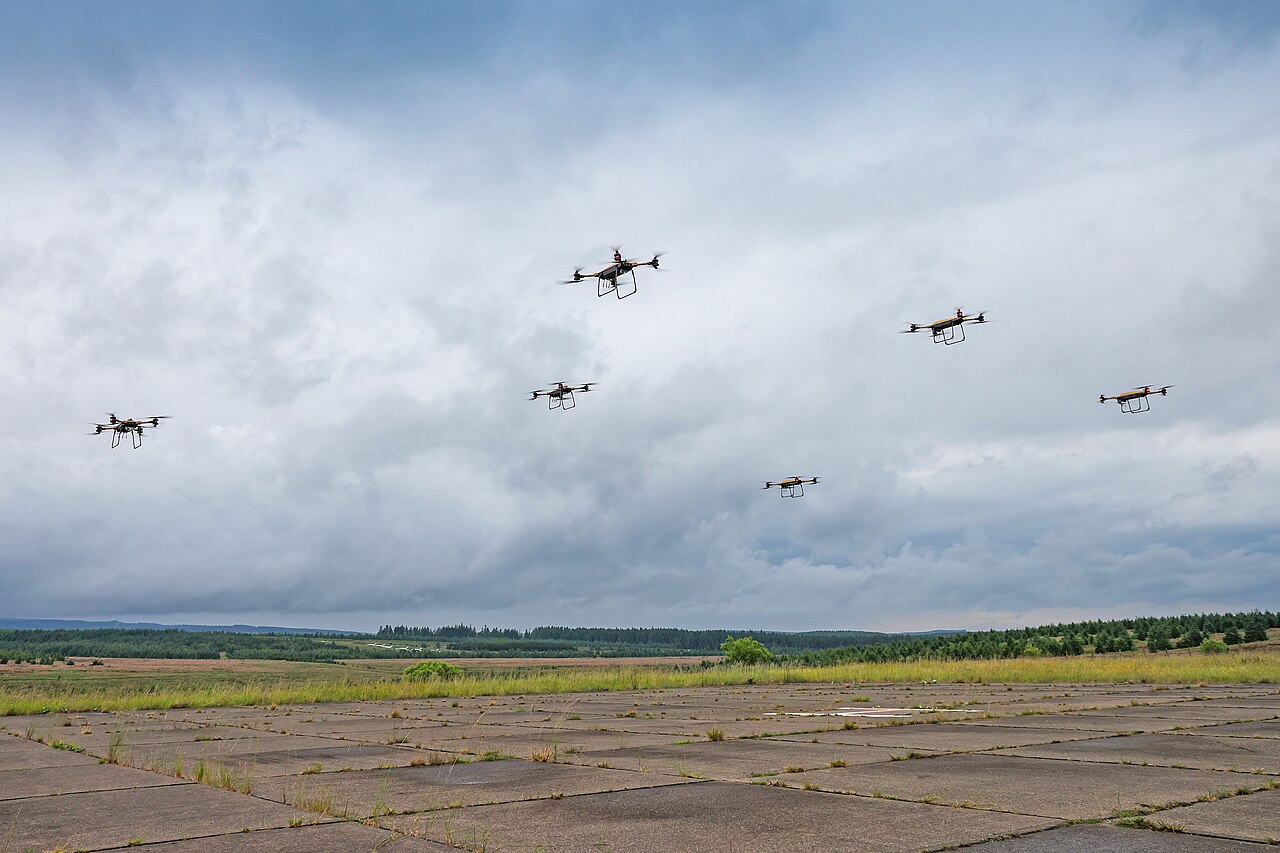
Since March, the Ukrainian military has been targeting Russian oil infrastructure with an increased intensity. The likely aim, given the timing, was to cancel-out the Putin regime’s ‘Iran war dividend’ and prevent it feeding through to the Ukrainian frontlines. The new intensity of the Ukrainian military’s drone attacks on Russia is unprecedented in the four-and-a-half-year-old war and signals a new phase in the conflict.
Alongside the changed global context, the escalation in the aerial war is linked to the intractable situation that has developed in the ground war. Russia’s military momentum has slowed in the course of this year to very incremental territorial gains. Grinding to a virtual halt in one theatre, the Russian military has also increased the intensity of its aerial bombardments of Kyiv and other cities. At least 437 civilians were killed in Ukraine in July alone. This is the highest number of civilian deaths since May 2022.
The Ukrainian military’s targets inside Russia have recently expanded to include the warehouses and distribution hubs of the massive online retailers Wildberries and Ozon. According to Reuters, these two companies control nearly 70% of the online retail market in Russia. In 2025, this amounted to combined sales of over US$121 billion.
The Ukrainian military’s shift in targets is an attempt to transform the political stakes for the Putin regime by disrupting day-to-day civilian life across Russia to a degree not yet seen. The Zelensky regime will be hoping to stoke a political crisis in Russia. Domestically, Putin has insisted on referring to his invasion of Ukraine as a “special military operation”. The new Ukrainian tactics make it virtually impossible to maintain this fiction, already strained beyond credibility.
The war has dragged on longer than World War One with no end in sight. The scale of army recruitment, conscription and returning casualties has already touched every corner of Russia. As of June, the Center for Strategic and International Studies (CSIS) estimates two million Ukrainians and Russians killed, wounded and missing. Russian military deaths are estimated at over half-a-million. This is three times more than Ukrainian military deaths, showing the cold calculations of the Putin regime and its meat-grinder tactics. Now, Ukraine’s attacks on Russia’s oil infrastructure have forced petrol rationing to be introduced in and around Moscow. Civilians filling up their cars face long queues in some areas. But motorists are not the only ones facing disruption. Wildberries and Ozon have an estimated 121 million ‘active’ customers and over one million small businesses trade via the two platforms.
The growing gulf between the regime’s rhetoric and the reality of living in a country engaged in a major war can discredit and undermine it further. Growing mass dissatisfaction can increase the pressure on the ruling elite, even without major protests developing, and open splits in the regime. In such a situation, fearing for its survival, the Putin regime can look to escalate the war, or threaten escalation, in the hope of diverting attention, rallying support around the regime and restoring its authority.
The threat of escalation has been a recurring feature of the Ukraine war. So-called ‘red lines’ have been tested multiple times by both sides. ‘Transgressions’ are then assessed by the warring sides for their impact on their ability to continue fighting. As long as this is not fatally compromised, the ‘red lines’ have been allowed to shift. This recurring ‘brinkmanship’ is a dangerous and not entirely predictable feature of the war.
Splits in the ‘Allies’
The attempt in November 2025 by US president Trump to impose a ‘28-point peace plan’ – drafted with some degree of collaboration with the Putin regime – was dead before the year’s end. The Zelensky regime refused to consider it, backed and encouraged by the pro-war European powers (the ‘Coalition of the Willing’), especially Britain, France and Germany. As a result, the proposal was substantially revised and the ‘28-points’ became ‘20-points’. This made it unacceptable to the Putin regime.
Ironically, the very fact that the Trump administration spent its first months in office calling into question US imperialism’s commitment to the NATO military alliance prepared the ground for the European ruling classes’ later refusal to cooperate. This forced the European capitalist powers to develop a more independent policy toward the Ukraine war. Initially they were reluctant to formalise the schism with US imperialism, at least over the Ukraine war. But having been forced down this road, the European powers were better prepared to defy its unreliable ‘ally’ when it demanded they limit their specific class ambitions in the Ukraine war. These are not identical to the interests of US imperialism. Ultimately, they flow from the particular crisis of European capitalism as it falls further behind US capitalism and China.
For the European ruling classes, as much as for the Russian capitalist oligarchy, the Ukraine war is being fought to decide who will occupy first position in exploiting the workforce, resources and markets of Ukraine and the countries on Russia’s borders, as well as commanding the geostrategic advantage in the region. These are the real war aims for which the working classes of Europe are expected to sacrifice their living standards, and that Ukrainian and Russian soldiers are expected to sacrifice their lives.
The huge concessions to the Putin regime that Trump’s ‘28-point peace plan’ contained threatened to tie the hands of the European capitalist classes for years to come. The changes between the original plan and the ‘20-point’ revision – on the size of the Ukrainian military, territorial concessions, NATO and EU membership – reveal the class calculations being made behind the scenes.
Crisis of US imperialism
Despite all of Trump’s bluster, US imperialism has in practice found it impossible to implement a fundamental change in its policy toward the Ukraine war. During its eighteen months in office, the Trump administration has maintained the sanctions introduced under the previous Biden administration. In October 2025, possibly as a bargaining chip for the then-soon-to-be-revealed ‘28-point peace plan’, it introduced its own sanctions for the first time. The White House supported another raft of sanctions in July. The nearly US$200 billion agreed by the political representatives of US imperialism under Biden has continued to be disbursed.
The biggest change in US policy on the Ukraine war under Trump has been to shift the military costs to other NATO members – first and foremost the European powers. US weapons continue to flow to Ukraine but are now paid for via the Prioritized Ukraine Requirements List (PURL) managed by the US Department of Defense. The industrial, technological and military muscle of US imperialism remains firmly behind the continuation of the Ukraine war.
US imperialism is caught in a snare. Every move by the Trump administration to reinforce US imperialism’s declining global position pulls it tighter. Notwithstanding fleeting ‘successes’, such as the intervention in Venezuela earlier this year, the decline of US imperialism is accelerating. This has been confirmed again by the quagmire into which Trump has marched US imperialism in the Middle East with its war on Iran.
The Trump administration’s policy toward the Ukraine war has strengthened the multipolar character of world capitalism. Despite the crisis of European capitalism, the European powers have been forced to reemerge as a more independent pole on the world stage. Their policy on the Ukraine war is an open-ended determination to continue it. Massive funding has been made available to the Zelensky regime to make this possible. Western capitalist media abounds with reports of plucky Ukrainian defence ‘start-ups’ building drones and helping their country ‘innovate’ its way to victory. However, it was the massive support of the European powers that made the Zelensky regime’s unprecedented new scale of aerial attacks possible.
This is still an unfolding process. The European powers are still highly reliant on US-produced weapons and technology in the short-term. But the direction of travel is clear. Trump’s dismal failure to make good on his boast to end the Ukraine war “in a day” upon entering office has shattered any lingering pretences that US imperialism can unilaterally force other capitalist powers – whether enemies or allies – to tow its line. There is no longer a power capable of playing the role of an unchallengeable global policeman. Trump is reminded of this every day that the crisis in the Middle East continues and every day that the war in Ukraine continues.
Class struggle
Given the imperialist character of the war, any peace will be an imperialist ‘peace’ without the independent intervention of the working class. In Trotsky’s 1934 work, War and the Fourth International, he pointed out that “…a modern war between capitalist nations carries with it a war of classes within each of these nations…” This remains true in the current era of capitalism. The absence of independent mass working-class parties armed with an independent class programme on war does not mean the class struggle is not central to perspectives for the war in Ukraine.
In 2025, protests in multiple Ukrainian cities forced the Zelensky government to shelve reforms that were perceived as weakening anti-corruption safeguards. Protests developed again last month when Defence Minister Mykhailo Fedorov, a figure perceived to be firm in combating corruption, was dismissed by Zelensky. These protests were not huge, with neither movement bringing much more than 10,000 onto the streets on any particular day. That they took place at all under a regime of martial law in which strikes and street protests are outlawed is significant however. This is not the only dissent in Ukraine. National Police figures recorded 341 attacks on army recruiters in 2025, compared with just five in 2022. A staggering 620 attacks were recorded in the first four months of 2026.
In Russia, the Putin regime has sharply tightened repression, largely pushing opposition underground. However, in 2022 the initial response to the so-called “special military operation” saw protests in multiple cities. Other protests, for example around conscription, and other symbolic signals of opposition have also remained a feature. In the final analysis, the Bonapartist character of the Putin regime reflects its narrowing social base.
The European powers’ militarisation policies will generally be funded through attacks on working-class living standards via cuts to public services and jobs. Countries without military conscription are openly debating its reintroduction. In other cases, incremental steps are already being taken toward it, as in the case of Germany. This is setting the scene for major class battles in the months and years ahead. The already deep polarisation in US society is set to deepen, and the class struggle will, sooner or later, further escalate there. All of this will impact the ruling classes’ war policies.
Programme
The role of Marxists in this situation is to link the impact of the class struggle on the ruling classes to a definite and independent working class programme. This needs to answer the question, ‘war or peace in Ukraine?’ from an internationalist and class perspective, making clear demands on the belligerent capitalist governments in order to mobilise the working class against the war. Without an organised working-class movement with definite demands, the ruling classes will be able to manoeuvre endlessly to deceive the working class and continue the war.
The CWI campaigns on a programme that includes: an immediate end to the fighting on all fronts – ground, air and sea; rejection of all imperialist ‘peace’ plans negotiated behind the backs of the people living in Ukraine and Russia; the immediate withdrawal of the Russian military from Ukraine; the immediate end of arms shipments to Ukraine from the US, European and other powers; and, for democratic, unhindered self-determination for Crimea and the Donbass region and the defence of the rights of national minorities.
But a programme needs a vehicle for its implementation. The CWI campaigns in all existing workers’ organisations, such as trade unions, for the adoption of an independent working-class policy toward the war. In the US and the European countries, we point to the connection between the looming class struggles against austerity and the war policies of the governments. We argue that opposing austerity and defending the interests of the working class requires overturning their war policies. The need to build independent working-class political organisation – workers’ parties – is therefore an integral part of the struggle against war. It is a necessary first step towards forming alternative workers’ governments that fundamentally break with predatory imperialist policies in favour of working-class solidarity and internationalism.
In Ukraine and Russia, a struggle to defend and restore democratic rights will be necessary to force open the space to campaign and win the working class to such a programme. This will mean confronting the regimes of repression and martial law constructed to suppress the class struggle and secure the ‘home front’ behind the war aims of the ruling classes. Workers and their organisations will at a certain stage need to defy prohibitions on strikes and protests to defend their interests. The role of Marxists will be to help consolidate this as a first step on the road toward the working class emerging as an independent factor able to influence the course of the war in the countries engaged directly in the fighting.
This will not be easy in Russia or Ukraine. Ukrainian Trotskyist and anti-war activist Bogdan Syrotiuk, for example, was sentenced to fifteen years in prison this month for a handful of online articles putting forward similar ideas. Nevertheless, it is the only road that can prevent an imperialist war turning into an imperialist ‘peace’. Both sacrifice the fundamental interests of the working class, and the latter always contains the seeds of future wars.
The basic task of Marxists in this era is to assist the working class to rebuild its ideological, political and organisational independence. The CWI is committed to this task under all conditions, including conditions of imperialist war.
