


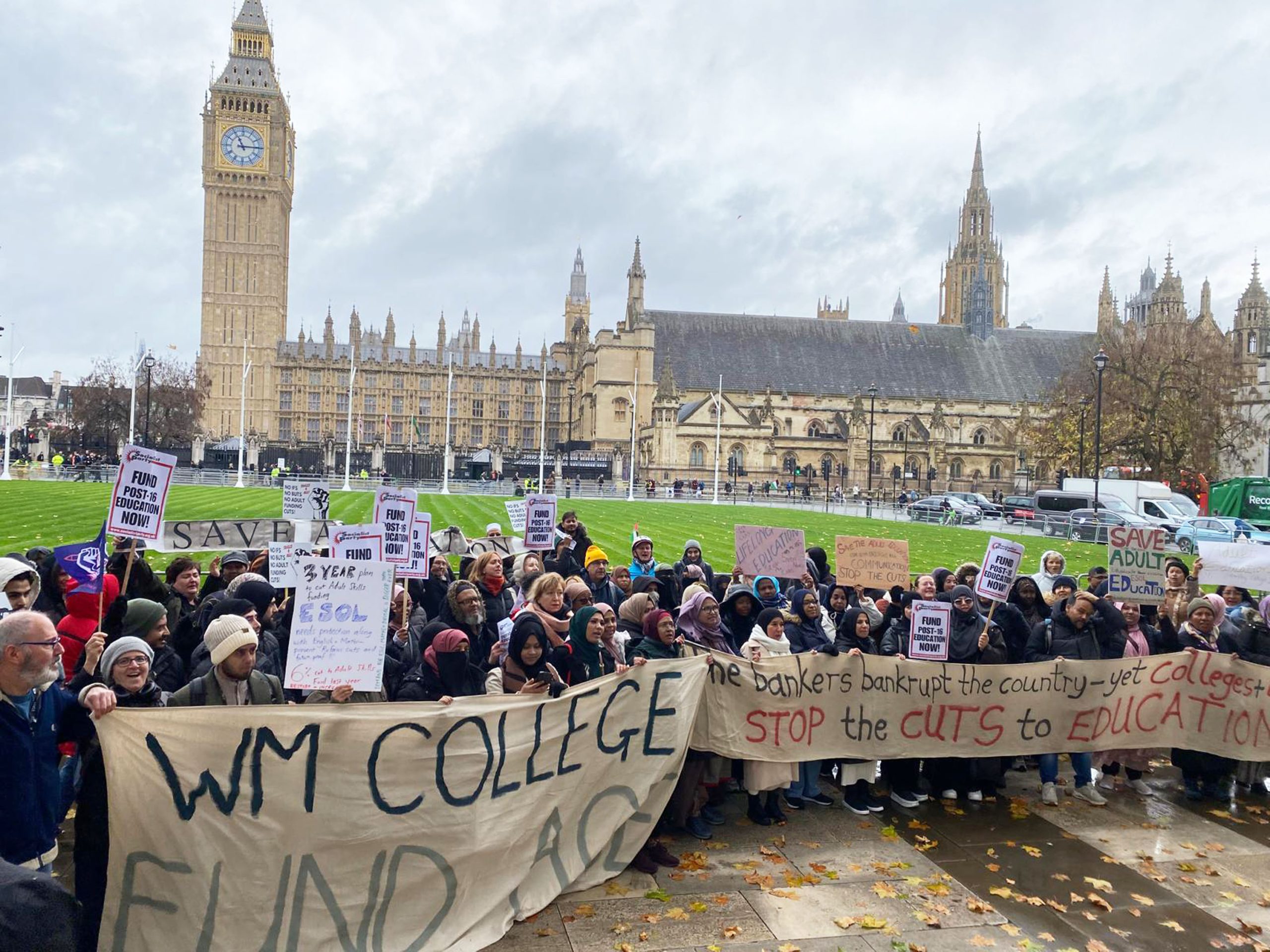
Marco Tesei, UCU NEC member, personal capacity
The further education committee (FEC) of the University and College Union (UCU) met on Friday 25 September to get to grips with delivering resolution FE5, passed at the FE sector conference in May.
As previously reported (see ‘UCU Congress votes for nationwide strike action’ at socialistparty.org.uk), this resolution – moved by Socialist Party member Duncan Moore on behalf of South Devon College – mandates FEC to set up an aggregated ballot of over 200 English college branches this autumn, leading to national industrial action for a ‘New Deal for FE’: demanding binding national bargaining, a 10% pay rise (moving toward pay parity with schoolteachers), and national workload limits.
FE England members have never in UCU’s history been balloted on an aggregated basis, rather than just college-by-college. And with the cost-of-living squeeze getting ever tighter for FE teachers (salaries have lost 40% of their real-terms value since 2010) and the pay gap with schoolteachers now averaging £10,000 a year and getting ever wider, never has such an opportunity for powerful collective action been so timely and necessary. But with this massive opportunity has come an urgent need: for UCU’s leadership to act boldly and decisively!
Friday’ meeting should have been to tie up loose ends from the September 11 special FEC meeting (see ‘UCU Further Education Committee agrees to ballot for national action’ at socialistparty.org.uk), before getting cracking with campaign preparations as then agreed, following a timeline culminating in strike action potentially before Christmas. Sticking to this timeline is important. FE employers typically make local pay offers at the beginning of October, and any further delay in launching the national campaign officially and calling UCU members to action risks a haemorrhaging of branches from the dispute. Branch reps like me are already advising members to beware of any paltry local pay offer when we can win so much more collectively. But for how long will my advice be credible if the national leadership now dithers?
The meeting should also have provided the perfect context for my and Duncan Moore’s motions to FEC, both based on civil service union PCS’s TUC (Trades Union Congress) motion P34 and instructing our general secretary, Jo Grady, to press the TUC to implement its resolutions and to start taking the lead herself. Mine focused on PCS’s call to balloting public sector unions to coordinate their pay disputes. Duncan’s focused on the call for a Saturday demonstration for investment in public services, organised by the broader trade union movement. What perfect timing, you would think, with both PCS and UCU about to ballot on pay! And imagine the benefits of campaigning with a much bigger union like PCS, especially if Department for Education workers struck alongside us, calling for full funding for FE pay as well as their own!
But no. Our motions, though heard and supported, were ruled out of order because they were deemed to be decisions for the National Executive Committee (NEC – higher education as well as FE), which alone has the authority to “instruct” the general secretary – and those ‘instructions’ will therefore have to wait until November when the NEC next meets! As long as we changed the word ‘instructs’ to ‘encourages’, we were assured our encouragements would be passed on to Jo Grady nonetheless!
But regardless of all that: why wasn’t our general secretary herself at the meeting, to hear not just our motions but also the debate around the ballot campaign and to infuse the meeting with a fighting leader’s vibes?
Instead, we got a meeting last Friday in which progress instantly got hamstrung over the unfinished business from our last meeting: a legal question revolving around whether adult education-only providers can be included in the dispute and on which the union’s head of FE (an unelected official) is seeking Senior Counsel. That counsel hasn’t yet been delivered, and therefore the grounds of our dispute cannot be finalised. Our agreed timeline has consequently been put on hold, entirely beyond the control of the FEC.
Nobody doubts the genuine complexities of framing this dispute, which stem from the unique features of the FE funding landscape. But these issues are resolvable and could have been sorted a long time ago if the FE official had taken a proactive approach and sought counsel earlier – in fact, right after motion FE5 passed in May! And if the chair of the FEC, not to mention our general secretary herself, had prodded him on from the start.
Reps on the left of the FEC (Socialist Party and other independents, and ‘UCU Left’ members) also found themselves once more, in a long-standing bone of contention, having to push back against a proposal by the head of FE to exclude branches deemed by him and regional officials not to be ‘strike ready’. This was particularly frustrating given that FE sector conference motion 4 established a new policy committing the union to proactively encourage branches to opt into the New Deal for FE (ND4FE) national dispute. Furthermore, one of our main agreements at the meeting two weeks previously was to assume the inclusion of all branches, except those obviously lacking an operational structure. Our argument is that bold leadership is precisely what builds strike-ready branches.
The FEC meeting confirmed, not for the first time, what has become abundantly clear: UCU’s FE leadership body, controlled by supporters of Jo Grady, and the general secretary herself, are trying to avoid leading a fightback against Labour’s refusal to fully fund further education, especially adult education. Instead, they are actively undermining the opportunity so hard-won by fighting delegates at sector conference to lift workers’ pay and conditions in dozens of colleges into the altogether improved dimensions of the ‘New Deal’.
This is not the kind of leadership UCU members are clamouring for. New Labour prime minister Andy Burnham is continuing the Tory, and now Labour, austerity agenda, for all his talk of radical change. There is money to spend on defence, but none for the very colleges and teachers Burnham is counting on to drive his ‘economically regenerative’ education and skills agenda!
In the next crucial couple of weeks, Socialist Party members in UCU and their allies on the left must continue to pressure the head of FE to deliver the legal counsel as soon as possible so that our ballot campaign can be launched.
As soon as this happens, FEC members must hold him and the FEC chair to their word, given at the special meeting on September 11, that the campaign’s official recommendation to branches will be to reject any local offer short of the demands of the dispute, and to participate in the aggregated ballot. Campaign materials, with the ND4FE’s underpinning demand for full government funding expressed loud and clear, must be ready to go to branches from the word go.
Meanwhile, reps and activists should immediately start preparing branches for the ballot through their own UCU networks and armed with their own materials, including Socialist Party members with their own special bulletin. We need to develop convincing arguments to deter members from settling at the first local offer. Cross-branch collaboration will be vital. We are fighting, despite obstruction, to ensure this national ballot takes place!