


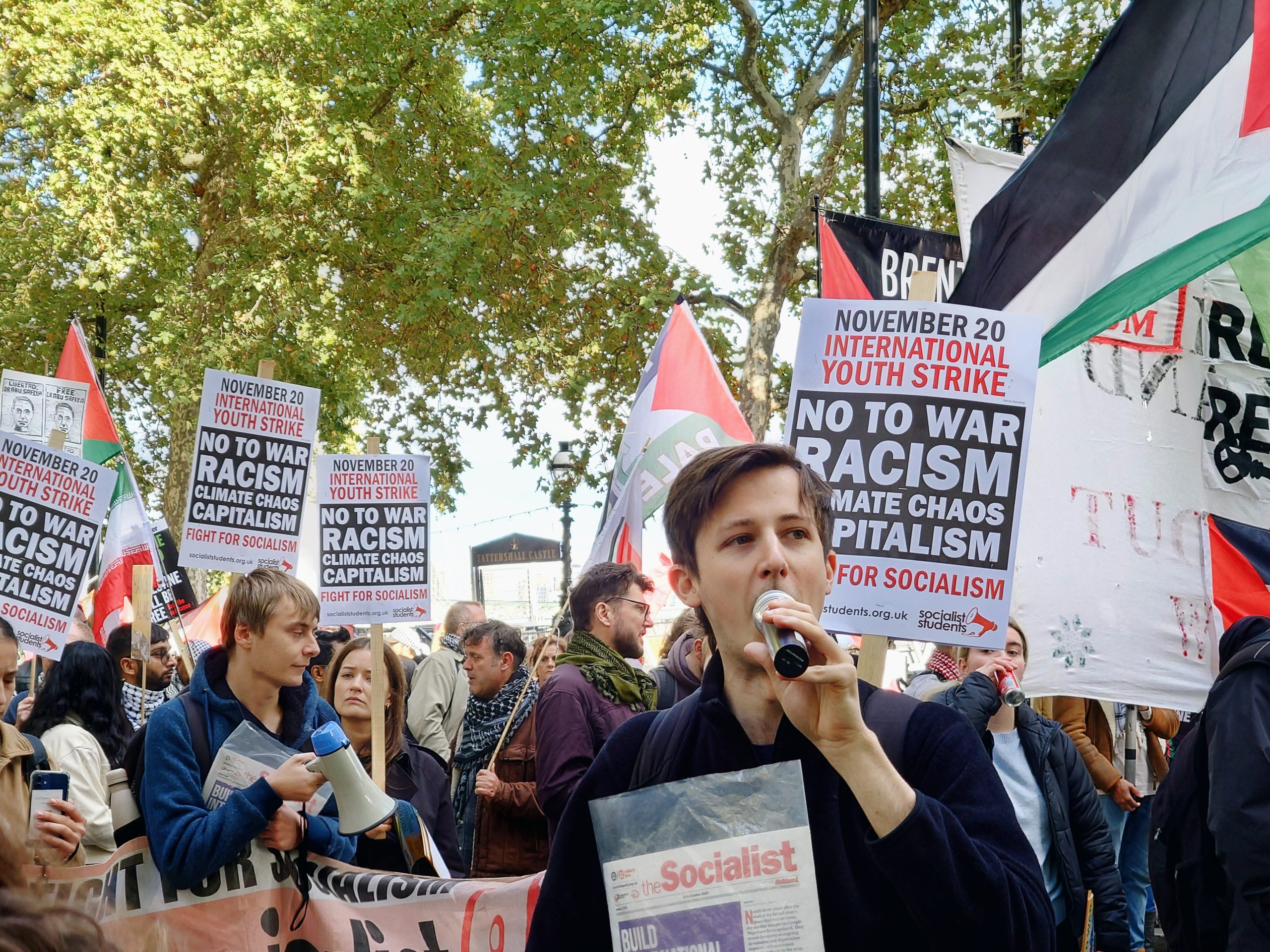
Socialist Students, hosted by the Socialist
To assist with its drive to build the biggest possible youth walkouts on 20 November, the Socialist has invited Socialist Students to have regular space in its pages.
This week, Socialist Students is running a two-page feature ‘Fight for our futures, not their wars’.
The invitation is initially open until the Socialist Students national conference on 5 December.
Fight for our futures, not their wars!
Becca Bayman, Liverpool Socialist Students
Across the world, young people are beginning to take to the streets expressing anger at the lack of a future being offered to us under capitalism, and in opposition to war and militarisation.
This wave of youth demonstrations is particularly visible in Europe, where the threat of increasing militarisation and military conscription looms. In Germany, nationwide school strikes against conscription have mobilised 55,000 young people. Inspired by these mobilisations, an anti-war youth assembly was formed and met in-person in June, bringing together 20 socialist youth organisations from 8 countries across Europe to organise an international youth strike ‘fighting for our futures, not their wars’, on 20 November. Socialist Students was invited to be part of this.
Students and young people in Britain have been a feature of the mass movement in solidarity with Palestinians and against Israel’s war on Gaza – including through university campus encampments. And in 2025, when Donald Trump was invited by the Labour government for a state visit, Socialist Students led school and college walkouts.
It was the success of this action, and coverage of it in the press internationally, that helped us find other youth groups internationally.
But it is necessary to build on these successes. The growing anger among young people provides an opportunity to build a united fightback of youth internationally, against war and militarisation.
However, to do this we need to understand what is driving the increase in war and why governments across Europe are pouring billions into rearmament, at the expense of our public services and education. The threat of increasing wars and conflict is rooted in the increasing tensions between capitalist powers internationally. Fighting for an end to war therefore means fighting the rotten capitalist system that produces it and building a socialist alternative.
Capitalism is in crisis. Across the world, economic growth is slowing and productivity has stagnated in many of the major capitalist economies. At the same time, governments face growing debt and are driving down the living standards of the working class in an attempt to protect the profits of the capitalist bosses. International capitalist institutions like the IMF and OECD have warned of a weakening global outlook due to trade tensions and instability.
But crisis is inherent to the capitalist economic system, based on profit and competing capitalist interests and competing capitalist states. When crises happen, competition between capitalist powers sharpens. The struggle for resources and political influence becomes increasingly backed by military power, fuelling further conflict.
The US, China and other powers are competing to protect their economic interests and expand their influence. In doing so, governments and states are not simply choosing to be aggressive but are responding empirically to the pressures created by the unstable capitalist system.
Growing international tensions
One element of this is the growing tensions between the US and China. The US has dominated the global economy and international political system for decades, but China’s rapid economic growth has challenged that dominance, and the US is now in relative decline. China has expanded its trade and investment across the world, while the US is attempting to defend its position. As each power strengthens its position, the other is pushed to respond.
In Europe, Russia’s invasion of Ukraine in 2022 was a turning point. The British government’s 2025 strategic defence review describes the Ukraine war as marking a ‘new era’, with “state-on-state war returning to Europe”.
This is driving increased militarisation across Europe. In Britain, before he left office, Starmer announced the plan to raise annual military spending to £80 billion per year by 2029 – an increase of £25 billion from the previous year. This funding is lifted directly from the pockets of the working class, with the Labour government making cuts in the form of increased taxes, reduced disability benefits, and reduced investment in the NHS, schools, housing, and other public services.
Working-class and young people won’t simply accept cutbacks to our services to pay for weapons and war. Many will however, have anxieties about increasing military threats. These threats are ramped up by the capitalist politicians and the media to try to justify spending on the military in the name of ‘defence’. The whipping up of nationalism by the capitalist class is part of that.
In fact, young people and workers in Britain have more in common with workers and young people in Germany, Italy or China than with a British billionaire.
We all face rising unemployment, unaffordable housing and climate catastrophe, while they live in luxury. And it is us and our friends and relatives who are most likely to be fatalities in wars and conflicts.
Young people across Europe are coming together to take part in the international youth strike on 20 November. The fight against war must be international. A socialist transformation of society would be the basis by which to replace competition between capitalist states with solidarity between the international working class.
However, an international approach begins with understanding and organising against our own governments. In Britain the drive towards militarisation is already having consequences for workers and young people.
We are already seeing militarisation creeping into our education system. 35 UK universities have entered the Defence Universities Alliance, which is a competitive arms research programme partnered with the UK government. Universities receive some income from this alliance. Amid an education funding crisis, this shows why we need universities and colleges to be fully publicly funded, and under the democratic control of the working class and students.
There are limits to how far governments can go to increase militarisation at the expense of the working class. Economic stagnation means that governments have less to spend. Former Defence Secretary John Healey resigned over Starmer’s reluctance to increase defence spending as far as he wanted. While Burnham has refused to commit to Healey’s target by 2030, he has retained Starmer’s £80 billion spending commitment and appointed Healey as Chancellor.
But pressure from the working class has also limited the government’s power to act. It was working class anger at Starmer’s cut to winter fuel payments for pensioners and disability benefits cuts that forced U-turns.
In 2023 Tory home secretary Suella Braverman was sacked due to her threats to ban protests against the genocide on Palestine. This is the largest and most sustained protest movement in the UK since the historic 2003 protests against the invasion of Iraq.
The fight against war and militarisation is happening across the world as well. Across Europe, governments are using the threat of war to justify increased military spending while workers face austerity and attacks on living standards. The EU has relaxed its fiscal rules to allow increased defence spending, while governments continue to impose restrictions on other areas of public spending. Rearmament is being prioritised as public services are starved of investment.
The German government is planning a dramatic increase in military spending, with an aim to match the combined totals of the UK and France by 2030. Furthermore, they have introduced the deeply unpopular conscription, sending out a survey to young people to which only 0.07% responded in favour of going to war for Germany. Tens of thousands of young people have mobilised against the threat of conscription. School strikes have shown that young people are not prepared to accept a future in which they expected to pay for militarisation, either through cuts to living standards or through being sent to fight.
In Italy, a one-day general strike in solidarity with Palestinians in autumn 2025 showed what the organised working class can achieve, students joined the walkouts and protests too. Workers have taken action at ports, demonstrating the industrial power they have to disrupt the movement of military cargo. This demonstrates that workers have the power to stop the machinery of war themselves.
We have also seen the power of youth movements outside Europe. In India, the youth-led ‘Cockroach’ movement mobilised hundreds of thousands around leaked examination papers, corruption and the lack of opportunities facing young people. After weeks of protests, Education Minister Dharmendra Pradhan was forced to resign and the government conceded to several of the movement’s demands.
These struggles all point to the fact that pro-capitalist governments have limits to their power. When workers and young people organise, they can disrupt the plans of governments and force them to make concessions. But this also raises a more fundamental question. If workers and young people have the power to force concessions from the government, why shouldn’t they have the power to decide how society is run? Winning individual demands is important, it can boost the confidence of workers and young people to struggle, but it does not bring an end to the rotten capitalist system.
The role of the working class
The working class has a unique position in society. It is workers that produce the wealth and keep society functioning. When organised, workers have the potential not only to resist government’s decisions, but to take democratic control of how that wealth is used.
Capitalism is based on competition between companies for profits and between capitalist states for markets, resources, and economic and political influence. While society is organised around these competing class interests, the pressures that drive militarisation and war will remain.
Working-class and young people therefore need a political organisation that genuinely represents their interests. The Labour government has shown that it is not prepared to challenge the interests of big business, including the arms industry. The Greens have opposed the government’s approach to rearmament and called for greater investment in diplomacy. However, their ideas do not challenge the capitalist system. Officially, they call for Britain to remain in the NATO military alliance with other capitalist powers including the US. The Greens ask how we can make capitalism more peaceful, but we must argue to change the system that produces war.
We need a political alternative that represents the interests of workers and young people and fights for the socialist transformation of society. A socialist society would mean democratically taking control of the wealth and productive resources of society and using them according to social need rather than private profit.
Workers in the arms industry, for example, have valuable skills and productive capacity. With that industry nationalised under democratic workers’ control, decisions could be made collectively to decide how those skills and resources could be used for socially useful production rather than for the creation of weapons and the generation of profit.
However, this does not mean workers should just accept physical attacks against them. Fighting for demilitarisation does not mean denying people the right to defend themselves. The question is which class controls defence, and in whose interests is it carried out? Workers should be able to organise to defend themselves through their own democratic organisations, rather than being forced to fight in the interests of governments and big businesses. The struggle for working-class self-defence can be connected to the wider struggle for workers’ control.
Ultimately, socialism provides the basis for overcoming the divisions between workers of different countries. The working class has no interest in fighting other workers for the profits of their respective ruling classes, they have directly opposed interests.
Workers and young people need peace, decent living standards, and secure futures, while arms companies want profit from instability and rearmament. An international socialist transformation would replace competition between capitalist states with democratic cooperation between working people, removing the material basis on which nationalism and war are continually reproduced.
This is why the fight against war is inseparable from the fight for socialism. The 20 November youth strike is a step towards building the organisation and solidarity of the international working class, and a chance for young people to demonstrate their need to fight for our futures and not their wars.
- Becca was a Socialist Students delegate to the June meeting in Cologne, which set the initial plans for the Youth Walkouts on 20 November