

Build the international youth strikes on 20 November
Hannah Sell, Socialist Party General Secretary
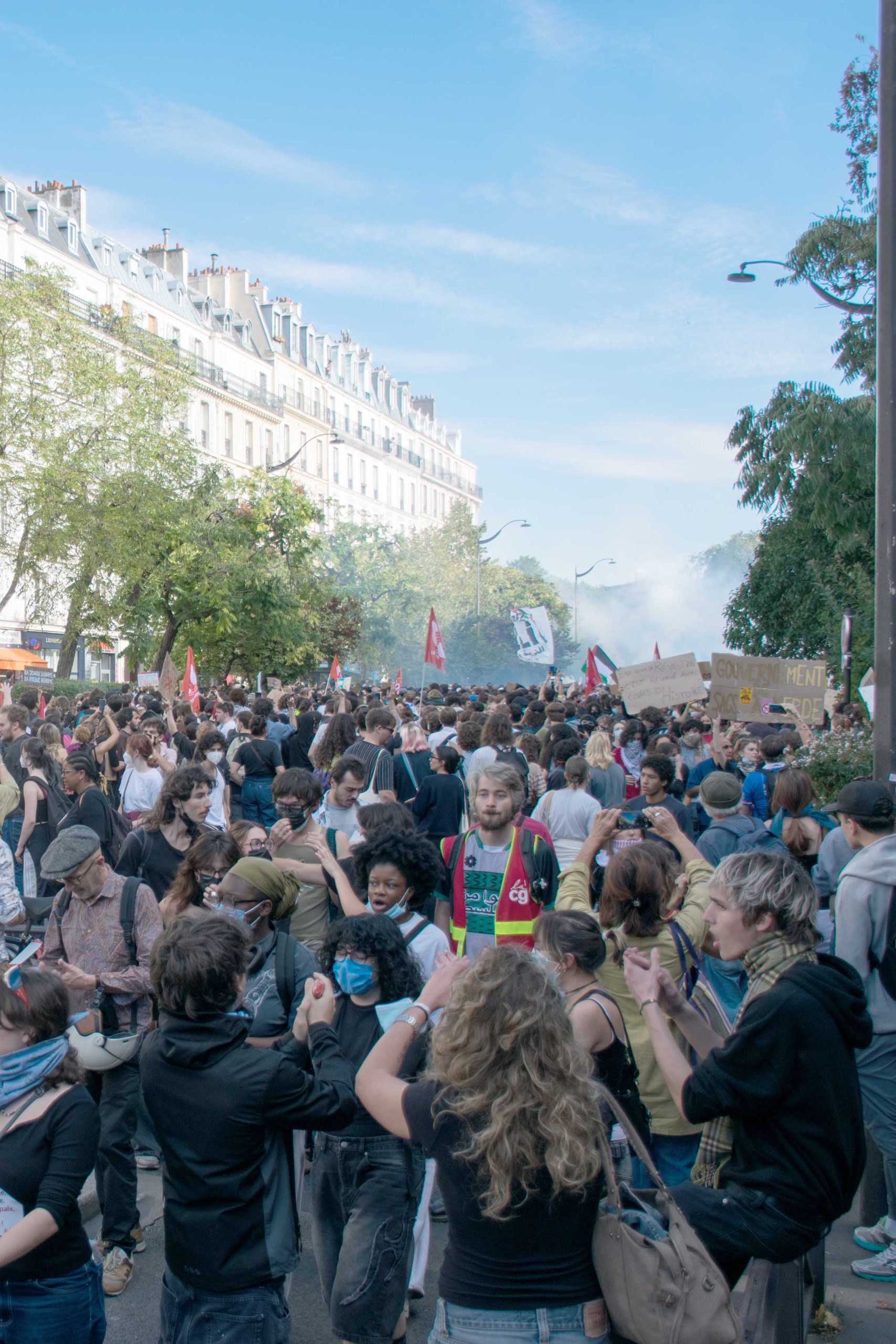
The slogan of the International Youth Walkout taking place in 12+ countries across Europe on 20 November is ‘fight for our future – not their wars’. Across Europe, that fight has already erupted. Many workers and young people in Britain will be inspired by the wave of mass strikes and protests across the continent. Whether it’s the tens of thousands of school students striking against militarism in Germany, the hundreds-of-thousands-strong movement over housing costs in the Spanish state – which has now led to a 24-hour general strike demanding wage increases being called for 11 November – the planned public sector strike over pay in the Irish Republic, the biggest for forty years, or the magnificent movement of school students and workers in France, which is also developing in Belgium.
In each country the specific trigger for the movement is different, but the underlying causes are not. Every government offers endless austerity and cuts to public services, stagnating wages, rising housing costs. Everywhere, young people feel that this system – where jobs are low-paid and insecure and education is inadequate and expensive, where halting climate change is impossible but a fortune can be found for weaponry – does not offer them any future worth having.
Britain is no different. Overcrowded classrooms and high pupil-to-teacher ratios are one of the main issues raised by the French students. But according to the OECD, average class sizes are even bigger in Britain. Unbearably hot classrooms during the heatwave affected students in France and Britain alike. The slogans on the banners of the French students, such as ‘schools with no money, a country with no future’, and ‘money for education not for weapons’, apply just as much here.
True, renters in Britain do not have to pay quite as much as the eye-watering 47% of their wages that Spaniards have to pay in rent, but many do – average rents in London have reached 41% of income – and nationally they still have to cough up more than a third of their incomes on it. And the rising cost of living that is forcing workers in Ireland to strike is true here, and everywhere. Continent-wide, capitalism is a system in crisis, increasingly incapable of meeting the needs of the majority. Whatever the colour of their rosettes, pro-capitalist governments become hated as a result.
In the Spanish state the prime minister, Pedro Sanchez, is leaning on the mass movement that has erupted over the question of housing to try and win re-election. Having taken no qualitative measures to solve the housing crisis over eight years in office, under the pressure of that movement he belatedly attempted to introduce some limited reforms – including protections against evictions until 2030 – but they were voted down by the right and far-right. Now he has called a general election on the issue, hoping that workers will lend him their vote on the promise of housing reform and in order to block the right. Such is the pressure from below, however, that the general election being called has not stopped the two biggest trade union federations going ahead with a 24-hour general strike eighteen days before.
Whatever the outcome of the election, a new phase of struggle has begun. If Sanchez’s gamble pays off, which is far from certain given his government’s record in office, he will face a resurgent working class. If, on the other hand, the right wins, its inevitable stepping up of attacks on living standards will face mass opposition from day one.
Escalating class conflict
It is perhaps in France, however, that the escalating class conflict is most acute. As the Financial Times put it last week, the French capitalist class is caught “between the bond markets and the barricades”. Like in Britain, the government is under pressure from the financial markets – and promising to take measures to satisfy the capitalists’ demand for austerity. France’s debt-to-GDP stood at 115% in 2025, while its budget deficit was 5.1%, compared with 94% and 4.3% for the UK. This year, the cost of French government debt has soared to its highest level in a quarter of a century. Meanwhile, the difference between the cost of French and German government debt – the two biggest economies in the EU – has gone up by two thirds in a month, pointing to the growing pressures on the eurozone.
The prime minister, Sebastien Lecornu, is trying to push a €54 billion-cuts budget through parliament, with only military spending protected. But it is far from clear he can succeed as students protest and, under pressure from below, public sector workers’ unions call strike action. Already under Macron’s presidency, seven prime ministers have had to resign because they could not force through all the cuts demanded by the capitalist class – including Lecornu, who resigned and then came back! And that was before the working class entered struggle on a bigger scale than for many years. Macron is now more hated than ever before, on just 10% in the polls. The Presidential election is just six months away, if Macron and his prime minister can hang on that long.
The French capitalist class are desperate for a Presidential candidate who will reliably act in their interests but also be popular enough – at first at least – to get elected! It isn’t going well for them. At this stage the two candidates who appear most likely to go through to the second round are Marine Le Pen from the populist right, and Jean-Luc Mélenchon on the populist left. Neither are reliable for French capitalism. There is a desperate scramble to promote alternatives the elites would prefer. This week, the capitalist politician Raphaël Glucksmann won the so-called ‘centre-left’ primary and declared a need to break with Jean-Luc Mélenchon’s “dominance of the left”. Le Monde reports that, as Glucksmann made his way to the primary, local people were hanging out of the windows shouting “Mélenchon President” and throwing rice and flour over him. The next day, 10,000 people attended a rally for Mélenchon.
Mélenchon and his La France Insoumise (LFI – France Unbowed) organisation had majority support among young people before the current movement. Around 60% of 18 to 24-year-olds said they would vote for Mélenchon. Now, having been the only national party to unequivocally back the student movement, including the LFI Mayor of Saint-Denis being tear gassed while joining workers trying to protect students from police brutality, the enthusiasm for LFI is bound to have increased among young people but also many workers.
Le Pen meanwhile, is promising the elites that she would viciously rein in public spending. The capitalist class would rather not have her as president, not so much because of her racism, but because she is populist and, like Reform in Britain, wins votes by demagogically claiming to stand up for the ‘little people’, promising, for example, to lower the standard retirement age back to 62, compared to Mélenchon’s pledge of 60. Above all, the capitalists fear that whenever she tried to attack the working class she would provoke huge opposition. One French financier told the BBC that her presidency would lead to a 20% chance of France crashing out of the eurozone. The chance of a Mélenchon Presidency leading to that were, he concluded, far higher. Faced with a choice between Mélenchon and Le Pen, the French ruling class would be likely to reluctantly back Le Pen.
If Mélenchon was to win the Presidency the capitalists would set out to sabotage his programme from day one. The French capitalist class have forgotten nothing about how, for example, they brought the 1981 Mitterand government to heel. That government’s programme included a 10% increase in the minimum wage, increasing pensions, and nationalisation of a number of major corporations and banks. Initially a number of these measures were implemented, but the government came under wholesale attack from French and international capitalism. Within months, the government was freezing wages and cutting public spending. There is no doubt similar measures would be taken against Mélenchon trying to implement his programme.
‘Cunning plans’
That does not mean that a Mélenchon Presidency would be powerless. But it points to the conclusions that will need be drawn by a new generation of workers and young people in France and internationally. Mélenchon, unfortunately, has not drawn those conclusions. His financial proposals have more than a whiff of the ‘cunning plans’ of Yanis Varoufakis in 2015 when he was Greek finance minister in the Syriza left government facing attack from all the institutions of capitalism. Mélenchon is suggesting he could convert nearly €500 billion of government debt into ‘zero-interest coupons’ that would still exist, but have no interest paid on them. The problem is that there is zero chance of the bond markets accepting that. Immediately when Mélenchon announced the plan, the heads of the Bank of France and the European Central Bank rushed to condemn it.
There is no ‘cunning plan’ that will allow a left President to sneak through pro-working class measures behind the backs of the capitalist class. Instead it would require mobilising to defeat them. In Greece in 2015, the working class showed its determination to defy the onslaught of the capitalist class. Had the Syriza government been equally determined the outcome would have been different. That would have required acting against the capitalists’ sabotage by immediately imposing capital controls and a state monopoly on foreign trade, and nationalising the commanding heights of the economy, under democratic workers’ control and management. This could not, of course, have been carried out successfully if the struggle was limited to proclamations by the Greek parliament. It would have needed a mass mobilisation of the Greek working class in support of such a programme, and an appeal for solidarity to the working class continent wide. If the mighty French working class took that road it would electrify the world, as it did in 1968.
Mélenchon, unfortunately, does not see the working class as the key social force in society, instead referring to a more nebulous ‘people’ (see ‘Not a model for workers’ politics’ – Socialism Today for more). Yet it is the working class – the class which keeps society running, and makes the capitalists’ profits – which, because of its collective role in the workplace and therefore collective consciousness, has the potential power to overturn capitalism and build a new democratic socialist order. Through all the current struggles shaking Europe, therefore, the crucial task is for the working class to increase its level of independent organisation – both in coordinating and organising the struggles, and by forging its own parties. LFI in France is unfortunately currently not conceived as a workers’ party, or a party at all. A qualitatively different degree of democratic mass organisation, based on the working class, is going to be needed for the battles ahead.
The tasks facing us in Britain are not different. Here, the capitalist class is desperately hoping that the Burnham-led government will be able to drive through austerity – cutting pensions, benefits and more – without mass opposition, because Burnham allegedly knows how to ‘connect’ with working-class people. It is a vain hope! Like other governments across Europe, Burnham implementing the policies that the bosses demand will result in him, over time, becoming as unpopular as Starmer, or even Macron! The Budget later this month will certainly not be ‘branded’ as an austerity Budget and will probably include a few minor crumbs to try and show the working-class Burnham is ‘on their side’. But, in essence, it will protect military spending while taking no measures to seriously tackle the cost-of-living crisis. And beyond the Budget, it is clear that new austerity measures are in the pipeline.
True, right now most of the trade union leaders are fuelling even the faint hopes in Burnham in order to try to avoid strike action this autumn. As a result, we are not yet engulfed in action on the scale of France, Spain or Ireland. However, most workers – even those with a few faint hopes in Burnham – understand that, like in the Spanish state. it is going to take strike action to force anything from this government. And action is planned. The University and College Union, UCU, and the civil servants union, PCS, are among those balloting, with Socialist Party members central to fighting for that to take place. In addition, the TUC Congress passed a PCS resolution for a national autumn demo against austerity: the battle is now on to make it a reality. As industrial action against this government grows, the question of a political alternative based on the trade unions will also be increasingly posed.
And N20 will be a first opportunity for many thousands of students in Britain, inspired by the growing student movement across Europe, to take to the streets. Workers in Britain will also be inspired by the solidarity between the French students and the working class, shown in the images of organised groups of workers including firefighters and teachers protecting the school students’ pickets from police violence. Here the trade union movement needs to make clear that it will not tolerate disciplinary action being taken, never mind police brutality, against school, college and university students striking on N20.
In the first half of the 2010s, as a result of the Great Recession, Europe was convulsed by mass movements. New left parties were thrown up in a number of countries, which then failed to act in workers’ interests when they were in office. It is clear that we are now at the start of a new phase of mass struggle, as a result of the utter incapacity of capitalism to take society forward. Many of the young people moving into struggle to fight for their futures already consider themselves socialists. The battles ahead are going to necessitate drawing conclusions about how a new democratic socialist society can be successfully won, as the only way to ensure that technology is harnessed to protect the planet and provide good living standards for all, instead of for profit and for war. The Socialist Party, and the international organisation we are part of – the Committee for a Workers’ International – has a vital role to play in that process.