

Kevin Parslow
Two Chancellors of the Exchequer with the same surname Healey – current Chancellor John and former Labour Chancellor Denis (1974-79). Both Labour MPs for Yorkshire constituencies. Both previously Secretary of State for Defence. Both became Chancellor in the midst of a Middle East crisis affecting the price of oil. Both dealing with precarious economic and financial situations for British capitalism.
The similarities between the looming financial crisis facing the Burnham government and that which faced the Labour government of the late 1970s are not just those of personalities but also in which class’s interests those figures govern, and what that means for workers’ struggles and a fightback against cuts and austerity.
The last few weeks have been dominated in the serious media by debate on the efforts of international finance capital, through the bond markets, to put pressure on capitalist governments to reduce their debts. The United Kingdom is not alone in this. In France, the cost of government borrowing is ratcheting up, even in the US the Trump presidency is under pressure.
British capitalism has been in relative decline for decades. In upswings, economic growth is generally weaker than in other countries, while the downturns are stronger. On occasions, these weaknesses develop into full-blown crises. Since 1976, these have included the European Exchange Rate Mechanism crisis of 1992 and the world slump of 2007-09. On each occasion, the working class is made to pay for the capitalist crisis, through attacks on their living standards.
Labour in the 1970s
The Sterling Crisis of 1976 followed this pattern. Labour was elected to office in 1974 on the back of the miners’ strike that defeated the Tory Ted Heath government. It promised in the February election to end the strike, but also reforms including nationalisation of aerospace and shipbuilding. These were underpinned by the ‘Social Contract’, an agreement between the Labour leaders and the Trades Union Congress (TUC) to effectively put its weight behind the government.
But Labour was only a minority government from March 1974 until the second election of they year in October, when it gained an overall majority of just four. This was seen by the capitalists as a chance to put pressure on the government to scale back its manifesto pledges in the interests of big business.
Behind the capitalists’ pressure was a worsening economic position. The Heath government had expanded spending to fund concessions to the working class following the crisis over the Pentonville dockers, the miners’ strike of 1972 and a general increase in worker militancy. But on a capitalist basis, this increase in expenditure worsened the government finances and raised the cost of living. This was inherited by Labour and, to exacerbate the situation, the Middle East war of October 1973 saw a huge spike in oil prices. Inflation massively increased, to 25% annually at one point in 1974. In reality, the world postwar boom, that had seen rises in living standards for most working-class people, was ending. The new period would see almost constant attacks on both the working wage and the ‘social wage’. Nevertheless, workers continued to take strike action to defend their living standards.
By 1976, Sterling was beginning to slide on the currency markets, a decline that would lose it about 30% of its value against the dollar. The fiscal deficit was 9% of Gross Domestic Product (GDP). Interest rates remained high. All these factors increased the pressure on workers’ wallets. Recognising the gravity of the situation, Prime Minister Harold Wilson resigned in the Spring, to be replaced by James Callaghan.
Workers vs the bosses
The dangers impressed themselves on the government but they were also facing the anger of working-class people.
This was reflected in the Labour Party conference of that year. The left, including delegates who were supporters of Militant, predecessor of the Socialist Party, demanded socialist policies to end the hardships working-class people were facing. Pat Wall, later the Marxist Militant-supporting MP for Bradford North and representing Shipley Constituency Labour Party, gave a fighting speech saying that the Social Contract had resulted in an 8% fall in living standards: “None of the successive wage policies,” he said, “has done anything to strengthen the economy or help the low paid. Only the taking over of the commanding heights of the economy could achieve the manifesto aim of a fundamental shift in the balance of wealth and power in favour of working people.” He received a tremendous ovation.
Instead, conference delegates got Denis Healey warning them that rejecting fiscal discipline and espousing left-wing policies would only cause deeper unemployment, worse inflation, and ultimately hand power to a Tory government (which happened anyway in 1979, with the election of the Margaret Thatcher Tory government). Healey was booed, heckled and shouted down for capitulating to the bond markets. Thirty minutes later, Callaghan told the Conference: “We used to think that you could just spend your way out of a recession, I tell you in all candour that that option no longer exists.”
Healey and Callaghan were preparing the way for big attacks on the public sector. In December 1976, the government went cap-in-hand to the International Monetary Fund for a loan. They negotiated an advance of $3.9bn (£2.3bn and $22.1bn in 2025 values) but this in turn led to £2.5bn in cuts (around 2% of GDP). And most of the trade union leaders, under the guise of backing a Labour government for fear of something worse, accepted pay restraint for their members.
Trade union action
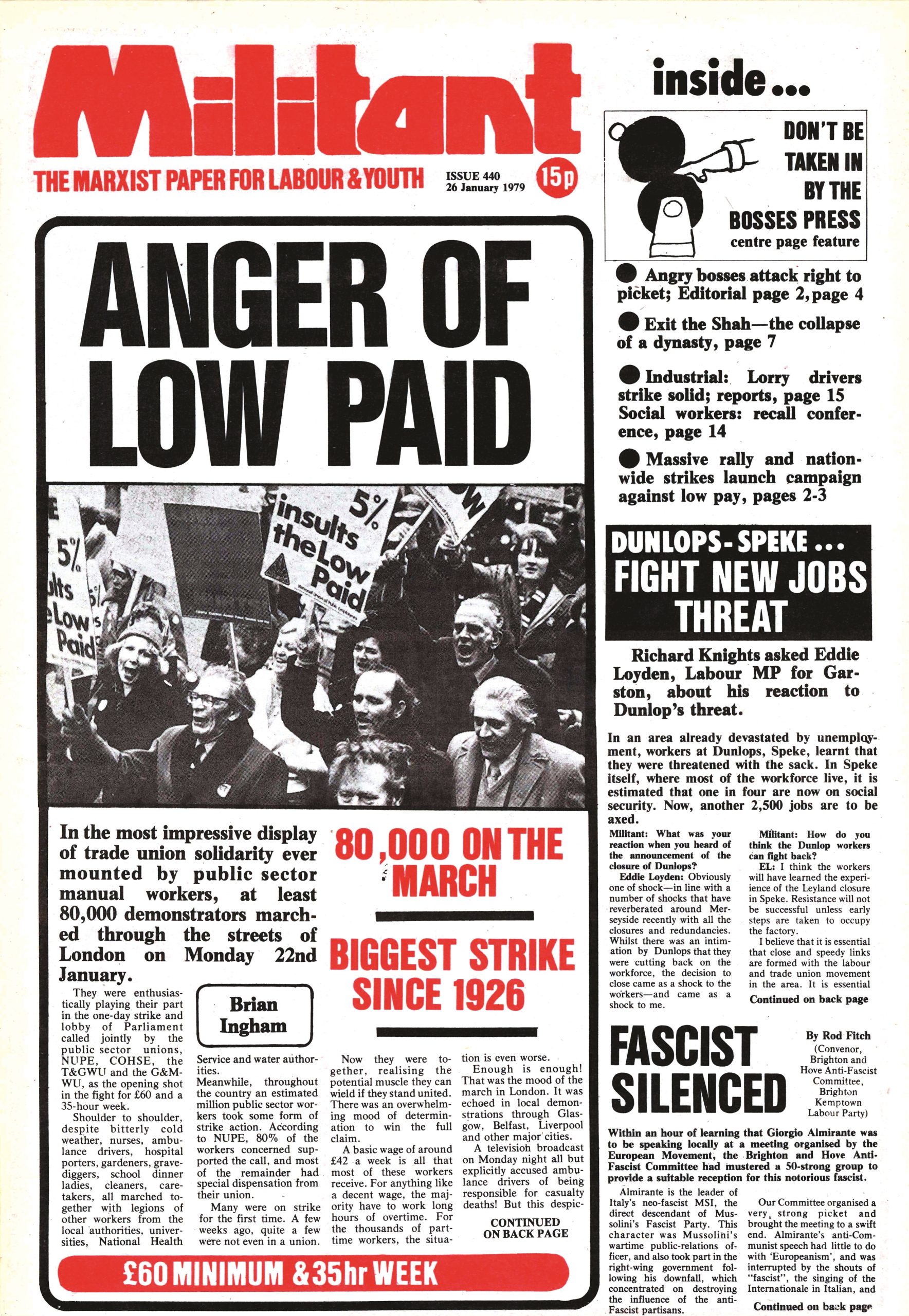
While most trade union leaders backed the Labour government, however anti-worker it had become, this wasn’t the attitude of many of their members. And some were prepared to act. A number of public sector unions called a demonstration and lobby of Parliament. Alan Fisher, General Secretary of the National Union of Public Employees, a predecessor of Unison, put his name to the front-page article of Militant that was sold at the demo, which was attended on a weekday by 60,000 workers!
And workers began to fight back against the limits on pay rises. There were already strikes of very low-paid workers taking place, most notably at the Grunwick photo processing plant in north west London. In the winter of 1977-78, the Fire Brigades Union went on strike to try to break the pay policy. By the Labour Party conference of October 1978, the line could not hold any more. Ford workers were striking to make up for lost spending power as the conference opposed the pay policy. This led to the 1978-79 ‘Winter of Discontent’ led by largely low-paid workers fighting for better pay. Workers showed that they could force their leaders to back their struggles and win.
Now, we have Chancellor John Healey preparing his Budget for 28 October. The financiers are circling, hoping that the government will cut public spending to soothe the markets and, at the same time, increase funding for war. This will only be at the expense of public services and their employees, as it was in 1976.
This time, however, the trade unions have already passed motions to fight austerity, including – two years running – for an anti-austerity demonstration. If the TUC General Council won’t lead, then a ‘coalition of those willing’ to defend their members and our services must act.
History is full of lessons for the working class, both in defeats and victories. What is unacceptable are leaders who do not learn from those lessons and repeat the same mistakes. We have no Social Contract but we still have leaders who fear opposing a Labour government will lead to the election of a right-wing government. But the alternative must be to fight industrially and politically, to give workers a socialist programme to fight around, which is the only real alternative to all the big business parties.
