


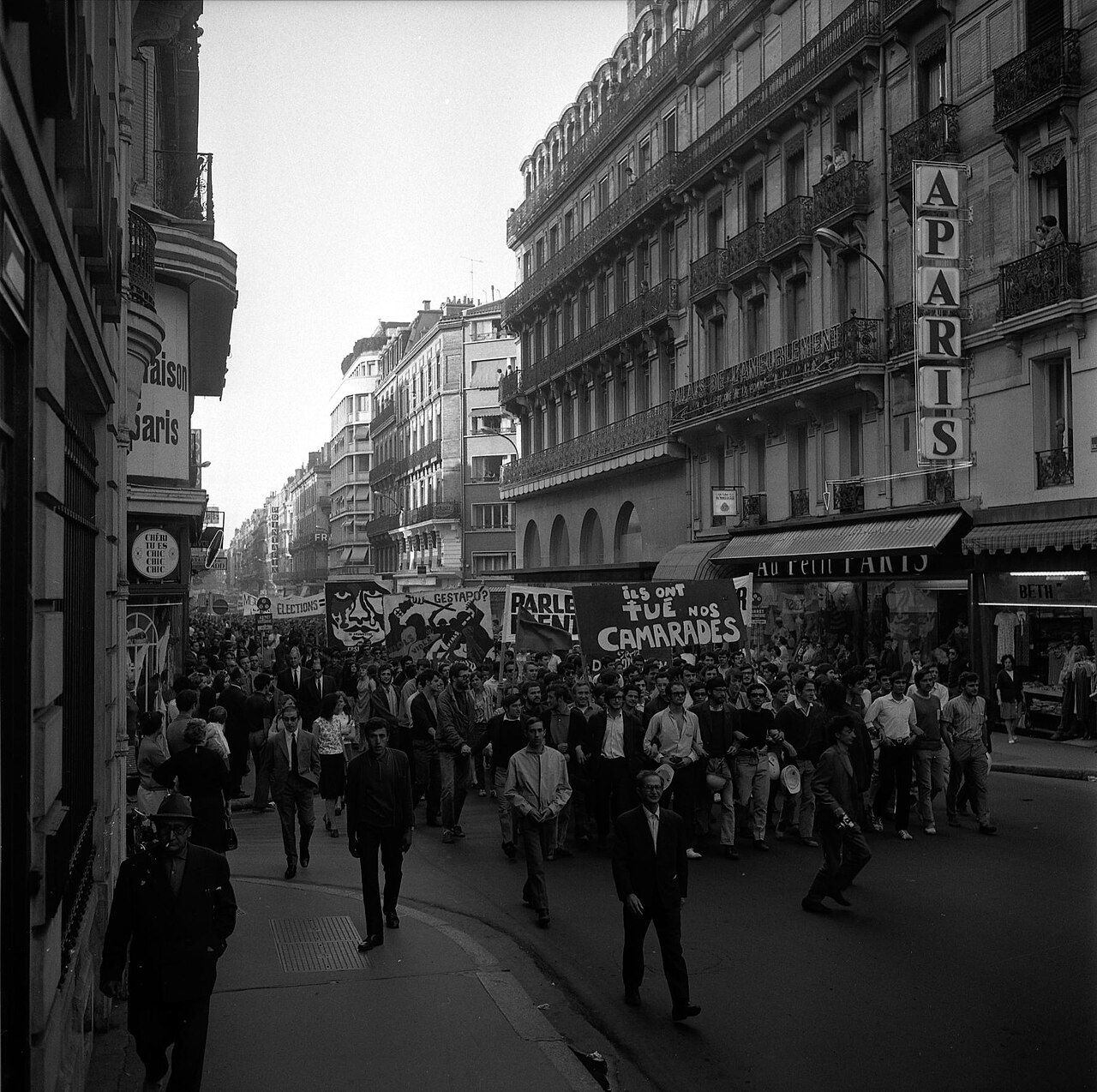
This article, written by Peter Taaffe as the revolutionary events unfolded in France, was initially published in Militant (predecessor of the Socialist) in June 1968.
One million workers out! Hundreds of factories occupied and controlled by the workers! Schools taken over by pupils and progressive staff! Capitalist newspaper lies ‘censored’ by printing workers! TV lies censored by reporters and technicians! Universities taken over! Docks, post offices, ships taken over – what a mighty demonstration of the invincible power of the working class when it begins to move! What a crushing blow to the cynics, sceptics and apologists for big-business, who have written off the working class as ‘apathetic’, ‘bought off’, etc – and to the professional orthodox economists none of whose arduous study of the complex mechanics of capitalist economics could enable them to discern the gigantic force beneath the surface of modern society: the creator of the new society to come, the working class. How clear it should be to even the most politically uneducated workers that their French brothers would be in power today, but for the cowardly policies of the French labour and trade union leaders!
The workers and the population of France were incensed by the brutality of the special police in their sadistic onslaught on the students. More particularly, they were impressed by the success of the students in gaining their immediate demands without delay, through their determination to act. The vast mass of students came out in a general strike throughout the country, protesting at the intolerable overcrowding, impossible working conditions (for example 2,000 English students to four professors), against the enormous failure rate (20%) and the numbers forced to leave before graduation (50% of the remainder), and against the lack of opportunities afterwards. The Daily Express reported that 80% of the population of Paris was for the students.
The industrial workers – and particularly the young ones – were emboldened by the success: “The students came first. They acted as a spark. They caused the government to yield, they gave us the feeling that we could go ahead”, said one of them to a Times reporter. Immediately the workers outpaced their union leaders and refused to restrict their struggle to a harmless one-day strike. They proved that they would tolerate their grievances no longer.
A gigantic wave swept from one end of France to the other. Not only the industrial workers but the bank employees, white-collar workers have responded to the call to strike. While only 10% were unionised, over 50% of the labour force is involved, which is incontestable proof of the revolutionary energy and determination that has been unleashed. As in all revolutions, from the cracks and depths of society the formerly politically backward workers, the sweated and impoverished, the demoralised and cynical, have been brought to their feet. The poor farmers have set up barricades around the city of Nantes and other cities “in support of the workers and students” (Times, 21 May 1968). Exemplary order is maintained and, as even the capitalist press has been forced to admit, the workers “check and grease factory machines that are lying idle”.
All the conditions for a successful overturn are there; the workers are determined to go the whole hog. The middle class, particularly its lower layers, look with profound sympathy on the strike wave and in many cases join in. On the ships “even the officers have joined the sit-ins begun by the crews” (Times, 23 May 1968).
A revolutionary situation
It is the working class which has the effective power in the factories, the ports, the mines and the streets. A classic revolutionary situation exists. Even the televising of the debate in the National Assembly was done only by the permission of the workers’ organisations, as a Gaullist MP was forced to admit. Those instruments of state repression which are still in the hands of the government, the police and the army, are completely unreliable.
The police themselves have been touched by the hot flares of revolt. Their union issued a warning to the government that “the police officers thoroughly appreciated the reasons which inspired the striking wage earners and deplored the fact that they could not by law take part in the same way in the present labour movement… the public authorities will not systematically set the police against the present labour struggles” (Times, 24 May 1968). In the event of a clash, many “serious matters of conscience” would arise, in other words, many sections, if not the majority, would go over to the workers. The army also would be split from top to bottom if the officer caste sought to intervene. This is shown by the comments of a national serviceman when he was “asked if he would fire on the students and workers and replied, ‘Never. I think their methods may be a bit rough but I am a worker’s son myself’” (Times, 21 May 1968). If ever there was a time when the working class could take power peacefully, that time is now.
In every shop, factory and workplace the workers’ councils would naturally be the dominant form of organisation. Established at local level they would come together also in the districts and eventually at national level. The organised sections would be drawn in until they embraced all the toilers; a parliament of the masses where their will and demands would be exercised; real democracy as opposed to the sham democracy of the jugglers in the National Assembly. Taking up the demands of the workers, the farmers, and the middle class it would be possible to tie them together, feeling the common need for a drastic change, the need for a socialist society. Once in power, the workers’ councils, where all officials would be elected and subject to recall, from being instruments of struggle for power would then become the organs of management and control by the masses themselves.
This is what the French working classes are groping for, as the strategists of capital so cunningly understand. The only thing that stands between them and extinction are the leaders of the mass organisations. They will try to use the prevarication and treachery of the Communist Party (PCF) leaders at a later stage, not only to discredit the latter but, with them, the ideas of Marxism in the eyes of the masses.
The leadership of the PCF and the CGT, along with the Catholic unions and the ‘socialist’ Force Ouvrière, refuse to carry through what the workers have begun: the seizure of power. Gratified, the Observer remarked, “the Communist unions and the Gaullist government they appear to be challenging are really on the same side of the barricades”.
At first the students came in for vicious attacks in the pages of L’Humanité, the PCF daily newspaper. Later the PCF leaders attempted to prevent all contact between students and workers. They attempted to restrict the movement against its very nature to purely ‘economic demands’ – as though these could be met for any length of time under capitalism! In spite of the utter ineffectualness of any opposition to the workers, they warned against ‘provoking the government’, causing bloodshed etc.
What alternative do the Communist Party put forward? Over the heads of the workers they are supposed to represent they have agreed, in private negotiations with big business, to send back the workers they never called out in the first place on certain compromise terms: terms which cannot be maintained under capitalism without causing inflation, crisis and unemployment.
The ‘Communist’ leaders put forward the idea of a Popular Front government. Far from being, as the PCF leaders claim, an “alliance with the middle class” it is in reality a bloc against them. By linking up with the leaders of the CFDT it is forming in reality a bloc with the political exploiters of the middle class who habitually sell out the interests of the small farmer, the shopkeeper, etc, to those of big capital. Only in action can these intermediate layers of society be torn away from allegiance to their traditional parties.
Programme
It is not in a Popular Front but in a United Front of struggle for power that these workers who retain allegiance to the other parties would be affected. If they agreed to a common struggle against capitalism, all the better; the Marxists would be able, in action, to demonstrate the superiority of their programme and methods.
Meanwhile the Popular Front will mean something different to the bosses. They will use the time to prepare the forces of reaction: the disillusioned poor farmers, students and middle class who will suffer from the inevitable devastating inflation and run-down in the economy. These sections will come to the conclusion that the working class has let them down and they will rally to any pseudo-radical force that seems to offer actions and an actual alternative. This is the basis of ultra-reaction. They are only able to do this because of the pusillanimity of the official labour leaders.
For the time being, they are prepared to eat into the enormous reserves they have piled up over the last ten years. Not the least of the effects of such a deal will be the undermining of the competitive position of French capitalism in the world market. What the bosses will be forced to give with the left hand – and they will have to do this or face the possibility of explosions which, despite the PCF’s role, could end their days – they will attempt to take back with the right hand tomorrow. Resulting inflation will be used in order to inflame the middle classes against the ‘excesses’ of the workers.
Vague promises of ‘participation’ will not, as all the capitalist commentators agree, satisfy the French workers. One thing is certain: the Gaullist ‘invincible’ regime is finished. Whenever its demise comes, within weeks or months, its position has been irretrievably damaged. The French workers will not only have succeeded in bringing about its downfall, but also in beginning to undermine all the honeycombed theories of ‘social peace’ which have proliferated in the Western labour movement in the last twenty years.
Not by accident did the Times mournfully comment: “When Louis Philippe was driven from his throne in 1848 after a few brisk days of rioting in Paris and took refuge in London, there were revolutions all over Europe. Italy, West Germany, Belgium and Spain are in trouble enough without the Mother of Revolutions once again setting a bad example” (22 May 1968). How well do the ideologues of capitalism, with devastating realism, understand the threat that faces them! And how timid and treacherous do the labour leaders’ vague and pious hopes sound in comparison! The diseased state of British capitalism too is preparing an explosion. The traditional parties in all the countries of Europe will be shaken from top to bottom.
Even if the PCF manages to sell the deal with De Gaulle to its own rank and file, this will not be without internal rumblings. No longer do the PCF leaders exercise the mesmeric effect or hold the fanatical devotion of the rank and file as in the 1930s. Already this is reflected in the resignation from the CGT of one of its leaders, a prominent PCF member, because he considers that the CGT is “not taking full advantage of the situation to overthrow the Gaullist regime”. In the event of a Popular Front, the PCF will precipitate a massive movement of opposition which could end in a split with the majority going over to the genuine programme of Marxism. The enormous sense of power, the gigantic steps forward in understanding, the combativity and ability to fight of many workers who have viewed politics as the preserve of lawyers and doctors in the past, will still be there. The French workers have unleashed a force that will yet end the rule of rent, interest and profit in Europe and throughout the world.
- Socialism Today issue 118 – May 68 special1968 – year of revolution at leftbooks.co.uk
May 1968: the main events
- Thursday 2 May: Six students appear in court. Nanterre University closed in protest. French Communist Party (PCF) denounces students.
- Friday 3 May: Police attack peaceful demonstration at Sorbonne, 596 arrested. University Teachers’ Union (SNE.Sup) calls a strike.
- Sunday 5 May: University strike spreads. Seven students are fined and imprisoned. Demonstrations in Paris are banned.
- Monday 6 May: The first university occupations start. Sixty thousand demonstrators are attacked by riot police, 739 are hospitalised. The first barricades since 1944 are set up.
- Tuesday 7 May: Young workers join the demonstrations. Strike at Sud Aviation against redundancies. Post office workers strike for higher wages. Students appeal for support from the factories.
- Friday 10 May: Latin quarter occupied and barricaded. police sent in with tear gas in the middle of the night.
- Saturday 11 May: The PCF-led trade union federation, the CGT, together with the ex-Catholic union federation, the CFDT, the Teachers’ Federation and the left parties call a 24-hour general strike for the following Monday.
- Monday 13 May: 24-hour general strike with mass demonstrations of 50,000 in Marseille, 40,000 in Toulouse, a million in Paris.
- Tuesday 14 May: Workers occupy Sud Aviation, Nantes, locking the director in his office and appealing for solidarity.
- Sunday 19 May: Two million now on strike, including banks, all transport, nationalised industries, and the metal industry.
- Monday 20 May: Six million on strike, including Michelin, Peugeot, Citroën, department stores, all ports and mines.
- Tuesday 21 May: Eight million on strike, over half of the French labour force.
- Friday 24 May: Ten million on strike.
- Saturday 25 May: Talks begin between the government, employers and trade union leaders.
- Monday 27 May: Workers’ mass meetings reject offers.
- Wednesday 29 May: CGT demonstration 500,000-strong. De Gaulle leaves Paris saying, ‘The game is up’.
- Thursday 30 May: De Gaulle returns having been assured of support from General Massu, commander of 70,000 French troops based in Germany. Dissolves National Assembly, announces new elections and launches smear campaign against the ‘threat of totalitarian dictatorship’. Tank and troop movements begin around Paris and right-wing demonstration attracts one million.
- Friday 31 May: Negotiations resume everywhere and, not without victimisation, a gradual return to work begins, encouraged by the PCF.
