

Militant Left (CWI Ireland)
“We’re in a different country now than we were on 13 October”. This comment from a leading trade unionist and Militant Left member sums up the seismic impact of the public sector general strike in the Irish republic on 14 October.
It has indeed changed everything. For the well over 300,000 trade unionists that took part in the action, it was a day that will never be forgotten. For the first time in 17 years, workers in Ireland took part in a mass strike that completely shut schools, colleges, universities, hospitals (apart from agreed emergency cover), all council and civil services. Indeed, it was the biggest mobilisation of working-class power seen in the state since 1979-80.
As soon as the clock ticked past midnight on Wednesday 14 October, pickets began to be formed at Dublin Port and some council departments. By 8am, tens of thousands of trade unionists had amassed outside their workplaces across the country. Union placards, flags and banners were to be seen everywhere.
In most cases, pickets were in place until 4pm. The more than 20 trade unions who were striking together had done a great job of ensuring the rosters were filled. As a Militant Left member from Cork explained: “The strike was solid and impressively organised. By 8am there were already hundreds of pickets outside the main hospital from across all the different unions. The same was repeated in dozens of picket lines across the city. Everyone seemed to have volunteered for a shift on the roster, meaning the pickets stayed solid all day walking with placards up and down the pavement back and forth past their gates, with cars tooting their support all day too.”
An outlet for massive anger
Yes, this strike was primarily about pay, and the demand for inflation-busting rises after years of effective pay cuts when taking account of inflation. But it was also an outlet for the massive anger at the out-of-touch political establishment, and a society that has seen huge profits for multinational companies and the super-rich at the expense of ordinary working-class people.
Time and again, striking workers told Militant Left members, that they had waited for this opportunity for a long time, too long. The majority were taking strike action for the first time ever.
Ciarán McKenna, a SIPTU NEC and Militant Left member, said the day after: “Yesterday was a momentous day to be a trade unionist. It was a privilege to take part in strike action to defend the living standards of public sector workers… In our SIPTU section there has been zero, and I really mean ‘zero’, pushback against taking strike action. Instead, there is a huge and palpable determination to fight this for as long as it takes.”
The mass strike involved public sector workers, yet it was a strike for all workers. And was treated as such by the enormous enthusiasm garnered from the wider working class.
The arrogance of the government, who had let the previous public sector deal come to an end in June with nothing to put in its place, was exposed for all to see.
By the end of August and early September, trade unions were announcing unprecedented support for strike action. SIPTU and Fórsa members – the two largest unions in Ireland – voted by a huge 97% to strike. INMO, the biggest health workers’ union, voted by an incredible 99% to strike. The largest teachers’ union returned a 95% vote for action. And so it went on.
Decades of partnership working between unions, employers and the government was suspended in mid-air.
The action began with a work to rule from 30 September. The government twiddled its thumbs, perhaps naively concluding that the trade union leaders would find a way to call off the national action and enter talks. They could not have been more wrong. A power had been unleashed, not only against the government, but also applying enormous pressure on the tops of the trade unions as well.
Too little, too late, the bosses’ coalition government of Fianna Fáil/Fine Gael realised that the action would go ahead. On the eve of the strike the minister pleaded with the unions to call it off. “Pay will be top of the agenda” in any talks, he promised.
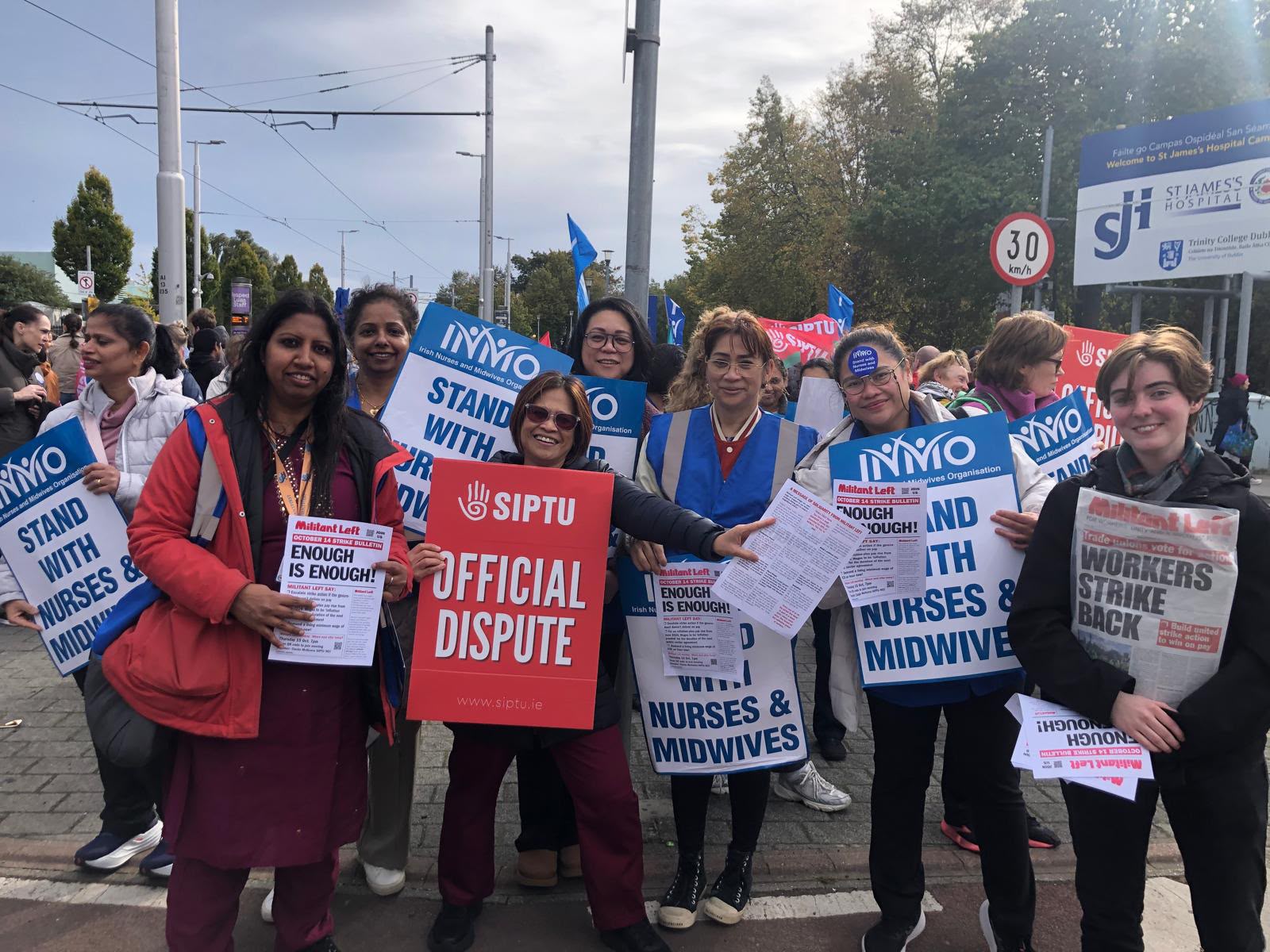
These and other ideas were among the central messages that Militant Left took to scores of picket lines across the country. The headline of our strike bulletin was ‘Enough is Enough!’ And it summed up the mood of the vast majority that we spoke to.
‘We visited 150 picket lines’
Militant Left members visited over 150 picket lines, including in Letterkenny, Cork City, Drogheda, Dundalk, Dublin City, Tallaght, Balbriggan, Swords, Ballymun, Sligo, Manorhamilton, Monaghan and beyond.
We not only brought our solidarity, but we also raised the need for the trade union movement to build its own political voice in the form of a mass working-class party, and for a socialist society to replace rotting capitalism.
We distributed over 4,000 copies of our strike bulletin. Militant Left members also played a key role in helping to mobilise a NIPSA trade union delegation from the North, which brought solidarity greetings.
The trade union movement and the working class is a mighty force. Wednesday 14 October proved that beyond any doubt. A turning point has been reached. And alongside workers and young people in France, Spain, Belgium, Italy and across Europe, a new power is standing tall.
- Since the publication of this article, public sector unions have suspended the planned strike action on 21 October following discussions with the government
Eyewitness reports from Socialist Party members who took part in Militant Left’s intervention:
A group of striking nurses and midwives at St James’s Hospital today took our leaflets enthusiastically and were chatting with us. Then they started chanting “Enough is enough – we want fair pay”, borrowing the first part directly from our leaflet which they were holding. We decided to walk between the first and second picket lines we had aimed to visit, and came across picket lines on the corner of just about every road we walked down and every major building we walked past!
Hannah Ponting
We went over to Cork. I’ve never seen anything like it! The power of the working class was on display. At the first picket we visited there were 450 people outside the hospital. Different trade unions representing the different workers but they had all merged together. It felt like the whole public was onside. If anything, the constant sound of car horns in support was annoying! Any attempts from the bosses at divide and rule don’t seem to have worked.
Colin Wray
It was early morning in south Dublin and the picket lines were out. Teachers, civil servants and museum staff all struck together. We leafleted over twenty of their picket lines. At every one there was a real sense of solidarity between the different unions. Workers marched up and down the streets chanting. They moved from one picket line to the next, signs held high, sharing tea and home baking along the way. I’m hopeful the Irish workers will win their dispute. And that it’s a sign of the struggles to come across the water in Britain!
Alex Gerroll
