


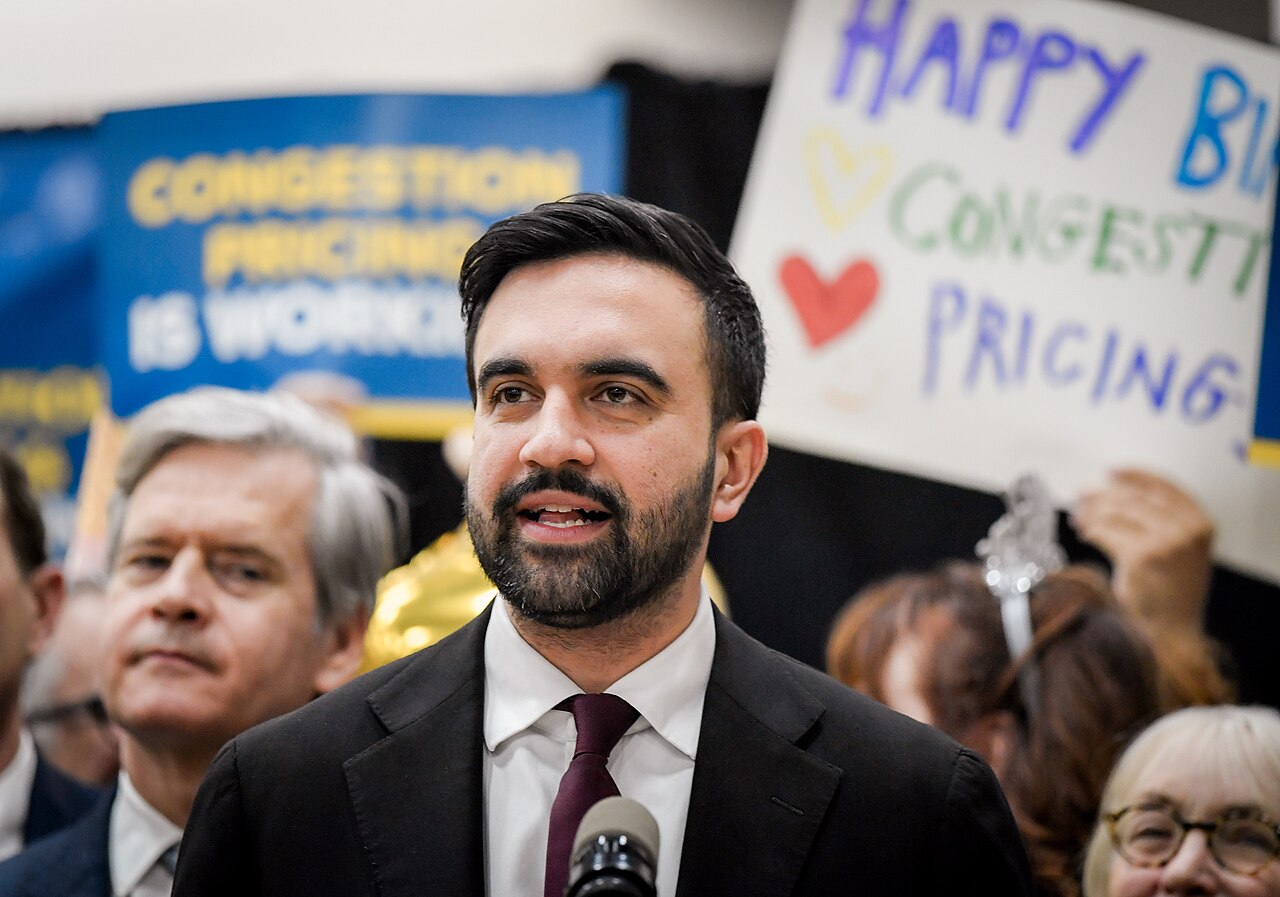
On 4 November it will be one year since self-described ‘democratic socialist’ Zohran Mamdani won election as New York Mayor. A year on, voters will head to the polls across the US for the mid-terms. Tessa Warrington, Socialist Party membership organiser, looks at Mamdani’s time in office so far.
On 1 January this year, Zohran Mamdani was sworn in as mayor of New York City (NYC). A member of the Democratic Socialists of America (DSA), Mamdani’s landmark election victory was heard by workers and youth around the world looking for an alternative to the grinding conditions of capitalism. Running on a platform pledging rent freezes, universal free childcare and a free public bus system, his ‘affordability agenda’ aimed at tackling the deep cost-of-living crisis faced by workers in NYC. Now, over nine months on, and with the DSA winning a wave of election victories in the Democratic Party primaries, what can socialists learn from Mamdani’s mayorship?
NYC may not be the capital, but it is the financial heart of the US. With a whopping 164 billionaires, the city boasts not just the largest number for one city, but more than any country in the world, other than China and Germany. The wealth gap is staggering – and it’s growing. Between 2019 and 2024, the top 50 ultra-wealthy families saw their average annual income swell from $315 million to nearly $600 million. The remaining 90% of the population saw median household income drop by 3.2%, as it failed to match inflation. 1 in 4 New Yorkers now live below the federal poverty line, with 69% of children living in financially insecure environments.
Public services have been systematically hollowed out and underfunded over decades and are at breaking point, heaping further insecurity and instability on working families and communities. The average renter is forced to spend 70% of their annual income purely on housing. All of this formed the backdrop to the success of Mamdani’s call for ‘A New York You Can Afford’.
Popular programme
Over 100,000 New Yorkers volunteered to go out and campaign for a self-described socialist mayor, knocking on 3.1 million doors and making 4.6 million phone calls. They raised $3 million in donations, with the average amount being $77, from primarily working and middle-class households. At the same time, over 26 billionaires poured more than $22 million into anti-Mamdani groups, propping up his opponents whilst giving the appearance of them lagging behind in direct donations.
Mamdani’s election showed two things; the unifying popularity of a programme of working-class reforms, and the pole of attraction such a campaign can provide workers and youth to organise around. 60,000 voters who previously backed Donald Trump in 2024 and 70,000 who skipped the 2024 presidential election voted for Mamdani. He also won 78% of the votes from among people under 30. Working-class New Yorkers wanted change and were willing to fight for it.
Since becoming mayor, Mamdani has delivered on a number of his promises. He’s brought in a two-year rent freeze on 40% of NYC apartments and introduced a ‘pied-à-terre’ tax on second homes valued above $5 million of those living outside New York. He’s launched his 2K expansion of free childcare as well as starting the process of setting up a number of city-owned grocery stores, and introduced the Mayor’s office of ‘Worker Power’, a department aimed at encouraging union organising and pursuing resolutions to the violation of labor laws.
However, this has not been met without resistance from New York’s elite. A coalition of prominent New York homeowners has filed a lawsuit seeking to overturn the second-home tax, and a coalition of real estate and landlord associations has filed a suit trying to block the rent freeze. The Multicultural Business Coalition, representing small, independent, and minority-owned supermarkets, has filed two lawsuits attempting to squash the existence of a single affordable public grocery store on the basis of unfair competition!
The roll-out of universal free childcare has also been plagued with an ongoing payment crisis. Some providers are owed months of funding and others are on the brink of closing. Educators have resorted to taking out personal loans or dipping into their savings to prepare for the new intake of children. This is a result of expanding the programme without addressing the underlying problems of chronic staffing shortages in public departments, a hangover from decades of underfunding.
While Mamdani’s rent freeze has been attacked by landlords, a layer of real estate developers welcome his moves to allow private housing developments on public land. Including for Sunnyside Yard in Queens – a development long opposed by tenant organisations and community activists.
The pledge to abolish bus fares on city transport has been dramatically scaled back, and Mamdani has resorted to cutting $30 million from public libraries, to which he had committed increased funding. The reality is that, even to meet the basic needs of New Yorkers, Mamdani’s programme would have to go much further.
Whereas Mamdani and the DSA turned outwards and mobilised working-class communities at election time, their approach when it comes to delivering their policies has been rooted in the backroom deal-making of establishment politics. This includes having a public buddy-buddy meeting with Donald Trump and conceding on keeping in position billionaire heiress and establishment darling NYPD commissioner Jessica Tisch.
Role of the working class
Identifying the role of the working class organised in mass campaigns, particularly through the trade unions, as being the pressure that forces the ruling class to make concessions, offers the working class a way to see itself as the agent of societal change. But that kind of struggle is also what is needed to win and defend immediate gains in the first place. How does Mamdani propose to fight the bosses’ litigious counteroffensive? The courts and legal system have evolved primarily to defend the rights of property owners and as such guarantee no protection for working-class reforms. The new office of ‘Worker Power’ doesn’t unionise workers in the public sector because, according to the mayor’s office, it presents a ‘conflict of interests’. This approach is shown by Mamdani’s office suing against the unionised paraprofessionals in education’s pay rise. Organised, combative public sector unions coming out on strike in defence of the progressive aspects of Mamdani’s programme would be a hugely powerful tool to back a socialist mayor under attack.
At the same time, workers can see the blatant attacks to overrule a democratically mandated programme, and it is possible workers can mobilise in defence of Mamdani in the future. The affordability agenda has raised hopes and set people’s sights on what they actually need, not what crumbs the super-rich will allow them to have. But the platform and reach of an elected socialist mayor in NYC offers a massive opportunity to organise and lead the working class in struggle – not just in New York but across the United States.
In Liverpool in the 1980s, the Militant-led (forerunner to the Socialist Party) Labour city council did just that. It led the city’s working class, including council workers, in a battle against Margaret Thatcher, bringing hundreds of thousands of people out onto the streets in support of the council’s programme of demands. 5,000 council homes were built, thousands of jobs and apprenticeships created and £30 million clawed back from the Iron Lady – the equivalent of over £90 million in today’s money. It also called on other Labour councils to follow suit and build a united struggle against the Thatcher government.
This victory wasn’t achieved on behalf of the working class but through it. Militant members fought and won support for a programme of fighting cuts through the democratic structures of Liverpool’s District Labour Party (DLP). This body had over 400 delegates elected from the city’s trade unions and Constituency Labour Parties (CLPs), providing a forum for workers to debate and decide on strategy and policy, directing the Council on what to do. The deep democratic roots in the labour movement allowed pressure to be exerted on councillors from below to act in working class interests but also meant the Council could call on organised workers to mobilise and back the Council in defence of its programme. In NYC Mamdani should call a conference of trade unionists, activists and youth to discuss the way forward, including the setting up of branches across New York with delegate structures from unions and communities to allow the working class a means to make decisions and take action collectively.
The question of Mamdani implementing his programme immediately raises the need for the fight to spread beyond New York. The mobilisation of mass struggles to fight to defend and implement reforms in NYC would inspire struggles nationwide, and would even more sharply pose the need for a party of the working class, one which presents an alternative to the continued rule of the capitalists – not just in NYC but across the US.
USA’s ‘left surge’
The mood to fight is clearly present in NYC and more broadly throughout America. The success of Mamdani’s election campaign has been influential in the ‘left surge’ of hundreds of thousands attending Alexandria Ocasio-Cortez and Bernie Sanders’ ‘Fighting Oligarchy’ rallies. This is also a direct response to the situation in the US; of ailing US imperialism and its expression in the form of Donald Trump. His arrogance in the ongoing conflict with Iran, killing thousands and triggering a global rise in oil prices. Attacks on democracy with the banning of media from the White House and installation of propaganda machine ‘Trump TV’. The vicious state attacks on migrants through ICE agents, murdering civilians and meeting fierce working-class opposition in Minneapolis. Most recently this includes the shooting of a man in NYC as his five-year-old son sat in the car beside him, causing hundreds to take to the streets in protest chanting “ICE off our streets” and “No justice, no peace”. Mamdani backed the protests, and among them was Mamdani-backed DSA member Darializa Avila Chevalier, who won the Democratic primary to stand for New York’s 13th Congressional District in the mid-terms. Demonstrators were attacked by NYPD, part of the city administration, showing the contradictions
A significant factor in Mamdani’s election was his open opposition to the genocide of the Palestinian people. Media coverage reports him being asked more questions during the election campaign about Israel’s right to exist than about taxation. The corporate media had no confidence to debate Mamdani’s economic programme given the dire conditions workers face, instead weaponising fears of antisemitism in an attempt to stir up division.
They grossly misjudged the mood. The savagery of the attacks on Gaza – supported by Trump, the same capitalist politician attacking workers in the US – has seen a mood of mass opposition develop from below. During his election campaign, Mamdani made noises about arresting Israeli prime minister Benjamin Netanyahu should he visit New York. However, when Netanyahu addressed the UN General Assembly in NYC, Mamdani’s office missed the opportunity to itself mobilise protests. In the event, it was over 100 demonstrators who were the ones arrested by Tisch’s NYPD.
The DSA and the Democrats
The urgent need for a far-reaching, systemic, socialist alternative to decaying capitalism will be plain to many and the search for that alternative is shown in the wave of people looking towards the DSA. However, the Democratic Party, within which the DSA organises, is an out-and-out pro-capitalist party, with a legacy of attacking workers and using undemocratic means to block candidates which can act as a conduit for workers’ anger.
Bernie Sanders lost out on the 2016 Democratic Party presidential nomination to Hilary Clinton due to a rigged selection process, for example. Then, activists in the CWI called on Sanders to stand as an independent. It is vital that we fight for independent working-class political representation, for a socialist alternative to the representatives of capitalism at the ballot box. Without an alternative on offer in 2016, anger at establishment politicians was articulated through over 1.5 million people transferring their vote from Sanders to Trump.
Ultimately, operating within the constraints of a capitalist party is bound to hinder the efforts of socialists to organise effectively. There is a need for the trade unions, for fighting workers and young people in the US to build an independent genuinely democratic mass party. Such a party, rooted in the organised labor movement, would provide a vehicle through which workers in the US could discuss and debate out a programme that meets their needs and the collective action required to achieve it. In that process, socialists would energetically intervene, fighting for a programme based on nationalising the commanding heights of the US economy, including the banks, under democratic workers’ control and management. On that basis, a socialist plan could be developed to use the country’s wealth and resources to meet the needs of the people, not the profiteers.
This is a step that workers the world over are reaching towards and would form the basis for an international struggle for socialism. Developments in the US along these lines would play an inspirational role, concretising this task in the minds of workers everywhere.
