


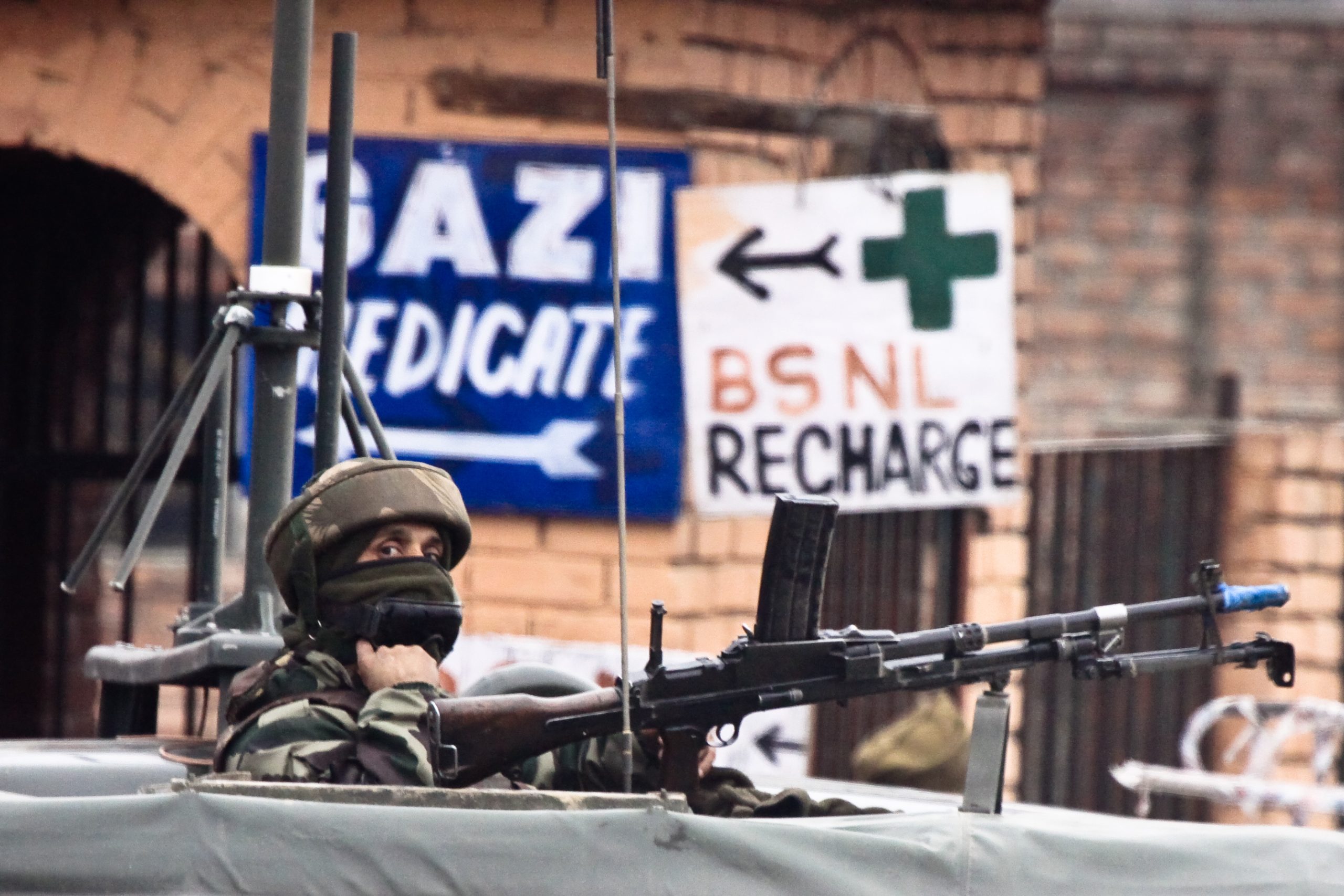
A ceasefire was agreed between India and Pakistan on 10 May. We print a leaflet distributed by Socialist Party and CWI activists at a Kashmir solidarity protest taking place in London, before the ceasefire was announced.
Tensions between two nuclear-armed powers – India and Pakistan – are rising, risking an escalation to all-out war. The conflict threatens the lives and livelihoods of ordinary people in the Jammu and Kashmir regions. There has been heavy shelling on both sides of the border, air strikes, as well as military and civilian casualties.
The recent tensions were provoked by an attack on tourists in the Kashmir region on 23 April. Various armed groups opposing Indian rule have operated in Indian-occupied Kashmir for decades, mostly targeting Indian authorities. However, an attack on civilians of this nature was unprecedented.
Indian government agencies claim that the attack was carried out by the Pakistan-sponsored group The Resistance Front. Pakistan’s Foreign Ministry, on the other hand, denied the existence of such an organisation, or of others named by Indian authorities, claiming they are fabrications.
There is a long history of claims, counterclaims, false propaganda, and disinformation between the two states, particularly concerning the occupied Jammu and Kashmir region. Pakistan claims to possess conclusive evidence that India is supporting terrorist organisations within Pakistan. In turn, India accuses Pakistan of sponsoring terrorism in Kashmir.
Grievances and dire conditions faced by oppressed communities in this region – as well as in other impoverished areas – are exploited by regional states and international powers to organise militant groups and foster terrorism for their own strategic interests. The horrific levels of repression by Indian authorities in Indian-occupied Kashmir have created fertile ground for terrorism and violence.
In 2019, after the Modi regime abolished Jammu and Kashmir’s autonomy and made them central government-run ‘union territories’, a complete lockdown was imposed on the region. A strict curfew was implemented, with orders to shoot on sight. Over 4,000 politicians and leading activists were imprisoned. This lockdown was followed by a full-scale military occupation of major government buildings and streets. Tens of thousands of military and paramilitary personnel were deployed.
The anti-Muslim propaganda of India’s Modi government has provided an opportunity for the Pakistani government to portray Modi’s India as “anti-Muslim” and to whip up patriotic support for itself. But the current Pakistani government is among the most brutal towards its own population and is also the weakest in Pakistan’s history. Scandals and blatant corruption involving previous prime ministers have led to repeated elections and constant political manoeuvring among the elite for power.
Shehbaz Sharif’s appointment as Prime Minister was the result of opportunistic manoeuvring and the formation of a weak coalition of major parties united against Imran Khan’s PTI, the former governing party. PTI’s strong ‘anti-corruption’ rhetoric has helped it gain significant support from urban youth and the rural poor. The struggle for power led to intense repression of PTI members and other opposition forces. Khan was imprisoned, other activists have been jailed or banned from political activity.
Corruption among the political elites in both India and Pakistan is rampant. Both governments have implemented policies that have devastated the lives of workers, peasants, and the poor. They frequently hide behind patriotic rhetoric and claims of ‘defending the nation’ to rally the very masses they continue to exploit. The Kashmir conflict has consistently been used to consolidate power and build support, particularly during times of domestic weakness and widespread opposition.
Pakistan’s extremely fragile government is using the possibility of conflict and war at its borders to tighten its grip on power.
The Pakistani military – which effectively controls the government – is currently no match for India’s military. The balance that existed during previous conflicts in terms of economic and military capabilities no longer holds.
The fast-changing global geopolitical landscape following Trump’s election in the US has created new complications for Pakistan, unlike in the past when the US fully backed its military and provided substantial subsidies. However, the broader geopolitical dynamics in Asia and South Asia are now dominated by Indo-China relations. The Chinese government’s decision to strengthen its support for Pakistan has further added to these complications.
Conflicts and clashes have become a global norm. Wars and unrest are taking place across Africa, the ongoing war in Ukraine continues, Palestinians face a genocidal assault, there is a looming threat of war or a possible attack on the Iranian regime, and tensions over Taiwan continue to escalate. All of this contributes to global instability. Trump’s trade war is only deepening global polarisation.
However, the so-called ‘Shah/Modi method’ of inciting ethnic riots could provoke divisions and escalate reactionary violence. A united struggle against the Indian regime, while also standing firmly against the repressive Pakistani state and other capitalist vultures, is essential to secure rights and dignity for all people in the region.
Appeals must be made to the workers and toiling masses across India to unite in a common struggle against the repressive regime and in defence of democratic rights, including the right of self-determination for Kashmir and the national rights of all minority communities.
Workers and oppressed people in Kashmir, Assam, and other parts of India, Pakistan, and China have more in common with each other than they do with their own capitalist rulers. It is through united struggle that a real challenge can be mounted against regimes that today may seem unchangeable and all-powerful.
A united mass movement can begin to counter and defeat the reactionary ideas that have taken hold among sections of the population. It would also raise the question of how resources in the region should be shared – among the people living there rather than being plundered by capitalist vultures. A socialist Kashmir, as part of a voluntary socialist confederation of nations in the region, would make sure that all cultural, language and national rights are safeguarded and resources can be planned and shared for the benefit of all.
Unless capitalist rule is collectively challenged, such a unifying force cannot be built. That is why the Committee for a Workers’ International (CWI) argues for the need to build a socialist alternative in all parts of Jammu and Kashmir and beyond, and to link these struggles together to put an end to the suffering and exploitation that capitalism imposes on the masses.
CWI demands
- Immediate end to all attacks!
- End occupation – withdraw all army and paramilitary forces from the region
- Stop repression – release all political activists and protesters
- No trust in the corrupt capitalist rulers – build mass organisations of workers and the poor
- For the right to self-determination for Kashmir
- For a socialist Kashmir as part of a socialist confederation of the sub-continent
- Read the article in full, ‘War Looms Over Kashmir’ by Tu Senan, published online socialistworld.net on 1 May