


Ellen Kenyon Peers, Waltham Forest Socialist Party
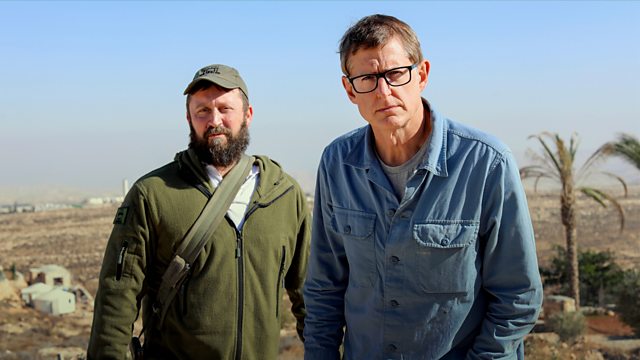
Horse-wrangler Malkiel Bar Hai lives in a dilapidated trailer and tarp-covered shack with his wife and eight children. Setting the tone for his latest documentary about the Jewish-Israeli settler movement, Louis Theroux gently presses Malkiel’s wife on her desire to live here, in abject poverty, in the desert. She talks about this place, ‘Judea’, which was ‘promised to the Jews’ as the camera pans over their chaotic, cramped home in the occupied West Bank. The appeal of cheap housing is often overlooked by those trying to unpick the hows and whys of the bloody conflict in the Middle East. Israel has the highest cost of living of all OECD countries, with the minimum wage equating to £1,300 per month and the average four-bed flat valued at over £1 million.
In another scene, Louis meets Issa Amro, a Palestinian activist who was born and lives in Hebron, which Louis notes he first visited in 2010. The occupied areas have grown in the intervening 14 years, leading to the extreme curtailment of free movement for the city’s remaining Palestinian population. In one clip, an occupation soldier forbids Issa from proceeding further down the street. There is no explanation as to why.
Issa has to circumnavigate a further two checkpoints in order to return to his own home. The street he is now forbidden from walking, in his own city, is webbed by strings of Israel flags and anti-Arab propaganda, including racist stickers which conflate all Arabs with terrorism and advise, in Hebrew, against their employment. These litter the ancient architecture of what Issa describes as a once-busy Palestinian marketplace, where he held his father’s hand tightly for fear of being lost in the crowd.
In perhaps one of the most enlightening moments of the film, checkpoint guards emerge in balaclavas and greet Issa by name; sarcastically enquiring as to his health whilst squaring him up. If they were not obviously armed, it would be recognisable as the thuggish behaviour of teenage boys. It is important to note that the Israeli occupation forces are stuffed-full of school leavers who, at 18, are compelled to complete military service unless they have a medical or religious exemption. Historically, these exemptions have also stoked the flames of the secular-religious divide in Israel, an area where The Settlers falls short.
Theroux’s superficial interrogation of the Settler mindset ends up propagating the rhetoric that it is only those from ultra-orthodox sects that seek to occupy land, aided by far-right campaigners. The belief in Jewish-Israeli superiority extends far beyond a particular religious sect and has been perpetuated by organisations across Israel’s political spectrum, legitimised by a very real fear of antisemitism which spans centuries.
Theroux’s signature style of interviewing, just a notch above fly-on-the-wall, is no match for Daniella Weiss, the so-called ‘godmother of the settler movement’, who is clearly media trained and dances easily around Louis’s liberal line of questioning. Happy to provide vox pops to local news crews regarding her vision – “Arabs disappear from Gaza (…) lose their right to live in this holy place” – Weiss takes obvious pleasure in the controversy of her views. Speaking from the kitchen table of a large house in the long-settled Kedumim, the contrast is sharp between her own surroundings and those of the dishevelled shacks inhabited by recent settlers.
There are rare moments of humility too. For example, as an olive farmer is harassed by occupation forces, Israeli peace activists help him to gather his meagre harvest. Fearing for his safety, he leaves on their instruction. Subsequent to a superfluous passport check – one of many that punctuate the film – Theroux questions the soldiers as to how the situation might have progressed had the farmer not acquiesced and fled? Gun at hip, one responds that he is “glad it didn’t get to that part”, the shame apparent in his troubled expression. Fear, substantiated or not, rules the lives of all.
In my opinion, Theroux’s exploration of the Settler phenomenon is a little surface level, a little safe. It is easy to document the extremes of one such society, so viewers might recoil in horror, comforted by our separation. But look carefully and you can see evidence of the complexities and contradictions in Israeli society, including deep inequality and poverty within both the Israeli and Palestinian populations, which only a struggle for socialist change in the region can address.
