


Helen Pattison, Socialist Party Executive Committee
On 1 April 2025, a government press release stated: “Payslip boost for millions as new minimum wage rates take effect”. It’s not as if the Low Pay Commission, an ‘independent advisor body’ to the government, doesn’t suggest a small increase to the minimum wage every year.
In fact, if it wasn’t on the government website, you might have thought it was an April fool. Especially as the business secretary Jonathan Reynolds also commented: “We promised to make low pay a thing of the past”.
2.7 million claimants of Universal Credit are in work, and still rely on that extra support to get by. Even this latest increase of the minimum wage to £12.21 an hour for people over the age of 25 won’t change the daily struggle people experience. Misnamed the ‘National Living Wage’, it leaves single individuals about £4,000 short each year on what the Living Wage Foundation calculates is needed to live. A couple with two children, both working on the minimum wage, will be about £14,000 short. Around 68% of Universal Credit recipients who were in work went without essentials such as toiletries and prescriptions in a six-month period in 2024. Millions use food banks despite being in work.
The recent increase to the minimum wage has not changed this dire picture. Of course, the low pay facing many isn’t just a reflection of Britain’s economic weakness, or the historically low productivity growth in industry, either in services or distribution. Since the 1980s, wealth inequality has been on the increase.
Rich keep getting richer
The share of the wealth owned by the top 0.1% doubled from 1984 to 2013, reaching 9%. In 2013 the wealthiest 1% owned £3,315 billion, by 2019 that had increased to £4,682 billion. During those decades, the British economy has been through both growth and recession – but the rich keep getting richer while increasing numbers are forced to scrape by on low pay.
When the minimum wage was first introduced in 1999 the number of people paid at that level was only about 500,000, but that number has been increasing. In 2001 around 2% of workers earned the minimum wage. While figures vary, today it is closer to 6.5%, with around 15.7% earning the real living wage – of £12.60 nationally and £13.85 in London – or below.
The workers’ and trade union movement now has to ask how can low pay be challenged?
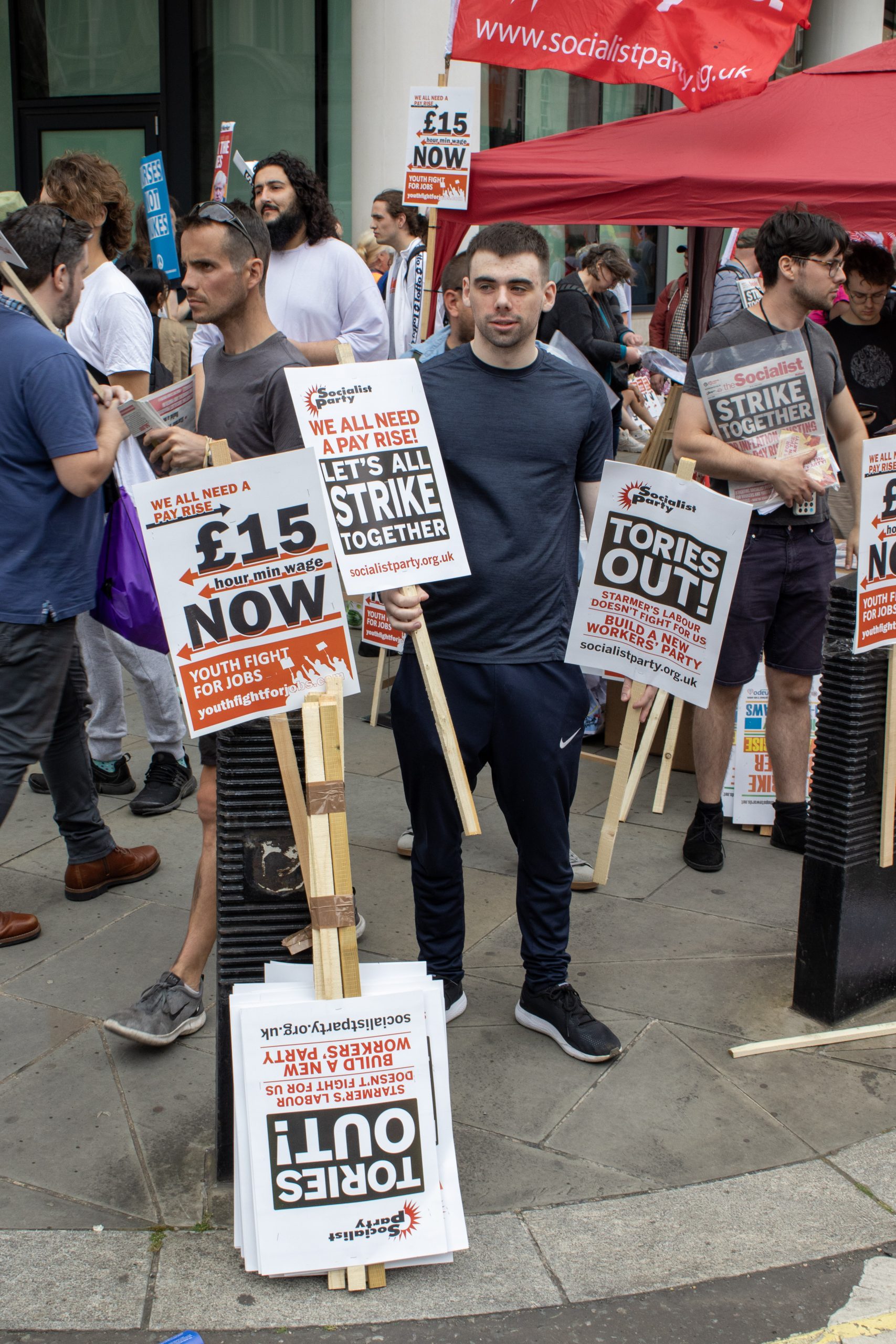
Part of that is clearly a demand on the minimum wage to be increased. The Trades Union Congress, which brings together the big majority of trade unions in Britain, voted in 2021 to adopt a policy in favour of a £15-an-hour minimum wage to be implemented as quickly as possible.
But, despite the Labour government being elected pledging to ‘make work pay’, including a policy to “change the Low Pay Commission’s remit so… the minimum wage will for the first time reflect the need for pay to take into account the cost of living”, the remit published just weeks into the new government also urged consideration of ‘the impact on business’ and ‘competitiveness’. The minimum wage is still just over £12 an hour.
The fight for £15 an hour, will need an organised and concerted campaign by the trade union movement. Including appealing to and organising new layers of workers on low pay, and drawing them into the workers’ movement.
Increasing the minimum wage to £15 an hour would impact over 5.3 million workers. It would represent a huge victory for the working class. It would signify that, despite all the talk of low growth, there is still huge wealth in society which can be redistributed. Such a victory would likely have a snowball effect; if the ruling capitalist class could be forced to increase pay for millions, could it be forced the fix the NHS, the housing crisis, reverse sky-high tuition fees?
An increase to £15 an hour would represent a transfer of wealth of around £2 billion a month from the capitalist class to the working class.
On the one hand, this is a drop in the ocean of the huge wealth that exists and is hoarded by a tiny few. The 50 richest families in the UK have wealth totalling £466 billion. It’s estimated that 20 energy companies made over £480 billion profits since the beginning of the energy crisis.
At the same time, Rachel Reeves is demanding £2 billion of cuts to civil service spending which could result in as many as 10,000 job losses in the sector. British capitalism teeters on the edge of recession, with high government debt and rising borrowing costs. The capitalists have many excuses as to why they cannot meet workers’ demands to end low pay, not least that it could unleash a growing appetite for change.
Organised fight
So to win a decent minimum wage will need struggle. It will require an organised fight, industrial and political, using the huge weight of the workers’ movement to force concessions from Reeves, Starmer and the bosses. It would mean copying and expanding the actions of, for example, Amazon workers in Coventry, and sections of fast-food workers, who have campaigned in their workplaces, and won people to the union to get organised for the first time around demands for a decent pay rise.
It would also include encouraging all workers already organised and discussing taking action to adopt £15 an hour as their demand. There are already examples of this, for example the local government unions’ 2025-26 pay claim is for a £3,000 a year rise for all staff and a minimum wage of £15 an hour. Sections of workers could take action and win £15 before the government is forced to increase the minimum wage. This would be a victory for those workers but also the movement as a whole.
Building a movement for £15 an hour could include demonstrations outside parliament to demand an increase. It could mean making low pay and the minimum wage an election issue, with thousands of council seats up for election next year. Low-paid workers should be encouraged to stand as candidates who will fight for councils to become £15-an-hour employers, including any outsourced workers, for example. All as part of the struggle against low pay.
Strike wave
A big chunk of the strike wave in 2022-23 was the action taken by nurses, not least because we had just come out of the most serious phases of the pandemic, which they had been on the sharp edge of, and yet many were struggling under the pressure of the cost-of-living crisis. On their demonstrations, workers held placards saying “you clapped us, now pay us”. among other Covid-related messages.
It’s also clear that the vital role they played during that period gave them a confidence to demand a meaningful pay rise after years of real-terms pay cuts and wage freezes in the NHS and public sector. The Royal College of Nursing put forward a claim of 12.5%. These qualified workers, who are now also forced to take on university debt after attacks on the nurses’ bursary scheme, earn just a few pounds above the minimum wage, even despite their recent heroic struggle against the Tory government and their partial victory.
Other workers in the health service, who also play a vital role preventing the spread of infection and ensure the smooth running of our hospitals, such as cleaners, catering and porters, are paid just 15p above the legal minimum wage. All these workers could be won to a struggle for a £15 an hour.
Before £15, the campaign for £10 an hour had been a beacon for the workers’ movement. With inflation driving up prices and driving down the value of workers’ pay, the demand was increased.
Campaigns such as the National Shop Stewards Network, which coordinates some of the most fighting union leaders and trade union activists, highlighted the need for a £10 minimum wage at that time too, against the backdrop of increasing anger at low pay. Activists, including from the Socialist Party, took part in ‘guerrilla leafleting’, slipping into high street shops and restaurants, known for their low pay and corrupt practices, to leaflet staff about how to get organised and get involved.
And this movement had victories. It didn’t win its overall demand. But charting the percentage increases of the national minimum wage and its level in comparison to the median hourly pay, shows that, under pressure, they have been forced to increase the minimum wage faster.
The Tory government was even forced to co-opt the idea of a ‘living wage’, distorting its meaning and rebranding the minimum wage for over 25s as the ‘National Living Wage’. This was a reflection of the enthusiasm for a rise, and of the enthusiasm for Jeremy Corbyn’s policies as the then leader of the Labour Party.
In 2019, ahead of his Labour Party leadership bid, posing as being supportive of the demand, even Keir Starmer was forced to stand on a picket line with McDonald’s workers holding signs demanding £15 an hour.
Today, the huge disparity in minimum wage levels for younger workers plays a useful role for the bosses. Campaigners often make the point that 20-year-olds don’t get money off their bills, despite getting substantially lower pay for the same work. But the bosses exploit younger workers, threatening to replace ‘more expensive’ older workers with ‘cheaper’ younger ones. It’s why the Socialist Party’s demand for ‘no exemptions’ to a £15 an hour minimum wage is so important.
While it wasn’t a panacea, looking at the 1970s and 80s shows what is possible, on the basis of working-class industrial and political organisation. At its height in the 1970s, 82% of workers’ wages were set by collective bargaining agreements, compared to around 26% today.
Collective bargaining
Linked to big changes in the global economic and political circumstances, in Britain, a huge change between the 1970s and today, has been the transformation of the Labour Party into an out-and-out capitalist party and, connected to that, the massive pushing back of working-class organisation.
The level of political and industrial organisation of the working class acts as a counterweight in society, in the collective interests of the working class against the bosses. If the working class in Britain is to change the trajectory of growing poverty and the continued enrichment of a tiny minority, it will mean transforming and rebuilding the mass organisations of the working class and engaging in struggle.
The Socialist Party demands ‘a trade union struggle for the immediate implementation of the TUC demand of a £15-an-hour minimum wage for all as a step towards a real living wage, without exemptions. For the minimum wage to automatically increase linked to average earnings or inflation, whichever is higher’. It is just part of our programme of demands to address the multiple crises capitalism inflicts on the working class – all linked to the need for the working class to struggle to end the exploitative capitalist system and bring about socialist change in Britain and internationally.
- What do you think the minimum wage should be, and how can it be fought for? We welcome your views. Send us your thoughts and experiences to editors@socialistparty.org.uk – if possible, please keep submissions to 500 words or fewer
