


Duncan Moore, UCU NEC member, personal capacity
While Liverpool FC fans milled around the conference centre on the Albert Dock in Liverpool, inside the venue delegates to the University and College Union (UCU) annual congress debated the issues facing post-16 education.
A palpable shift in mood has taken place since the last conference. There was a sense of looming crisis for our sector, which required us to take bold action.
Half of universities are in debt, crippled by a chronic lack of funding and a broken tuition fee system heavily reliant on international students, now being targeted by a Labour government chasing Reform UK with its immigration policy. Cuts, closures, and redundancies are spreading in higher education (HE). In further education (FE), half of all college lecturers quit within three years, due to low pay and overwork.
Shift in mood of members
Activists on the left of the union, including Socialist Party members, have argued for a fighting industrial strategy. Crucially, we have fought for national action in our sectors, as it has become clearer and clearer that the crisis cannot be fought at a local level alone.
The general secretary of the union, Jo Grady, and the team around her, however, are desperately trying to avoid confrontation with Keir Starmer’s government.
At the special sector conference for FE in 2024, delegates from the right of the union argued that most members were not willing to take strike action, that the branches were not strong enough, and that the Labour government would fix things with its new deal promising sectoral collective bargaining. At the time, these arguments won out.
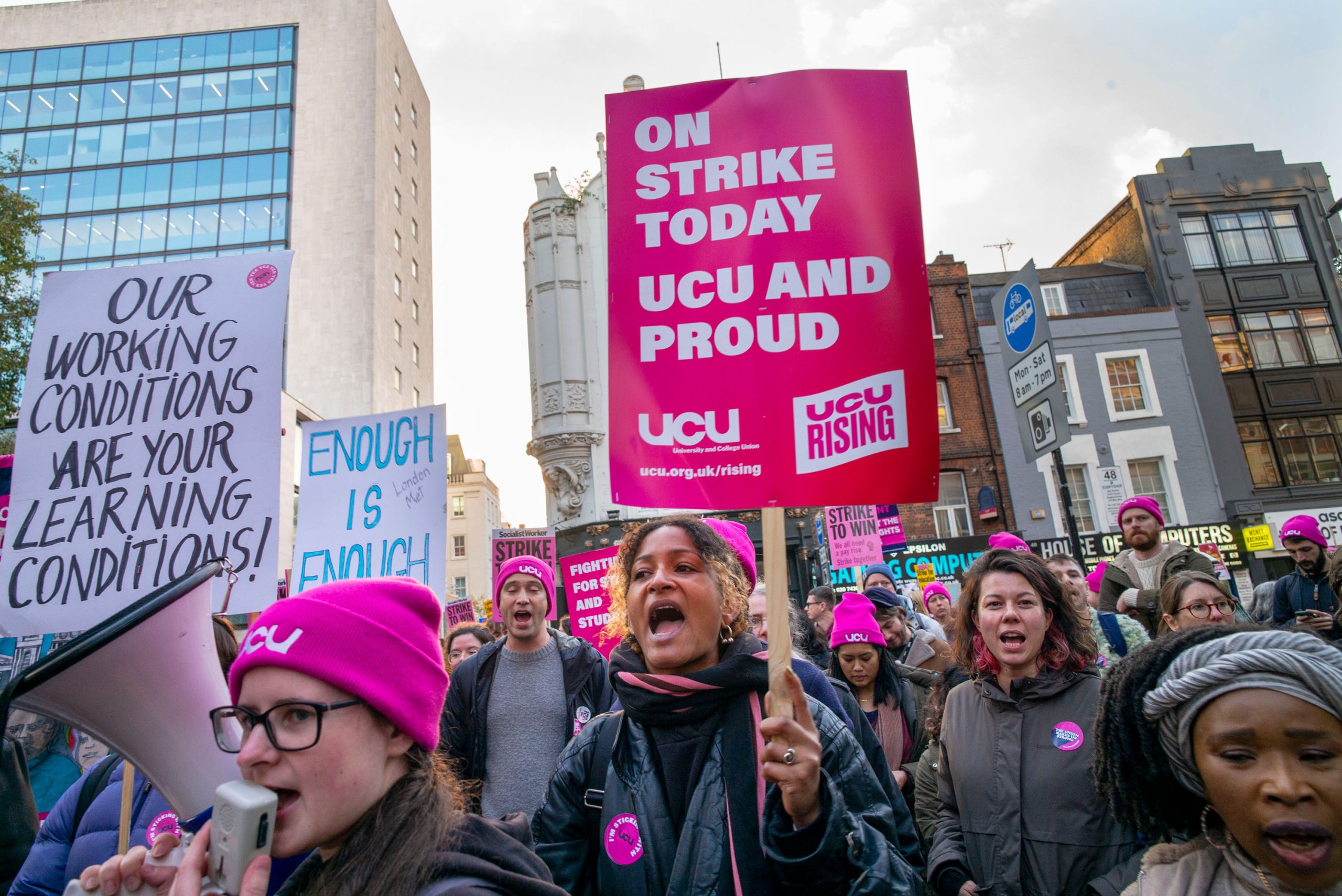
But no longer. In both the HE and FE sector conferences, motion after motion was carried by large majorities resolving the union to ballot for nationwide industrial action in the autumn. Motions agreed to coordinate with other education unions.
Political strategy debated for first time
Important debates took place on the union’s political strategy too, for the first time.
At the fringe meeting of the ‘UCU Left’ faction, Socialist Party members argued for the urgent coming together of trade unions to discuss founding a new mass working-class party as an alternative to the pro-capitalist Labour government.
Members of the SWP (Socialist Workers Party), which is the main organisation in UCU Left, while agreeing with the need for a ‘new political alternative’, muddied the waters, arguing that a new party would have to come from a “mass movement”, with no reference to the working class or the unions.
What else are the trade unions but mass organisations, with 6.5 million members! It is not enough to wait until a new party ‘organically’ emerges. Somebody has to take a lead, and even one union taking steps in this direction would be a crucial development.
Motion for political alternative passed
This debate played out on the conference floor on the third day. Socialist Party member Marco Tesei, a delegate from Ealing, Hammersmith and West London college, moved a motion from his branch, which called for the union to take steps towards “an alternative political voice to Labour”.
Delegates who supported this motion argued that the rise of Reform made this an urgent task. Against, were those who said that it was too soon to judge the Starmer government, that we have to give them time. The newly elected vice president argued against the motion. Even so, it was passed by a large majority.
I brought a motion from my UCU branch, South Devon College, calling for the union to demand that Labour immediately repeals the Tory 2016 Trade Union Act and its undemocratic turnout thresholds for strike ballots. This was passed with only one vote against.
Important discussions also took place between activists over the weekend on the need for a new genuinely democratic broad left, to bring together members who want to organise for a fighting union.
Exciting steps for the union – and the Socialist Party
It was my second UCU congress this year and I was less dazzled by the novelty of it all. While the number of Socialist Party delegates to congress was fairly small, we certainly punched well above our weight! In the mornings we gave out our bulletin and sold the Socialist. Absurdly, all the organisations leafleting outside were expected to be penned in together behind a small metal fence! It was indicative of increasing political pressure the leadership of the union is under.
I also had the honour of meeting with student Socialist Party members studying and building Socialist Students at University of Liverpool, Hannah and Thomas, at our party fringe event on Sunday. They both spoke eloquently, and their actions in supporting the Liverpool Hope University dispute were an inspiration (see page 11). A leader of the Hope dispute attended our meeting.
I can’t forget the brilliant speech given by Steeven, a Birmingham bin striker, fighting the Labour council attempting to impose huge pay cuts. Their struggle is an inspiration. We also cannot forget the Unite dispute of UCU staff, facing harrowing treatment by the senior leadership team.
This congress saw exciting political steps forward. The leadership is trying to paper over all the contradictions. But their ideology can only stretch over the cracks so far until it renders at the seams. This congress has shown that now these contradictions cannot be covered over any longer. Now is the time for action!
James Kirkup, delegate from Guildford, personal capacity
Suspense as conference debates working-class political alternative
A highlight of congress was the passing of motion 63, carried by a comfortable majority. It called for UCU to invite Jeremy Corbyn, the Independents and other pro-worker MPs to our national executive to discuss how they can support our union’s fight for post-16 education funding. It also called for us to encourage UCU members to themselves stand in elections, linking up with other trade unionists, to fight for our union’s policies.
Our sector is in profound crisis and we heard many criticisms of Labour from other delegates. But this motion was unique because it was the only one with a clear political call. As we are all in agreement Labour is attacking, not supporting us, why don’t we, the trade unions, take the lead in starting to build a political alternative!
One UCU member came up to us to say she was not a delegate but had come all the way from Bristol as an observer simply to hear the debate around this motion. There was a palpable sense of attention in the hall as this idea was proposed, and of suspense while we waited for the result. And when the result came, the applause clearly expressed how widespread the appetite is for change, for a political alternative!
Marco Tesei, newly elected to the National Executive Committee, personal capacity