


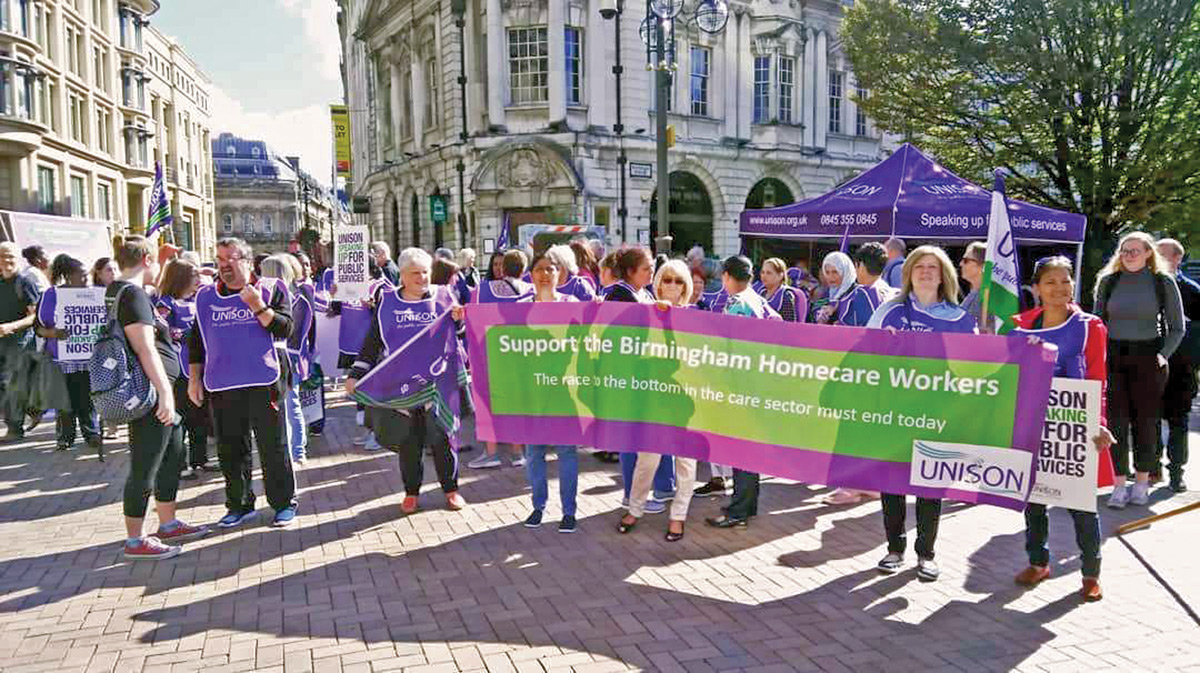
Glynn Doherty, Social care trade union organiser
Even before the 2024 general election there were widespread fears that Keir Starmer’s Labour would backtrack on promises to overhaul social care in England. Social care is the responsibility of each devolved government in the UK.
The commitments previously given to invest in social care, while drastically lacking, had sought to tackle endemic low pay, without which there would be no chance of bridging the current huge vacancy gap. Since the general election… nothing, except for January’s announcement of another ‘commission’.
The British Association of Social Workers said: “We do not need another commission to tell us what we already know.” The commission’s first phase – the implementation of a national care service – now has a deadline of 2026, with the final report not due till 2028.
Unison general secretary Christina McAnea told a conference of union members in February that the government needs to move quicker. But the Independent newspaper in May reported:
“Unison, which describes itself as the largest union in the care sector, said solving problems in social care was ‘never going to be a five-minute job’ and said the national care service is ‘something best introduced properly, not rushed through’”.
Conservative views
Into this vacuum, the latest Fabian Society report Seizing the Opportunity – The Fair Pay Agreement in Social Care, has dropped. But those expecting radical answers will be disappointed. Unison is a supporter of the project and it would appear to be very much the conservative views of Unison’s right wing that dominate its 40 pages.
It very much echoes a previous Fabian Society report Support Guaranteed: The Roadmap to a National Care Service. As I wrote in ‘Labour says social care will stay privatised’ in a previous issue of the Socialist: “Unless the issue of ownership is tackled, it will leave a situation where thousands of private providers protecting their profits will suppress fair wages.”
The new report lists the statistics and emphasises some of the worst aspects of the social care crisis:
- 120,000 currently unfilled vacancies
- Three in ten care workers on zero-hour contracts (nine times more than workers across all sectors)
- Average care worker pay in 2024 of £12.67 an hour
- Taking into account the ‘legal fiddles’ of not paying for travelling time and sleep-ins, 15% of care workers don’t get the national minimum wage
This crisis will only worsen under Labour’s new immigration rules which will limit overseas workers getting sponsorship to work in social care, potentially vastly increasing vacancies and turnover
But the key statistics are:
- In 1979, 64% of beds in residential and nursing homes were provided by local authorities and the NHS
- By 2023, just 4% of social care provision was public
- 85% of the total workforce is now employed by ‘independent’ care providers, with 8% employed by recipients of direct payments and just 7% by local authorities
- There are 40,000 separate workplaces and 18,500 employers
This needs to be fully recognised for what it is – a huge transfer of wealth from the public sector to big business. And it needs a commitment from the unions to fight to reverse the process by both pressurising the government but, more importantly, launching a major campaign amongst staff, users and the general public calling for nationalisation.
The money is available
The document claims funding the recommended measures over the course of this parliament would cost £2 billion. This would mean a modest (and to be honest, inadequate) pay rise to £13.17 an hour, occupational sick pay covering at least 50% of pay, improved employer pension contributions and investment in training and development.
To do this, a number of proposals are mooted, most of which are levies of some kind on other workers. While many have larger incomes than care workers, it would still be ‘robbing Peter to pay Paul’. Yet the answer is staring them in the face – in a separate section is the line: “The gross operating surplus of private and voluntary providers in social care was £2.9 billion in 2023.” So the most modest proposals could be paid for one and a half times over in the same year with this profit!
If the big business profiteers were removed from the equation altogether, without compensation for the super-rich who exploit the sector, there would be enough money available for year-on-year improvements so workers could benefit from an immediate £15-an-hour minimum wage, full sick pay and decent pensions.
Organising within social care is currently hampered by the unions’ past failures in fighting privatisation and outsourcing, leaving workforces open to endemic low pay, inadequate training, bullying and exploitative practices. I deal with approximately 350 social care providers. In only two of these is there a recognition agreement with the union and in one of these, pay levels are still so low the company has to implement pay rises just so as not to fall foul of minimum wage legislation!
Social care trade union leaders are belatedly beginning to organise more vigorously but from the wrong starting point. They seek employers’ participation in ‘partnership working’ in the hope of getting them to sign recognition agreements. The quickest way of getting employers to recognise unions is for the workers to organise and propose action to win higher wages. This can have a ‘domino effect’ for social care workers, with victories raising confidence and leading to the likelihood of further breakthroughs, something which cannot be achieved by simply talking to employers.
Until the social care unions grasp the mettle and go on the offensive, the promised Fair Pay Agreement is doomed from inception and social care will not only remain in crisis but could soon reach the point of total collapse.
The Socialist Party demands:
- Renationalise social care and the health service. Bring all services back in-house with no compensation paid to the fatcats at the top
- Solve the vacancies crisis by paying care workers a wage they can live on. For an immediate increase in the minimum wage to £15 an hour without exemptions, as a step towards a real living wage
- Reverse the cuts to local government. Take the wealth off the super-rich to fund the services we need
- For a democratic socialist plan for health and social care, with workers, service users and the local community deciding what we need not what makes a profit for a few at the top
