


Ali Mansfield, Camden and Haringey Socialist Party
This month marks one year of Keir Starmer’s Labour government in office. It also marks 80 years since the transformative 1945 Labour government of Clement Attlee. Coming in the wake of the Tories’ historic collapse, Starmer was not swept into power by a wave of enthusiasm, but reluctantly turned to as the only way to kick out a Tory government which had presided over 14 years of brutal austerity.
The Covid-19 pandemic brought anger at the Tories to boiling point as it laid bare for many their ineptitude, corruption and contempt for the working class. Moreover, economic instability alienated the Tory Party from its traditional social base, and discredited in the eyes of big business what was once the most successful capitalist party in history.
The Labour Party was thus able to gain some qualified support based simply on not being the Tories, but it too has seen its historic social base eroded. This was reflected in a historically low turnout at the 2024 General Election, with Labour being elected on the lowest vote share ever recorded.
Scrambling for a base of support, figures within the Labour Party have sought comparisons with the post-war Attlee government, remembered as the most radical reforming government in British history.
‘Spirit of ‘45’
In an article for the Mirror promoting the government’s summer spending review, which maintained the Tories’ austerity status quo, Angela Rayner cynically made reference to the 80th anniversary of the Attlee government: “From the devastation of war, this great Labour legend built a country that worked for working people. His proud legacy – homes for heroes, our NHS, a modern welfare state – lives on. And now, after 14 chaotic years of failure and neglect, this Labour government is delivering in the same spirit”.
The 2024 Labour manifesto, entitled ‘Change’, is littered with references to the “chaos” of the previous administration. As much as wishing to distance themselves from the Tories in the eyes of voters, Labour aim to present themselves to the bosses as a more stable representative of their interests, vowing “an enduring partnership with business to deliver the economic growth we need”.
Capitalist commentators have also contrived to draw comparisons between this current Labour government and the 1945 government, including the Financial Times, which claimed “Starmer must signal a new direction… snatching back the mythology of 1945 for his own, more moderate agenda”. This is not because they hope to replicate any improvement in the conditions of the working class.
By conjuring the ‘mythology’ of 1945, and leaning on support from the trade union leaders, the capitalists hope Starmer’s Labour can, more skilfully than the Tories, carry out policies in their interests, without provoking struggles of the working class. Those mass struggles won’t be avoided. The Labour Party, British capitalism, and the world in 2025 bear no resemblance to 1945.
The 1945 general election took place only months after VE day, and while war in the Pacific still raged. There existed a profound war-weariness and a determination not to return to the conditions of the 1930s.
This was reflected in a decisive rejection of the pro-capitalist Liberal Party and a huge swing from the Conservatives to a Labour Party, at that time openly and explicitly declaring itself as socialist, with a bold manifesto taking aim at big business. The importance of nationalisation was acknowledged, stating “there are basic industries ripe and over-ripe for public ownership” and, of iron and steel, “only if public ownership replaces private monopoly can the industry become efficient”.
One fifth of the economy was taken into public ownership, including coal, steel, the railways and the Bank of England. Much of the move towards public ownership stemmed from a motion put to the 1944 Labour conference in favour of nationalising land, building, heavy industry and the banks. This motion was initially opposed by the party leadership, including Attlee, but supported overwhelmingly by the rank and file. Under pressure from the membership, and the revolutionary mood of the masses, the leadership was pushed further than it would have liked. The internal democratic structures which allowed the working-class membership to exert its influence, in this case by a motion from a constituency becoming part of the party’s manifesto, have since been destroyed.
The NHS
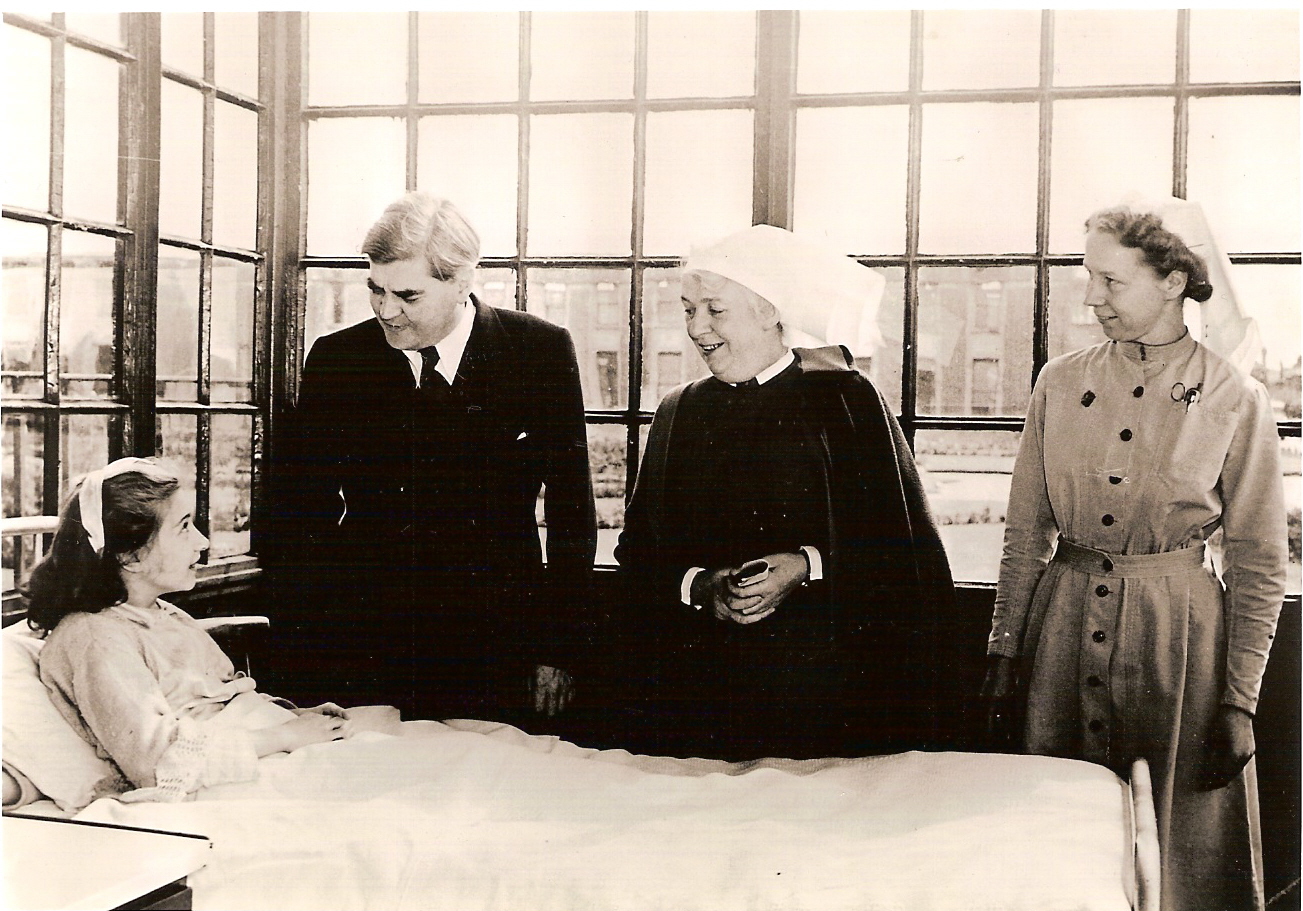
Perhaps the most significant and emblematic gain won under the post-war government was the establishment of the NHS.
Until the time of the second world war, there had been no planning of medical provision in terms of coordination between different services, and the geographical distribution of doctors in response to need. A majority of people had no access to a GP, and those who did had to pay. State-run medical services had been a trade union talking point for many years prior.
With the advent of the NHS, hospitals were brought into public ownership, and were free to access. Healthcare provision was planned at a regional level and GPs, dentists and opticians provided free services. Deaths from diphtheria, typhoid and tuberculosis were significantly reduced in this period.
The NHS stands as the most enduring gain from this period, despite being continually attacked by successive governments ever since, and is still treasured as one of the most significant victories for the working class in Britain.
Another major component of post-war reconstruction was an extensive housing programme which included the building of more than 800,000 council houses over the course of six years.
Today, the NHS is in a state of crisis. Health Secretary Wes Streeting has defended the encroachment of the private sector on the running of the NHS, including public statements that he is “very sympathetic” to the idea of reintroducing Private Finance Initiatives. His claims that this will help bring down waiting lists are decried as “utter nonsense” by the Centre for Health and the Public Interest.
Housing
An important part of Labour’s messaging on ‘national renewal’ relates to housing, where Rayner has sought especially to draw comparisons with the 1945 government: “Labour’s towns of the future will be built on the foundations of our past. The post-war period taught us that when the government plays a strategic role in housebuilding, we can turbo-charge growth to the benefit of working people across Britain. That is what Labour’s plans will achieve.”
Even at the most ambitious extent of its recent proposals, the Labour government plans to build 180,000 social rent houses over ten years – amounting to less than a tenth of the yearly rate of council house building by the post-war government, adjusted for population growth. Significantly larger amounts of funding under this scheme will go straight to private developers, and undoubtedly the small portion set aside for social rent will be the first to go, should Labour feel compelled to make future savings in the face of inevitable economic instability.
It is clear that even an optimistic reading of Labour’s current plans offer nothing remotely close to the historic gains whose image Starmer and Rayner wish to conjure.
Starmer’s Labour government is one determined to do the bidding of the capitalist class, by making working-class people pay. The Labour Party is transformed today into an out-and-out capitalist party, entirely different from the workers’ party with a pro-capitalist leadership that existed in 1945.
The post-war Labour government, under pressure of the mood from below, with the threat of workers rising across Europe, made significant concessions to the working class. But at its head were leaders who, though susceptible to working-class pressure from below, were committed to the maintenance of capitalism.
While important industries were nationalised, these represented a minority of the economy. Crucially, these industries were not placed under democratic workers’ control, meaning that production was not planned fundamentally on the basis of meeting the needs of the working class, but on meeting the demands of the privately owned majority of the economy.
Far sighted representatives of capitalism in part recognised the fetter of private ownership on the economy. And that to best manage the capitalist system as a whole, to help it recover from the devastation of war, and to be able to offer concessions to a restive working class, it was beneficial to nationalise key sectors to be used for the benefit of other privately owned sections of industry.
Similar considerations of how to best manage capitalism’s inherent contradictions while avoiding mass anger are at play today, but recent steps towards nationalisation of rail and state intervention into Scunthorpe steelworks are of a different order of magnitude.
The extent of post-war reforms was possible only on the basis of an unrepeatable period of sustained economic growth and a balance of forces internationally incomparable to that which exists today.
Stalinism emerged strengthened in the aftermath of World War Two. The Soviet Union had degenerated from the workers’ state established through the October 1917 revolution into a brutal top-down regime bearing no resemblance to genuine socialism. However, its planned economy represented a different social system, and the idea of socialism was supported by large sections of the working class – representing a threat to capitalism.
Motivated by trying to avert that threat, and with breathing space afforded by the post-war economic boom, the capitalist class made concessions, assisted by loans from US imperialism seeking to instill stability. These factors combined to initiate a period of relative unity between capitalist nations in an international framework dominated by the interests of US imperialism.
Britain today
21st Century Britain exists in an entirely different world. Capitalism globally is stagnant. The world balance of forces has transformed multiple times into today’s multipolar world of increased tensions between capitalist states, with a protectionist US unable to play its former role. British capitalism is increasingly feeble and especially vulnerable to global economic shocks. This crisis compels Starmer’s Labour government to impose further austerity and cuts.
Recent policy U-turns show that this government can be pushed back by working class anger, but the crumbs off the table will not satisfy the working class’s hunger for change. The fundamental constraints imposed by Labour’s unshakable commitment to capitalism will continue to expose their inability to offer any way forward.
This process would be accelerated with the existence of an independent political voice of the working class which could give expression to this anger. Such a party would amplify the pressure to achieve greater concessions and, by providing a forum for workers to debate the way forward, expose more clearly and more rapidly the fundamental limitations of the capitalist system.
It was true in 1945 that the gains of that period could only be defended on the basis of overthrowing capitalism altogether. But a reformist leadership was able to sow illusions under conditions of unparalleled and unrepeatable economic growth. Under the protracted global crisis facing capitalism today, no such illusions can be maintained.
With capitalism offering no way forward, major class battles are inevitable in Britain and internationally. Independent working-class organisations will be vital in cohering these struggles, and the process of developing such organisations will sharply pose questions on what is needed to take things forward. Socialists have an indispensable role to play in pointing the way forward to the necessity of the socialist transformation of society.
