


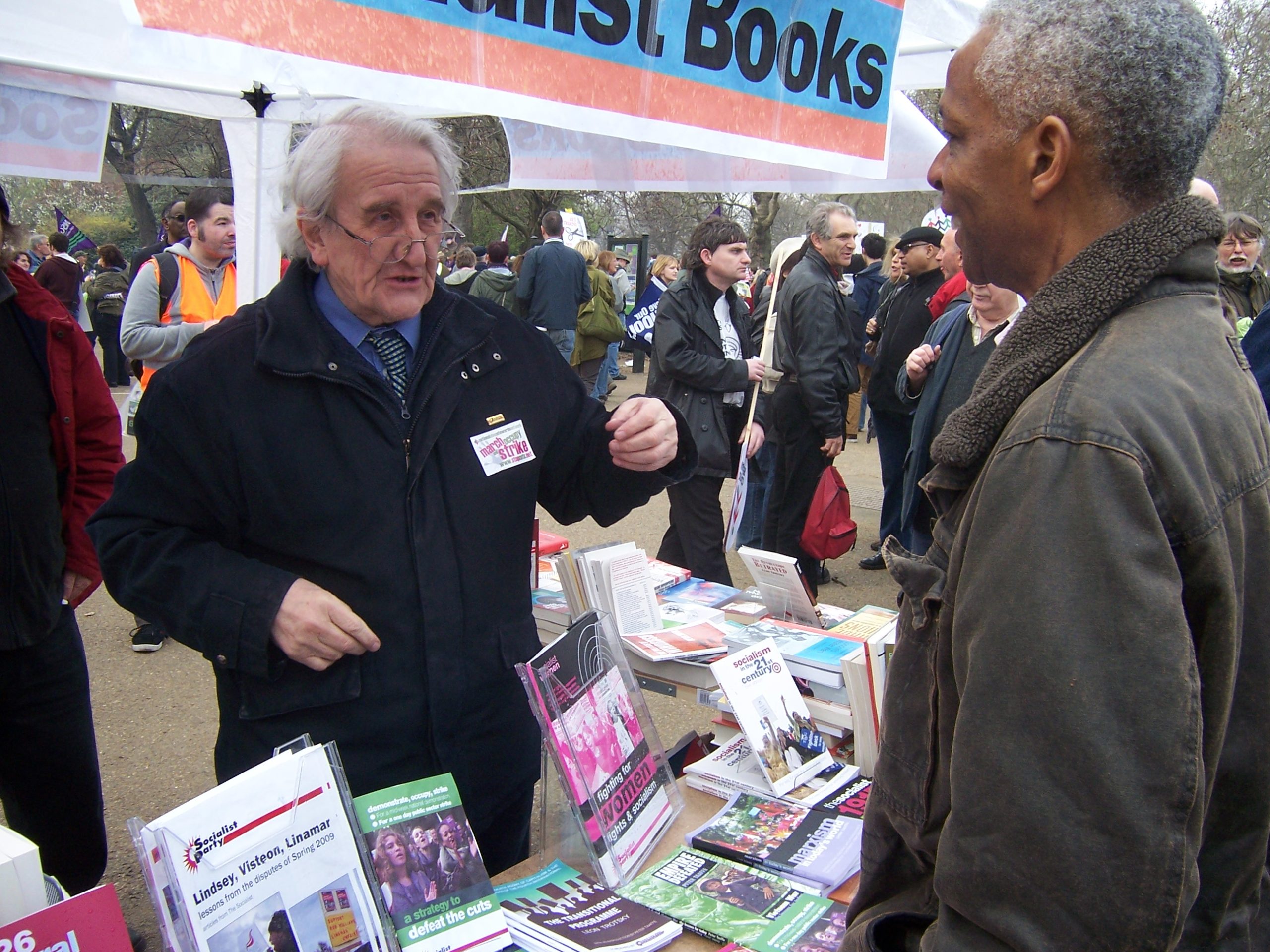
To mark the 90th birthday of the Socialist Party’s longest-standing member Keith Dickinson, Scott Jones sat down with him to ask about his life and time in the party.
How did you become a socialist and where did it all begin?
My mum and dad were in the Labour Party, and it was that post-war Labour government which brought in the National Health Service. I had chronic asthma and the NHS probably saved my life. It also influenced me as a young adult to join the Labour Party.
I left school at 14 and started work in the print industry as a messenger boy, working for the Liverpool Evening Express, then the Echo in the branch offices and was moved around Merseyside branches, and joined the National Union of Printers, Bookbinders and Paper Workers when in Huyton. I was eventually sacked and got a job at Eric Bemrose, a large union ‘closed shop’ and played a big part in the 1959 print workers’ strike, getting elected to the Merseyside strike committee.
Soon after this I got involved helping the huge engineering apprentices strike in 1960. This was a very important educational period for me. On Merseyside, the Labour Party Young Socialists (LPYS) branch in Walton was crucial in establishing the strike. First of all, sending an apprentice comrade to Glasgow where engineering apprentices were on strike. So we brought one of them down to Merseyside to speak. The branch had leafleted all the engineering firms that we could and ended up with 5,000 apprentices from 50 firms out on strike on Merseyside.
What about the roots of the Socialist Party at this time, tell us about Socialist Fight.
I joined the Socialist Fight group, as we were known at that time, in 1958. Socialist Fight was our monthly paper. We had a branch on Merseyside of about a dozen with around six present at the weekly branch meeting discussing basic Marxist ideas. It was a totally working-class branch that supported and intervened in the strikes taking place and we were among the main fighters for Marxist ideas. Our ideas got support, particularly in the Walton constituency. We also had delegates and a big influence on the Liverpool Trades Council and Labour Party. We convinced Walton Labour Party to produce regular pamphlets and leaflets challenging the leadership’s ideas. We gave them out at conferences and we would send copies to every constituency in the country. In this period we only had other branches in London, Tyneside and Swansea, with individual comrades around the country.
How did that lead to Militant and the big decision for you to move to London to build the party, and what were those early days like?
I moved to London at the request of the national leadership because we needed help with the youth intervention in London. I moved down in 1962, but initially I was not full time. I took jobs mainly connected to the print industry and trade unions. But I then worked through an employment agency looking for jobs where I could learn to operate small offset printing machines, which the party needed.
When I moved from Liverpool it was to West London, where I am still. We started recruiting youth such as in the LPYS. In North Paddington we managed to convince the majority there, and became an active branch involved in the campaign against the Rachman landlords. I had a few dodgy landlords myself in that period, moving from bedsit to bedsit, for quite a few years.
Peter Taaffe, who had joined us in Socialist Fight before I moved down, then built a very big base particularly among the youth and as we grew we took him on as our first full-timer. Peter made a huge difference to developing the organisation. We gradually built support, particularly among the LPYS where the comrades in most regions won a majority for our ideas in the early 70s. And from there we held a majority on the National Committee, it grew into a mass campaigning youth organisation and got big support among the Labour Party ranks.
What was the role of the Militant newspaper and how did Militant grow?
Our first issue was in 1964 just prior to the October general election, and it enabled us to build contacts nationally and get our ideas and programme out to people generally. This is the importance of the Socialist today and the longer theoretical articles of Socialism Today. The ruling class, despite all their efforts, cannot prevent workers from exchanging ideas and organising around them
At first the main sales were to members of the Labour Party, which of course at the time was a working-class party. We then decided that we would start doing sales on the street and built up our influence in Labour, the trade unions and in the wider working class. That’s when the Labour Party leadership, with the capitalist class behind them, decided that we were getting too much influence. By the early 1980s, we had three supporters elected as Labour MPs and majority influence in Liverpool council. At one Labour Party conference we had, out of 500-600 delegates, 100 who were Militant supporters elected by the local constituencies.
The Labour Party leadership used the national press to campaign against us, and we were expelled, I remember 23 February 1983 when the Militant Editorial Board appeared before the Labour Party National Executive Committee and we were expelled despite huge support among the rank and file, hundreds of whom protested outside the Labour Party headquarters. The expulsions were not welcomed by the majority of the active Labour Party membership. We were allowed to appeal to the Labour Party conference but we got expelled on the basis of the block vote of the union bureaucrats. Only a few of the left unions actually voted against our expulsion. Only the building workers’ union had discussed the issue of our expulsions at their national conference, and they voted against our expulsion, but their general secretary decided that the only way he could prevent his delegates voting for us was to have a delegation meeting outside the conference so that they didn’t vote at all.
Neil Kinnock was elected leader the day before we were expelled and he just continued with the witch-hunt campaign, but he still couldn’t stop all the achievements we made in Liverpool, with the council building more houses than all the other councils around the country together. Neither could he undermine our leadership of the anti-poll tax campaign later, that defeated Thatcher and the poll tax.
In your book you also talk about building the party internationally.
From the very beginning, we kept international contacts. Despite our shortage of funds and time, it was still very important for us to do. Then, after trying to work in what remained of Leon Trotsky’s ‘Fourth International’ until we were manoeuvred out, we decided we would have to build out of fresh new forces. We founded the Committee for a Workers’ International in 1974. Many international visits were made by comrades as they are still today, I only officially visited Ireland and Belgium as part of these efforts. Otherwise I used my few holidays, which all comrades should do today.
In the preface to your book you say one of the desires was for the current workers’ movement to know where the Socialist Party came from. What do you think are the lessons for today?
The most important thing really for all comrades, workers and youth fighting today – not just in Britain, but also internationally – is that as long as you concentrate on the ideas and use those ideas whenever you have an opportunity to speak to other workers, even if you have only a small group, whether it’s in a town or a small group spread throughout a country, I’m confident, you will pick up support.
In the present international situation it could happen in a much shorter time than the period I have lived through. The current period is really volatile and people are looking for ideas. In the past, many people thought that they could rely on reformism. But capitalism has proven incapable of satisfying people’s needs and to give people reforms they are looking for. Capitalism is driving the world backwards. Look at the starvation, genocide, environmental destruction compared to the greed of those responsible.
Organisations that are confident that they are going to change society, not just reform society, but actually change society, will, as long as they continue to keep an international outlook, be successful. And that’s what’s enabled me to reach my 90 years. Ideas! They keep the mind working. That’s what keeps you alive and working with like-minded, self-sacrificing comrades in a disciplined, well-organised revolutionary group or party.
