


James Collett, Gloucestershire Socialist Party
Tony Blair made an unwelcome return to the headlines this Spring when his thinktank, the Tony Blair Institute (TBI), slammed net-zero policies aimed at ending fossil fuel emissions to stop the climate crisis. “Any strategy based on either ‘phasing out’ fossil fuels in the short term or limiting consumption is a strategy doomed to fail”, his foreword to the White Paper said.
The report and Blair’s introduction are, inadvertently, an admission of the profit-driven capitalist system’s inability to take meaningful action to prevent catastrophic climate change.
The paper concedes that, in the last 15 years, “production of fossil fuels and demand for them has risen, not fallen, and is set to rise further”, that COP UN climate summits “will not deliver change at the speed required”, and that none of the efforts of capitalist nations to cooperate on climate change have been effective.
The Tony Blair Institute for Global Change, founded in 2016 by Blair and named with characteristic modesty after himself, claims to be a “new policy platform” focused on “re-energising the centre ground, African governance and Middle East policy, and fighting religious extremism”, as well as combating “frightening authoritarian populism”.
The word ‘hypocrisy’ is inadequate: life for the working-class and poor in Africa and the Middle East has been turned into a nightmare by the imperialist policies of the capitalist class, which Blair represents, and the wars started or supported by him and his ilk, while religious extremism builds its base on the misery caused by those wars and policies.
As for the “centre ground” of politics, it has been irreparably discredited by the anti-working-class war-mongering policies typified by Blair. The “frightening authoritarian populism” to which Blair refers trades on exploiting the anger of working-class people who have been consistently betrayed by Labour and other capitalist politicians. If Blair really does find authoritarianism “frightening”, it can only be regarded as curious that his consultancy firm accepted $13 million between 2011-2016 for advising Nursultan Nazarbayev, at the time president of oil-rich Kazakhstan, famous for killing protesters and routinely using torture. The TBI itself has enjoyed funding from the reactionary government of oil-rich Saudi Arabia. Hypocrisy saturates the pages of the TBI’s White Paper on Net Zero.
It asserts that more greenhouse gases are being emitted by China, India, and the neocolonial world, and congratulates Western countries for reducing emissions. It celebrates the 2006 Stern Review (commissioned by Blair when he was Prime Minister), which argued that “the economic costs of inaction would be significantly higher than the cost of taking early and decisive action to reduce greenhouse gas emissions”. The TBI implies that the Stern Review contributed to the EU and UK “decarbonising” during this time, which Blair calls the “Optimism Era”.
This “Optimism Era” was in fact the tail-end of the era of increasing globalisation, in which western capitalism moved industrial production to low-wage economies. Therefore, while emissions fell in the advanced capitalist countries, they were enormously increased in China, India and the neocolonial world to the benefit of the Western capitalist classes. At the same time, governments engaged in the charade of ‘emissions trading’, whereby richer nations sell ‘carbon credits’ to poorer ones. If the ‘embodied emissions’, i.e. the greenhouse gases ‘exported’ mainly to China by western deindustrialisation, are added to the western powers’ figures, there has been only a small cut in greenhouse gases by Europe and the USA.
The TBI paper goes on to complain that the “Optimism Era” was rudely interrupted by “geopolitical uncertainties (including the Brexit vote in 2016 and the US-China trade war) and stagnant economic momentum” – and blames these factors for the lack of international cooperation on climate change. The TBI deliberately ignores to the inescapable trends of capitalism: Brexit and the US-China trade war are not aberrations; neither is the economic crisis or any of the other factors which prevent cooperation between capitalist nations. The multiple crises pushing the world into deeper turmoil and escalating national tensions are symptoms of capitalism’s long-term decline.
Capitalism
The capitalist class has abandoned its historic role of investing profits to advance productivity, science and technique. Now entirely parasitic, the capitalists prefer to gamble on the financial markets and privatise public services, which they then run into the ground. Their banking crises and other failures are continually bailed out by the state while productivity stagnates, wages are driven down, new ways to scam the working class are concocted, and capitalism becomes more predatory, more wasteful and more destructive.
With capitalism in crisis, national tensions are increasing as each nation ruthlessly pursues the interests of its own capitalist class. More than any other question, global climate change demands a response based on international cooperation. Governments everywhere are moving instead to increasing nationalism, protectionism, war and military spending (the arms industry is another major contributor to climate change).
The TBI also closes its eyes to capitalism’s inherent short-sightedness. There is a very obvious reason for the failure to reduce fossil fuel usage: the profit motive. Capitalism means production for profit: the capitalist class is motivated to produce commodities solely in order to make profit, which it does through the exploitation of both the working class and natural resources.
Some companies embellish their public image with ‘greenwashing’, but the bottom line is always the same: they want to make more profit in this quarter than they did in the last, pay big dividends to their shareholders, big bonuses to their executives, and conquer more market share. Capitalism is, by definition, an unplanned system in which a tiny minority (the capitalist class) prioritise their own short-term goals and live extravagantly at the expense of the majority (the working class) to the inevitable detriment of the environment. This in itself makes a planned transition to a green economy impossible on a capitalist basis.
Green alternatives to steel, cement and aviation fuel are available but, the TBI laments, too expensive to be profitable. In other words, production for profit is an established impediment to the utilisation of technology which could vastly reduce emissions.
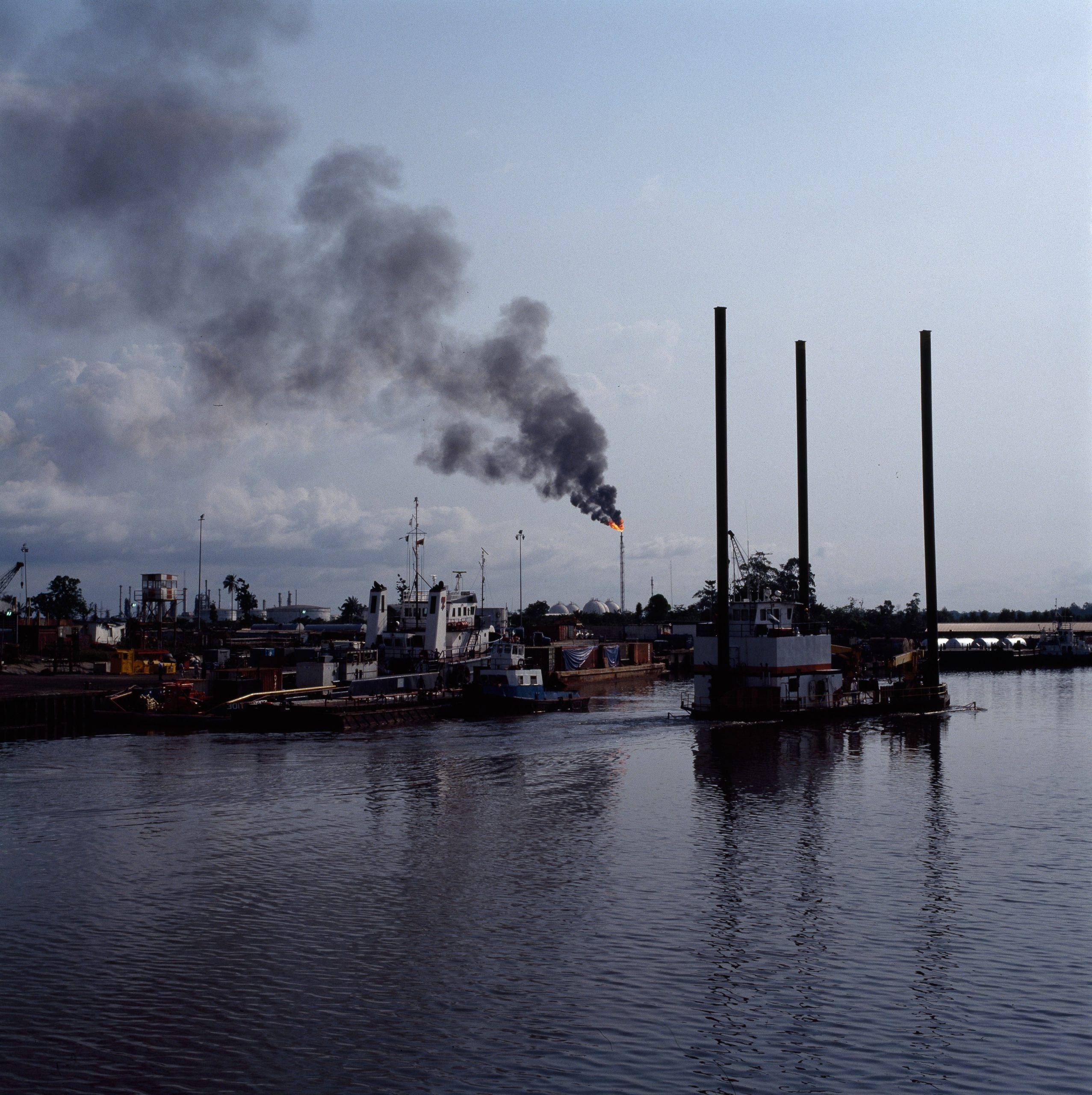
Carbon capture, meanwhile, is promoted as ‘central’ to tackling climate change. This is disingenuous at best. Carbon Capture and Storage (CCS) involves capturing CO2 emissions before they enter the atmosphere, but in 2024 this removed a tiny fraction of the 38 billion tonnes of CO2 that were emitted through human activity. CCS is fraught with dangers, including the question of safely storing CO2 once it’s been captured. Incredibly, much of the CO2 captured through CCS is used by oil companies which pump it into depleted oilfields to extract residual reserves of oil! Clearly we can’t trust the capitalists with this technology, and, predictably, its implementation is limited by cost. Bolting carbon capture equipment onto industrial smokestacks adds roughly 25% onto the operational costs of the business.
Research into these technologies is necessary, but must be carried out under the democratic control of the working class – even then, it is no substitute for the transition to a green economy.
The “resistance of the fossil fuel industry” to decarbonisation is rather casually mentioned by the TBI, but it strikes at the heart of the matter: fossil fuel companies will not voluntarily give up profits. The same is true for the mining industry, agribusiness, etc. – and for those companies which purport to manufacture ‘environmentally friendly’ goods: companies that make electric vehicles, for example, don’t care if the materials they use in production are mined in an environmentally devastating way, as long as they can advertise their vehicles as ‘green’.
Greenwashing and the cynical exploitation of Net Zero by companies and governments fuel the idea that Net Zero is inherently anti-worker. Carbon taxes, including Ultra Low Emission Zones, hit the working class the hardest. The poorer you are, the more you spend proportionately on travel and energy bills, and it’s workers who suffer when, for example, steel plants are shut down on the deceitful pretext of “reducing emissions”.
The resentment this inevitably produces is jumped on by right-wing populists like Reform UK MP Richard Tice, who boasts that Reform is the only party that wants to scrap “net stupid zero”. Tice is a millionaire. Reform is backed by millionaires and billionaires, members of the capitalist class who see that the traditional capitalist parties are failing and hope Reform will cut regulations and allow them to make more profits.
Reform’s interests lie with the capitalists, not workers: they aren’t interested in cutting our bills or saving jobs. In reality, it’s capitalism that’s inherently anti-worker: it always makes the working class pay. This is true of any capitalist party, including Reform.
Moreover, it’s the working class and poor who suffer most from the effects of climate change. Droughts, floods and heatwaves wreck the lives, not of the rich, but of the working class – and no longer only in the neocolonial world. After 200 were killed by flooding in Valencia last year, the King and Queen of Spain toured the area and had mud thrown at them, amid shouts of “murderers”. The capitalist class is responsible for the climate emergency, and is responsible for placing the burden of it onto workers. It turned out that the Valencia Emergencies Unit had been shut down in 2023 as a ‘superfluous expense’, worsening the loss of life. Reform’s ambition to take a ‘DOGE-style’ approach to local government could easily have similar effects in Britain, as Trump’s cuts have in Texas recently.
Trade unions
A genuine alternative must be put forward by the trade unions. While being the only union prepared to fight the closure of the blast furnaces, Unite mistakenly failed to raise the demand for nationalisation of Tata Steel. Nationalisation is key to any green transition that protects jobs: you can’t control what you don’t own. The Campaign Against Climate Change Trade Union Group has produced a report which demonstrates in detail how a million green jobs could be created. This is the basis on which trade unions should campaign. Trade unionists, socialists and climate activists must play a key role in the building of a new mass workers’ party which rejects the limits dictated by capitalism, fighting for a socialist, internationalist programme.
The major corporations and banks must be taken into public ownership, under democratic working-class control and management, as part of a socialist plan of production. Socialism means the transformation of society from a system based on production for profit to one based on production for need. It means taking power out of the hands of the billionaires and running society ourselves – in our own interests, which also means in the interests of the environment.
Instead of profit-hungry monopolies deciding how much we should pay for electricity, the working class should decide collectively, through elected committees of workers and consumers. Instead of subsidising polluting water companies that charge extortionate bills and fail to maintain infrastructure, we should nationalise those companies and provide clean water as a public service.
Tremendous wealth is produced by the working class but is currently stolen from us by the bosses in the form of profit. The scale of this wealth is attested to by the colossal fortunes of the super-rich. That wealth could be used to fund not only the decent jobs, housing, healthcare and education we need, but also massive investment in renewable energy, free public transport and a huge expansion of transport networks. Without the millstone of the capitalist class around our necks, we could divert scientific research away from arms manufacture and towards socially useful innovation. A planned economy would allow us, for the first time, to use the full force of scientific and technological development to nurture rather than exploit the natural world – and there is no limit to the heights which human inventiveness may reach once the majority of the world’s population is freed from the scourge of poverty. There is also no limit to the level of international cooperation possible once the barrier of capitalist competition is eliminated.
The capitalists like to characterise socialism as ‘utopian’, but it’s the notion that capitalism can save the environment which is utopian. The capitalist class stands before us as the main obstacle to overcoming the fundamental challenges facing humanity, including climate change. “The choice is clear,” Blair tells us, “innovate and cooperate or face a future of escalating climate chaos.” As the level of innovation and cooperation needed is totally unrealisable on a capitalist basis, Blair’s warning, though far from intentional, confirms the prognosis made over a hundred years ago by Rosa Luxemburg: the future, she wrote, is a choice between “either socialism or barbarism”.
