


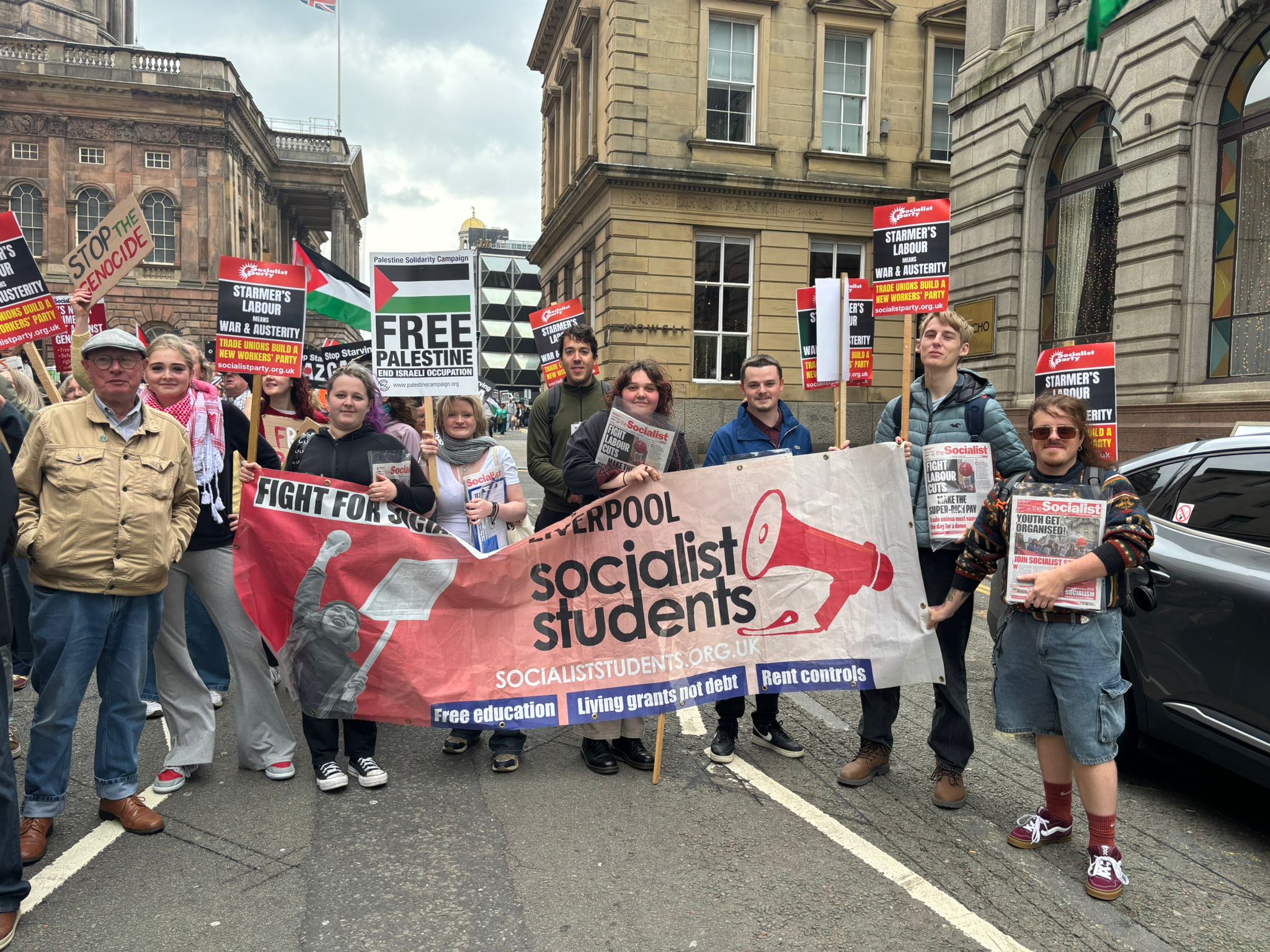
Fight for free education, make the super-rich pay!
Adam Powell-Davies, Socialist Students organiser
The Labour government has announced that it will bring back maintenance grants for tens of thousands of students from ‘low-income backgrounds’ who opt for so-called ‘priority courses’.
Labour has not yet announced how much grant money students would receive, nor whether the grants would be paid on top of the existing maintenance loan allowance. But if the introduction of grants means that some of the poorest students have more money in their pockets, and leave university or college with less debt, then that is a victory.
Reintroducing maintenance grants, even in this very limited current form, was mentioned nowhere in Labour’s general election manifesto last year. This latest announcement has to be seen as a concession to the widespread anger that has developed against Labour since then, as millions of working-class and young people correctly see Starmer’s government as doing nothing but continuing the Tories’ war and austerity agenda.
Jeremy Corbyn
Labour’s hand has also been forced by Jeremy Corbyn and Zarah Sultana’s ‘Your Party’ announcement. As leader of the Labour Party, Corbyn inspired millions of young people with his offer of free education: scrapping tuition fees and introducing maintenance grants for all. A new party fighting for free education as part of a socialist programme to transform young people’s lives today would gain massive youth support – and Labour knows it.
Just the prospect of a new party fighting ‘for the many, not the few’ has Labour under pressure. At the same time, there is the prospect of a new round of national strike action in further and higher education, as the University and College Union (UCU) launches ballots this month (see page 7). Now is the time for students to join the fight – to go on the offensive and fight for what we need by making the super-rich pay, not workers and young people!
We could start by demanding the government rolls out its maintenance grant plans immediately, rather than waiting until ‘the end of the Parliament’ as is currently planned. We should also demand that grants are made available for all courses, not just so-called ‘priority courses’ deemed most important by big business and their politicians.
Another important battleground will be the level of grants paid to students. The current level of maintenance support for students is woefully inadequate, whether that comes in the form of a loan, or as a mixture of a loan and a grant (as is the case for Welsh students studying in Wales, for example). A student receiving the maximum maintenance loan would still need to work 20 hours per week to meet a “basic standard of income”, according to the Higher Education Policy Institute.
Explaining the targeted rollout of maintenance grants at Labour conference, Education Secretary Bridget Phillipson declared: “Students’ time at college or university should be spent learning or training, not working every hour”. Great! In which case, let’s make sure that maintenance grants are made available to all students.
Let’s also make sure these new grants cover the full cost of living and studying. That would also stop student loans saddling us with a lifetime of debt after we graduate.
The shareholders of the FTSE100 companies get payouts of around £85 billion every year. Instead of charging a levy on international fees to provide grants to a fraction of ‘home’ students, students should unite in a mass movement to demand free, fully funded education for all, paid for by taking the wealth from the super-rich.
Funding Not Fees
These are the kinds of ideas Socialist Students societies will be fighting for on campus with the ‘Funding Not Fees’ campaign this term. As part of this, we will be organising lobbies of MPs ahead of the 26 November Budget, for them to raise an amendment calling for free, fully funded education, including the introduction of living maintenance grants for all students.
We will also be raising the campaign in Your Party meetings between now and the founding conference, to make sure the call for free education forms a key part of a new mass socialist party giving a voice to young people and the working class.
Struggling with rent, over 50 join Herts Uni Socialist Students
Morgan Tritton, Hertfordshire Socialist Students
We ran two campaign stalls across freshers’ week, and were the only political society on campus. Over 50 new people signed up to Herts Socialist Students.
At our stalls, students voiced concern about the rise of the far right, following the ‘Unite the Kingdom’ march, and increasingly seeing England flags across small towns in Hertfordshire. Others were excited about the idea of a new party that amplifies the voice of students, especially scrapping tuition fees and cancelling student debt.
Many wanted to meet other socialists, and build a community on campus. There was frustration with political apathy on campus, but real enthusiasm to take action locally, especially through our campaigns to improve democracy in our student union, and to end violence and harassment against women at Herts.
18 students attended our first meeting, discussing ‘what is socialism?’ Almost everyone attending was completely new to organising.
The main issues brought up by students in the discussion were struggling to pay rent or find accommodation; rising tuition fees and inequality in education; mental health and community isolation; disillusionment with mainstream politics; and wider crises of climate chaos, endless war, and the growing power of the super-rich.
There was a lot of enthusiasm in our first meeting to get organised, defend our right to protest, and to fight for socialism to end all wars. A number the new people will be joining the Socialist Students contingent on the national march for Palestine on 11 October in central London.
We need free education
Committee members of King’s College London Your Party Society
Extortionate rent. Delayed, expensive travel. No network to lean back to. These are some of the challenges that force students to give up their dream university. So what can universities and student welfare groups do to really help young people get into the university they aspire for?
Student accommodation must stop operating like a business. The maximum student loan (£13,348) cannot cover the average annual rent (£13,595) anymore, according to Unipol and Higher Education Policy Institute. Commuting is not always an option either – in cities like London Zone 1 travel alone can cost £44.70 per week.
Cost of living
Schemes like King’s Affordable Accommodation Scheme (KAAS) offer some relief, but only 20% of rooms participate in the scheme. Demand outpaces supply, despite campaigns to raise this to 40%. Similarly, hardship funds at King’s – such as the King’s Student Fund – exist, but budget expectations often ignore the realities of the cost-of-living crisis.
This inadequacy of existing affordability schemes forces students to use up their loan on rent and seek alternative sources of income to cover their other living expenses, especially when parental financial support is limited. But that comes at a cost – missing out on studying and socialising and constantly stressing. On top of that, with more than 50% of students relying on part-time work during term time, those from lower socio-economic backgrounds are disproportionately impacted by this cost-of-living crisis.
Universities’ responses should be not only to offer more affordable housing, but increase hardship funding and reflect socio-economic background in admissions. A truly impactful long-term policy for working-class students, however, must also bring back free education and maintenance grants.
Every student deserves an equal chance to pursue their dreams instead of being penalised for their background. And when education equality is achieved, that’s when we will live in a fairer society.
