

Nick Chaffey, Socialist Party Southern Regional Secretary
As the horror in Gaza has unfolded, millions across the world have marched in anger demanding an end to the war and national self-determination for the Palestinians. In Britain, mass demonstrations in London and across towns and cities, hundreds of thousands have marched month after month. Two years on, how has the Gaza movement reshaped politics and the outlook of workers and young people in Britain? What lies ahead and how can we build the socialist movement to end war and capitalist crisis?
The roots of this conflict and other capitalist wars raging across the world, now and in the past, stem from the inherent nature of the capitalist system. In a system of periods of economic growth, recession and crisis, rooted in the nation state, capitalist states are compelled to defend the interests of their own capitalist classes. Increasingly, the capitalist crisis globally brings capitalist interests into deeper conflict, spilling over into trade wars and brutal military wars that are unfolding around us, including the horrific war of national oppression on Gaza by the Israeli regime.
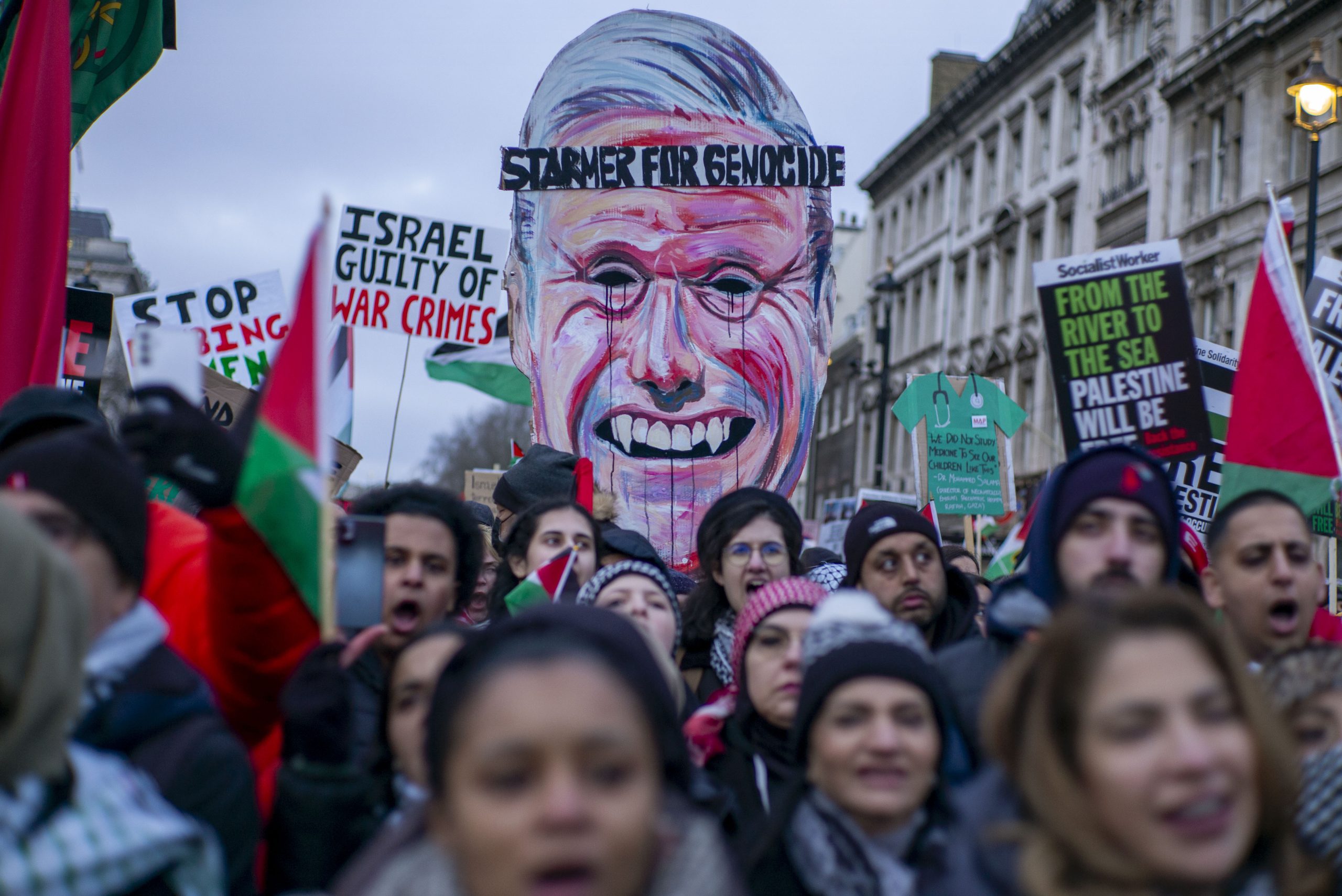
Though the huge scale and impact of the anti-war demonstrations has not been able to halt the genocidal slaughter, it has had reverberations in Britain and beyond. For two years, mass demonstrations through London have been sustained. This is an unprecedented protest movement, with an impact similar to the protests against the 30-year-long Vietnam war. The protests and the war have had a big effect on people’s outlook, especially among young people exposed to the horror of war and capitalist crisis. Looking for answers, many have been attracted to the ideas of the Socialist Party.
The movement has contributed to the historic defeat of the Tory government in the July 2024 general election. But it has also contributed to the undermining of Keir Starmer’s capitalist, pro-war, pro-cuts Labour Party, following its slavish support for Israeli state terror. Despite Starmer’s more recent token recognition of a Palestinian state, his government still grants export licences to British arms manufacturers to supply the Israeli state’s murderous onslaught.
In the face of mass opposition, both Tory and now Labour governments have attempted to cut across the movement with increased repression, fearful of its political radicalising effect in opposition to the establishment. One of the latest repressive measures has been to proscribe protest group Palestine Action as a ‘terrorist’ organisation, its tactics have included occupying and sabotaging arms manufacturers in Britain linked to the Israeli state. Hundreds have been arrested for peacefully expressing support.
Attempts by reactionary Tory then home secretary Suella Braverman to mobilise the far right to ‘defend the cenotaph’ and ban a march in November 2023, led to a humiliating climbdown. It provoked the largest of all the anti-war demonstrations, and led to her being forced to resign. We wrote in the Socialist: “Though one Tory sacking is a start, it is not enough. This movement poses the potential to bring down the whole rotten Tory government. But to do this it has to continue to build and spread. The Socialist Party is campaigning for the trade unions to play a leading role in this movement, which would add enormously to its power.
“We also raise the need for a trade union-led electoral alternative to Starmer’s anti-worker and pro-war policies at the next election. Socialist Party members will continue to push for the workers’ movement to take steps in this direction.”
Radicalising effect on society
This movement has had a radicalising effect on all layers in society but especially amongst the Muslim working-class communities across Britain. Support for the Palestinian struggle has grown also amongst young people. There were school walkouts and protests in December 2023, including on the issue of draconian attempts by school leaders to prevent students wearing badges in solidarity with Palestine. Student encampments were set up on numerous university campuses, inspired by similar developments in the US. Anger over Gaza, and the role of Donald Trump and Keir Starmer, was a key factor motivating the school and college walkouts against Trump’s state visit to Britain this September, led by Socialist Students.
At the beginning of the war in 2023, as leader of the opposition, Starmer provoked huge anger by stating his belief that the Israeli state has a right to cut off power and water to the 2 million Palestinians in Gaza.
Despite leading in the polls ahead of a general election, in the two months to March 2024, Labour lost 23,000 members. Starmer’s refusal to call for a ceasefire in Gaza was cited as a reason for the resignation of scores of Labour councillors, including leading to the party losing control of councils. The effect was greatest in areas with larger Muslim populations, where the pressure of the mood from constituents on the issue was more sharply felt.
The results of the May 2024 local council elections showed how the Gaza movement had shifted voters. Socialism Today in June 2024 reported: “Most recently opposition to the war on Gaza led to an 18% drop in Labour’s vote in May’s local elections in areas where more than a fifth of the population identified as Muslim, according to a survey of 930 wards conducted by Southampton University researchers.” In the July General Election, in the 92 constituencies where those from a Muslim background make up more than 10% of the electorate, Labour’s vote fell by 34% on 2019.
In May, a glimpse of the potential to develop the movement politically in readiness for the general election was shown in results for Socialist Party members standing under the Trade Unionist and Socialist Coalition banner. National Election Agent Clive Heemskerk reported: “The highlights of the campaign were the results in Southampton council’s Bevois ward and the Deepdale ward in Preston, with the TUSC candidates’ scores of 32.2% and 31.3% respectively rattling the local Labour Party as our ‘No to cuts! No to war on Gaza!’ message struck home. Bevois was the safest ward for Labour in Southampton before May 2nd – but not now!”
Nadia Ditta in Bevois, Southampton, like many, had been attracted to our socialist anti-war message and our bold challenge to Starmer’s Labour. On the eve of the May elections she wrote: “It’s events that trigger us, that make us say ‘enough is enough’ and to fight for our rights. For me, it was the Israeli state’s war on Gaza – supported by both Tories and Labour. Every day in my community people are fighting their own wars – wars to keep a roof over their heads and to keep food on the table.”
After the local elections, looking ahead to the yet to be announced 2024 general election, the Socialist Party argued: “What is needed is a mass democratic workers’ party, based on the organised working class, with socialist policies. That is not likely to be achieved before the general election, but further steps to prepare the ground can be taken now. It is entirely possible that a bloc of workers’ MPs, including Jeremy Corbyn and others, could be elected and from day one force Starmer to at least look over his left shoulder.”
Whilst Jeremy Corbyn and the trade union leaders did not take up the idea and lead in bringing together a broad anti-war, anti-cuts electoral challenge to Starmer’s Labour, the general election results did vindicate our perspectives and affirmed the potential to build a new mass workers’ party, with the re-election of Corbyn and the four independent Gaza MPs.
Based on the mass Gaza demos and the huge strike wave of 2022-23 – the largest for 30 years, which at its height saw over 500,000 sign up to ‘Enough is Enough’, led by strike leaders Mick Lynch (RMT) and Dave Ward (CWU) – a trade union-led platform could have won even greater support and seats. It was a missed opportunity and would have put the working class in a stronger position to fight against Starmer’s war and austerity.
The 2024 general election also clearly showed that Gaza has not been the only event that is shaping the lives and outlooks of working-class people. The historic collapse in support for the Tories reflected anger at 14 devastating years of austerity, and also the failure of their divisive, anti-immigrant, ‘stop the boats’ incantation, to save them. Over that time, living standards have fallen, public services have been cut savagely, schools, the NHS and local councils hit hard, which have left working-class communities as wastelands.
Since the global financial crisis of 2007-08 there have been 18 years of austerity, driving down living standards through cuts in wages, pensions, benefits and vital public services. As the system faced an existential crisis, the banks were bailed out using state resources and the bill was sent to the working class. The capitalists and their political parties, including Tony Blair and his pro-capitalist Labour Party, defended the 1%.
It was as a reaction to this that Jeremy Corbyn was elected as Labour Party leader in 2015, opening up the possibility of Labour being transformed into an anti-cuts mass workers’ party. With its 2017 manifesto calling for nationalisation, council housing, NHS funding and free education, Jeremy won the sharpest rise in votes for any party since 1945. Whilst he mistakenly failed to drive the pro-capitalist wing out when the chance was there, and as a consequence was himself driven out by Starmer’s right wing, he retains enormous authority. Add to this, his prominent support for the Gaza movement. It is no wonder that hundreds of thousands, in just a few weeks, signed up to the proposed launch of a new party with Zarah Sultana in August.
At the general election, Starmer’s Labour government was elected by just 18% of the electorate, the lowest share of the vote of any government since 1918. And it has become much more unpopular since.
There is huge anger at continued austerity, attacks on pensioners’ winter fuel payments and disabled people. A Labour government attacking the working class is driving fault lines between Labour and the organised workers in the trade unions. Significantly, the seven-months-long Birmingham bin strike brought this to a head at the policy conference of Unite the Union – Labour’s biggest affiliate with over 1 million members. With just four abstentions, its 800 delegates voted for a Socialist Party initiated resolution, to review their links with Labour and suspend Angela Rayner and Birmingham councillors from the union.
Your Party
This is the background to the launch of Your Party by Jeremy Corbyn and Zarah Sultana, that could now potentially fill the vacuum with a mass anti-war and anti-cuts workers’ party. That would be a huge boost to the anti-war movement and would have ripples beyond Britain to the Middle East, where rotten regimes sit on top of burning anger in the ‘Arab Street’.
A new party that takes off will need to face up to the challenges of filling the vacuum with a concrete programme to oppose war and cuts, with candidates across the country in next May’s elections. It will open a confrontation with Labour and the entire capitalist class and media who will feel their interests threatened.
To be successful, Your Party must base itself on the power of the mass trade union movement, and its power in the workplaces, where workers come together and prepare to take collective action in defence of their interests. That power also needs to be taken into the anti-war movement.
The magnificent strike action of Italian dockworkers that spread to many other sections of workers across Italy on 3 October, with 2 million demonstrating against the further export of arms for Netanyahu’s genocide, and in support of the Global Sumud aid flotilla, shows a glimpse of the power of the organised working class. Throughout the anti-war movement, the Socialist Party has pointed to this potential power, arguing for the trade unions to put themselves at the head of the anti-war movement. Not just by mobilising their members to attend demonstrations but, for example, by convening meetings of shop stewards in industries related to the manufacture and distribution of arms to Israel, to discuss what steps can be taken.
The pay dispute of Unite members opening up at Leonardo’s arms factories, many of which have had protests outside in solidarity with Palestinians, shows the potential for future common struggle of the anti-war and anti-cuts trade union movement.
The elections in May are an opportunity to harness the anger at Labour and the capitalist establishment. Your Party could potentially win hundreds of councillors and even take control of councils. That in itself would be a huge boost to the confidence of millions. It would open up decisive battles to deliver real change via the significant powers local authorities have to deliver many of the positive aspects of Corbyn’s 2017 general election manifesto on jobs, housing, rent controls and restoring vital services. The effect of this would be to cut across Reform and the far right, as Corbyn’s 2017 manifesto did, winning 1 million votes from Ukip.
The nightmare in Gaza continues, capitalist crisis deepens globally under the new era of Trump 2 and his tariff wars. But the outrage over Gaza is reshaping Britain in the consciousness of millions of protesters, workers and youth who are experiencing a rotten system first hand. Increasingly they are open to the ideas of a new socialist society and socialist world. They are the key conclusions we must draw and grasp every opportunity to build and strengthen the socialist opposition to win the important battles that lie ahead.
