


Josh Asker, Socialist Party Executive Committee
“They own you, lock, stock and block vote”, Tory prime minister David Cameron once taunted then Labour leader Ed Miliband, referring to the trade unions. To the capitalist class, the idea of the trade unions – mass organisations of the working class – having a collective voice in a political party is an anathema.
In fact, by the time Cameron made that accusation in the 2010s Labour had long been transformed into an out-and-out capitalist party, with the ability of the working class to exert pressure on the leadership through the trade unions long gone. He, the Tory party and the capitalist class, knew it. One senior Tory said of Margaret Thatcher: “Her real triumph was to have transformed not just one party, but two”.
During his time as leader, Ed Miliband was pushing through another counter-reform to even further drive union influence in the party into the dirt. The 2014 Collins Review introduced a new category of individual trade union ‘affiliated supporters’, removing a trade union’s collective voice. It also abolished the electoral college for leader and deputy leader elections, in which a third of the votes was allocated to the unions.
The earlier removal of local trade union representation in the selection process of parliamentary candidates in favour of a one-member-one-vote system, in 1993, was later described by Tony Blair’s deputy leader John Prescott as being more important in changing Labour into a ‘pro-market’ party even than the abolition of the socialist Clause Four in 1995.
Since, Keir Starmer’s Labour Party has further centralised democracy under the control of the Parliamentary Labour Party. And faced with enormous working-class anger, it now faces the prospect of a new mass workers’ party developing. The enthusiasm for such an alternative is shown by the 800,000 signing up to support Jeremy Corbyn and Zarah Sultana’s Your Party.
Now, it is in discussions around Your Party, its democracy and trade union involvement, that those arguing against trade unions being able to affiliate and have a collective democratic voice that some are joining Cameron in criticising the trade union ‘block vote’ that used to exist in the Labour Party.
Organisations affiliated to the Labour Party had their representation through its democratic structures aggregated, with votes weighted according to their size. Before 1992, for example, the share of votes at Labour conference allocated to affiliated organisations (the trade unions, the Co-operative Party and socialist societies), was 90%.
Some of those opposed to the trade union collective voice being expressed in future ‘Your Party’ democratic structures raise the threat of right-wing trade union leaders wielding votes against the wishes or interests of their members.
Of course this is a possibility. But where is their confidence in the willingness and ability of trade unionists to hold their leaders democratically to account? Even in the right wing-led unions, this happened in the old Labour Party structures.
At the 1982 Labour Party conference, for example, the leader of the National Union of Railwaymen (NUR), Sidney Weighell, broke with the democratic mandate from his members and conference delegates to put the NUR’s votes behind a right-wing candidate on the party’s National Executive Committee (NEC) – the party’s leadership body.
Weeks later, this entrenched right-winger in the trade union movement was forced from his post by members’ anger.
Before the party’s transformation into its current form, Labour Party conference was an event in stark contrast to the charade of ‘democracy’ that it is today. It was then a reflection of the contradictory character of a party with a mass working-class membership but with a pro-capitalist leadership. Labour Party conference was an arena in which those class forces contended.
At the 1982 Labour Party conference, reported on by Lynn Walsh in Militant, “The tremendous conflicting class pressures which will be brought to bear on the next Labour government were evident… Enthusiastic support for radical policies from the floor of conference foreshadowed the enormous pressure which will come from the working class for Labour to carry out bold anti-capitalist measures. The ifs, buts, and maybes, on the other hand, are a warning of the role which will be played by the Healeys, Hattersleys and others [on the right] who, backed by the capitalist media, will attempt to sabotage the implementation of radical policies.”
Labour Party politics in that period were feverish. The 1974-79 Labour government had been elected on the back of a victorious miners’ strike. But with British capitalism in crisis, and the party leadership in the hands of the right unwilling to implement a socialist programme, Labour implemented the ‘Social Contract’ to restrain workers’ wages. Huge workers’ discontent built up, leading to the industrial struggles against a Labour government in the 1978-79 winter of discontent, and ultimately to Thatcher’s Tory victory in the 1979 general election.
The effects of the Labour government’s betrayals and Thatcher’s implementation of her brutal programme to weaken the power of the organised working class, led to tumult in the Labour Party and a layer of activists looking to the left. An expression of this was Tony Benn’s left-wing campaign for election as deputy leader in 1981. His candidacy was possible as a consequence of the electoral college which was introduced in 1980, a democratic reform won by the left. Until then, the Labour leader and deputy leader were elected solely by the Parliamentary Labour Party.
In this process, Militant, the Socialist Party’s predecessor, was gaining strength and influence. Weighell’s antics at the 1982 conference were part of a desperate attempt to ensure the right maintained control of the NEC. His sympathetic obituary in the Daily Telegraph, a Tory newspaper, quotes him as saying, “I’m glad to have been a casualty if it means that the party executive does not fall into the hands of militants.”
He was part of a section of the trade union leaders who, with the Labour right, acted in service of the capitalist class. Likewise, the right wingers who left Labour in 1981 to found the Social Democratic Party, standing as part of the ‘Alliance’ with the Liberals in the 1983 general election, helping Thatcher to secure a second term.
The right was using all tools at its disposal to defeat the left and ultimately to make Labour a safe tool for the capitalist class, including trying to oust Militant and its influence. “The angry row at Blackpool, however, makes clear the hollowness of the right’s NEC majority”, we wrote. “The way the block vote has been used by some general secretaries does not reflect the wishes or the mood of their members. This was also true on the register, which is intended to open the door to expulsions of Militant supporters… Now the right has a majority on the NEC it will attempt to use it ruthlessly. But they will be attempting to launch a purge and reverse, or at least shelve, radical policy decisions on the basis of a rigged NEC”.
Militant warned: “Weighell will now face a storm of opposition within the NUR. There may be moves to censure or dismiss the general secretary by the National Executive”
Less than a week later, “A hundred members of the National Union of Railwaymen lobbied the union’s Special General Meeting (SGM) on 13 October, travelling into Birmingham from as far afield as Glasgow.” In the interim period, Weighell had tended his resignation.
“Despite the press reports of a mass mood of support for Weighell, the placards outside showed the real feelings of many rank and file NUR members. ‘Roll out the Weighell – wheel in the new’ said one, with others naming the general secretary ‘Slippery Sid’.
“The SGM voted by 41 to 36 to accept Weighell’s resignation. The news was greeted with jubilation by the lobbyists with shouts of ‘fantastic’, and ‘magic’. Delegates were applauded and hands shaken all round as the news came out.”
It is no accident that the SGM that voted to accept his resignation was convened to reconsider a pay deal that his leadership had called off strikes over. “His swansong was sung to the same old tune the union leadership have sung for years of the ‘joint approach’ between management and the unions” (Militant, 22 October 1982).
Weighell’s departure broke the grip of the right wing on the leadership of the NUR. He was succeeded by Jimmy Knapp, who was to his left. Knapp in turn was succeeded by left-winger Bob Crow, who played an important role as general secretary of the Rail, Maritime and Transport (RMT) union, leading it to begin to forge its own political representation. Including, in collaboration with the Socialist Party, in the formation of the Trade Unionist and Socialist Coalition (TUSC).
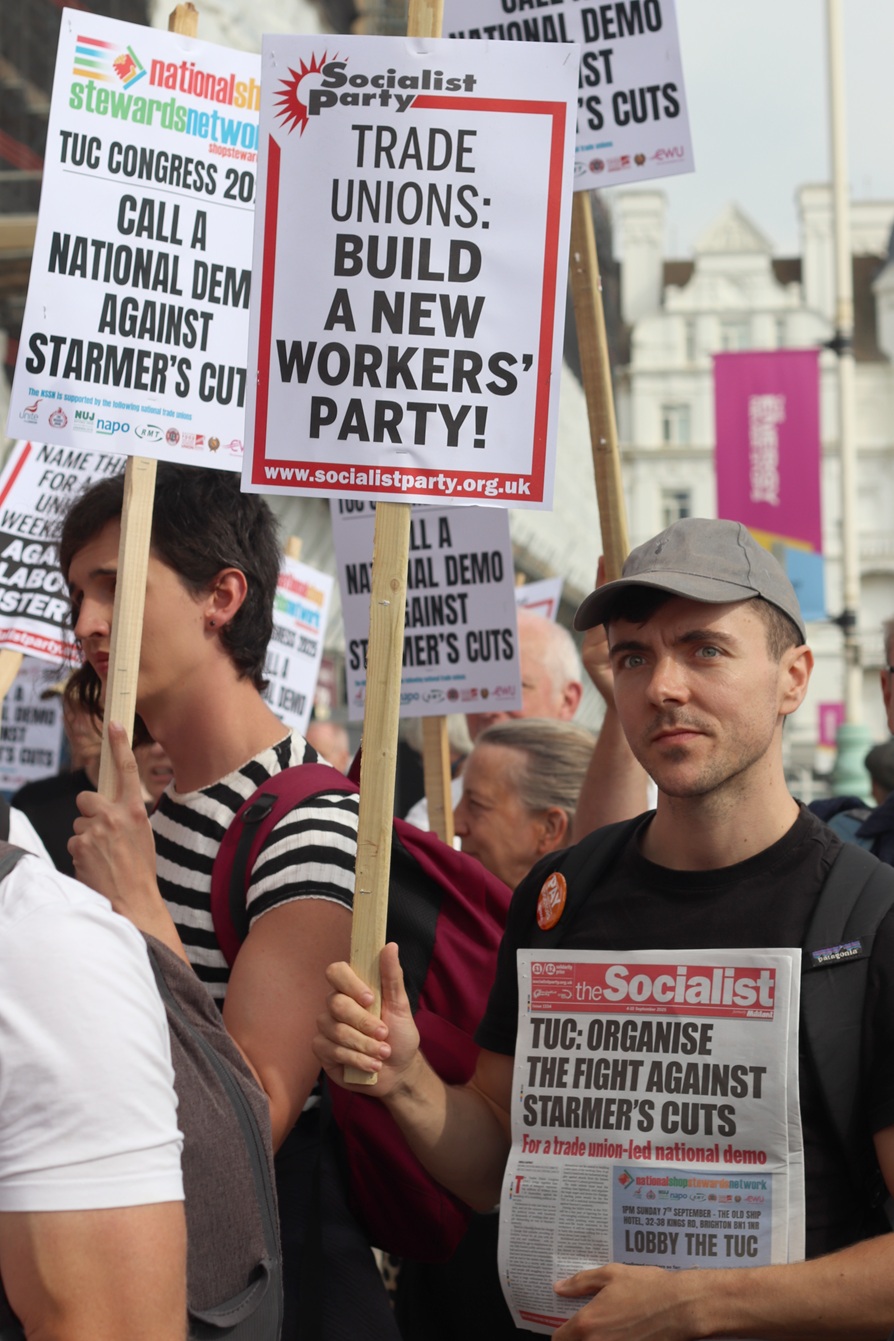
The Socialist Party argues for the trade unions to lead in the process of the working class creating its own mass party. We argue for the unions, as existing mass organisations of the working class, to have a democratic voice inside Your Party.
Any political force and its elected representatives, let alone a new mass party, will come under contending class pressures. Your Party councillors will, for example, enter into meetings with council officers and commissioners telling them they have to obey the ‘rules’ – capitalist rules – and continue to cut services and raise taxes on workers.
Trade unions’ collective voice in the democratic structures of Your Party would give those councillors confidence that behind them in defying Starmer’s austerity is the strength of the organised working class. That was the role, for example, of the Liverpool District Labour Party, made up of delegates representing thousands of organised workers, during the successful struggle, led by Militant, against Thatcher. (see ‘Liverpool’s Militant Labour council struggle – lessons for democracy’ at socialistparty.org.uk)
The fight for the working class to have its own mass political party goes hand in glove with the struggle for democratic trade unions, armed with a fighting programme.
The July Policy Conference of Unite the Union, currently the Labour Party’s largest affiliated union, voted to suspend then deputy leader of the Labour Party Angela Rayner from membership and to discuss the union’s relationship with Labour. Socialist Party members and supporters helped to give expression to the anger of delegates at the role of Birmingham Labour council trying to ‘fire and rehire’ bin workers to impose an £8,000 a year pay cut, backed by Rayner and the Labour government.
Members of the misnamed United Left (UL) group in the leadership of the union had hoped to use the conference to try to overturn the union’s position that councils should set no-cuts, needs-based budgets, in favour of “working with Labour councillors in lobbying the government for more funds”. Faced with the overwhelming mood of delegates, UL stepped back from its attempts to act as a shield for Starmer’s government.
In Unite the Union, Socialist Party members will continue to fight to keep the union’s leadership out of the hands of those who want ‘partnership’ with Starmer’s government carrying out austerity, as well as fighting for the union to lead in developing a political voice of the working class. Including, as part of ‘Trade Unionists for a New Party’, winning support for the model motion calling for the “convening of special policy and rules conferences to draw political and organisational conclusions, potentially including the building of a new workers’ party, standing and supporting workers’ candidates, calling for a conference across unions to build a political alternative for workers on a pro-worker, socialist programme.”
