

Build workers’ struggle against reaction
Javier Milei, Argentina’s right-wing ‘libertarian’ president, won the country’s 2025 midterm elections, significantly strengthening his political position and ability to push forward with his reactionary economic policies.
Hugo Rodriguez and Pedro Albornoz (CWI Chile) look at the election results, the record of Milei’s anti-working-class government and the failure of the Peronist opposition to offer an alternative to working-class voters.
Javier Milei has achieved a resounding victory in the Argentinian midterm elections. This scenario was not predicted by any poll, much less by the Peronist opposition.
Milei’s Libertad Avanza party won the election to elect half the Chamber of Deputies with 40.59% of the votes, going from 37 to 93 deputies. And in the election for a third of the Senate it rose from 6 to 19 senators, a chamber in which it obtained just over 42% of the votes. But the big surprise was how it overcame the gap in the province of Buenos Aires, the country’s main electoral district where, on 7 September, it had lost by almost 14 points to Peronism. In this election it was just one point. However in the separate electoral district of Buenos Aires city, Milei’s party won just 25%.
Nationally, Fuerza Patria, the Peronist alliance, came in second, with just 33.64%. The third force, with 6.94% of the vote, was the Provincias Unidas Alliance, a force of six governors that was trying to occupy the political centre.
It should be noted that approximately 67.37% of the electoral roll voted in these elections. This was the lowest turnout in recent years; two years ago, when the president was elected, it was 77.01% and, before that, 70.83% in the 2021 midterm elections. Fourth place went to the Frente de Izquierda (FIT-U), a coalition of the ‘Trotskyist’ left, with 3.9%, down from the 5.53% in the previous midterm elections in 2021.
It is essential to analyse why the government won despite attacks on large sectors of the population and the ongoing deep economic crisis.
There are undoubtedly several factors that contribute to explaining what happened. On the one hand, there is acute social fragmentation and polarisation. The consolidation of the anti-Peronist vote is clear in recent Argentine history. This vote has been consistent and has always hovered around 40%. This vote is made up of the traditional right-wing conservative vote but also includes support from popular sectors that have suffered greatly from Peronism, especially during the last government of Alberto Fernández. This includes important sectors of the younger population who reject traditional parties and have seen in Milei a hope for change.
Furthermore, the Argentine population has faced a polarised and extortionate electoral situation, where they have been forced to vote for the lesser evil. Between Peronism, which has not led struggles, which does not present a clear alternative programme, and which only proposes managing capitalism in permanent crisis. And a government that, during the economic crisis, has intelligently argued that the opposition’s victory would mean the country’s collapse.
Finally, the government’s last-minute bailout by Donald Trump and the US Treasury has temporarily sustained the economy and the exchange rate, thereby somehow controlling inflation. This issue has been fundamental for broad sectors of the population. Trump’s support and his threat to abandon Argentina if the opposition won have had a significant impact on the election results.
It should be noted that the geopolitical interests of the United States under the Trump administration and its trade war with China have been key reasons for supporting Milei’s ultra-neoliberal government in the region.
Why the defeat of Peronism?
As revolutionaries and fighters for a socialist society, it is necessary to dig beneath the surface to find the reasons for this defeat of Peronism.
On the one hand, for the Argentine population and working class, the traditional parties have not offered any alternative to solve the problems they have endured for decades.
This election demonstrated that criticism of the government’s fraudulent actions is not enough. There are important sectors who did not vote; more than 30% of the population abstained; because they don’t believe in anyone, they don’t believe in the institutions. Furthermore, with Milei’s limited representation in parliament, some Peronist and Radical parliamentarians voted for some government laws.
The complete discrediting of the opposition and the lack of a party that genuinely represents the working class explain the advance of the populist and far right, not only in Argentina but worldwide.
What we will undoubtedly see in the future will be a government of crisis. Despite all the dollars the United States can send, they will not be able to resolve the serious structural problems of Argentine capitalism.
With this result, the attacks on workers’ rights will continue. A labour reform is already being announced to introduce greater job insecurity, increase working hours, and make collective bargaining agreements more flexible, making them reversible. According to a government official, this is “a very necessary measure for job creation” and economic growth.
The union leadership, which has played a passive role in these two years, will be put to the test, once again.
Much anger is building, much rage, and some current analysts and commentators are speaking of the urgent need to make a change to channel this debacle within the institutional framework, before it is too late and a situation like the civil unrest that took place in 2001 occurs again. This situation could be catastrophic and turn into a bloodbath.
It must be remembered that the results are misleading. If we consider the high percentage of abstention, we find that the government obtained only about 25% support.
A government of crisis
This will be a government of crisis, that will not change. On the contrary, with each measure against the rights of the working class, the crisis will worsen.
The political situation in Argentina shows the complete bankruptcy of Peronist reformism on the one hand, and of the trade union leadership on the other.
Milei’s government has weathered major social conflicts with relative success, despite the colossal failure of his economic programme and actions linked to crime and fraud.
Shortly after Milei took office, he began a brutal attack on the living standards of the working class. His two main axes for governing are to overcome the fiscal deficit inherited from previous governments and lower inflation.
We must remember that the previous president, Alberto Fernández, took office with inflation running at 36% and left office with a rate above 210%.
To face these challenges, the promise was to make the elite pay the cost of the crisis. What was never specified was who the elite was.
Javier Milei and his government focused their direct action against the most vulnerable layers of the population; cutting public spending on pensions for retirees and medicines for cancer patients; completely paralysing public works programmes.
In his ultra-neoliberal discourse, he claimed that spending on social rights was theft, an attack on private property, and even went so far as to say that, if a town needed a bridge, it wasn’t fair for the entire country to pay the cost of building it; that it should be the townspeople who pay as they would benefit from it.
In addition to brutally attacking the retired protesting for pensions improvements, the police shot a photographer and reporter in the head, who to this day remains hospitalised and in a serious condition after eight months of treatment.
There was also an episode of a massive scam. The government became embroiled after it backed the buying of a crypto currency (Libra). When it was promoted by Milei, the Libra rose by 1,200% in just a few minutes. It then collapsed, resulting in the loss of millions of dollars by 40,000 investors.
Regarding the economy, Milei’s government has been determined to keep the price of the dollar anchored at the cost of intervening in the foreign exchange market, injecting billions of dollars to keep the peso overvalued. These dollars come from the savings of thousands of middle-class Argentines, loans from the World Bank, the International Monetary Fund, and most recently from the US Federal Reserve Treasury.
All these measures have led to a rise in poverty rates. Thousands of families are unable to make ends meet. Consumption fell 6.3% in one year and in September it fell by 7.9% compared to August. Thousands of small industries closed, laying off thousands of workers.
As well as the economic debacle, repression. Javier Milei endured humiliation at the hands of Donald Trump in his eagerness to receive an economic bailout. Milei has also promoted the plundering of Argentina’s natural resources.
Lack of a working-class organisation
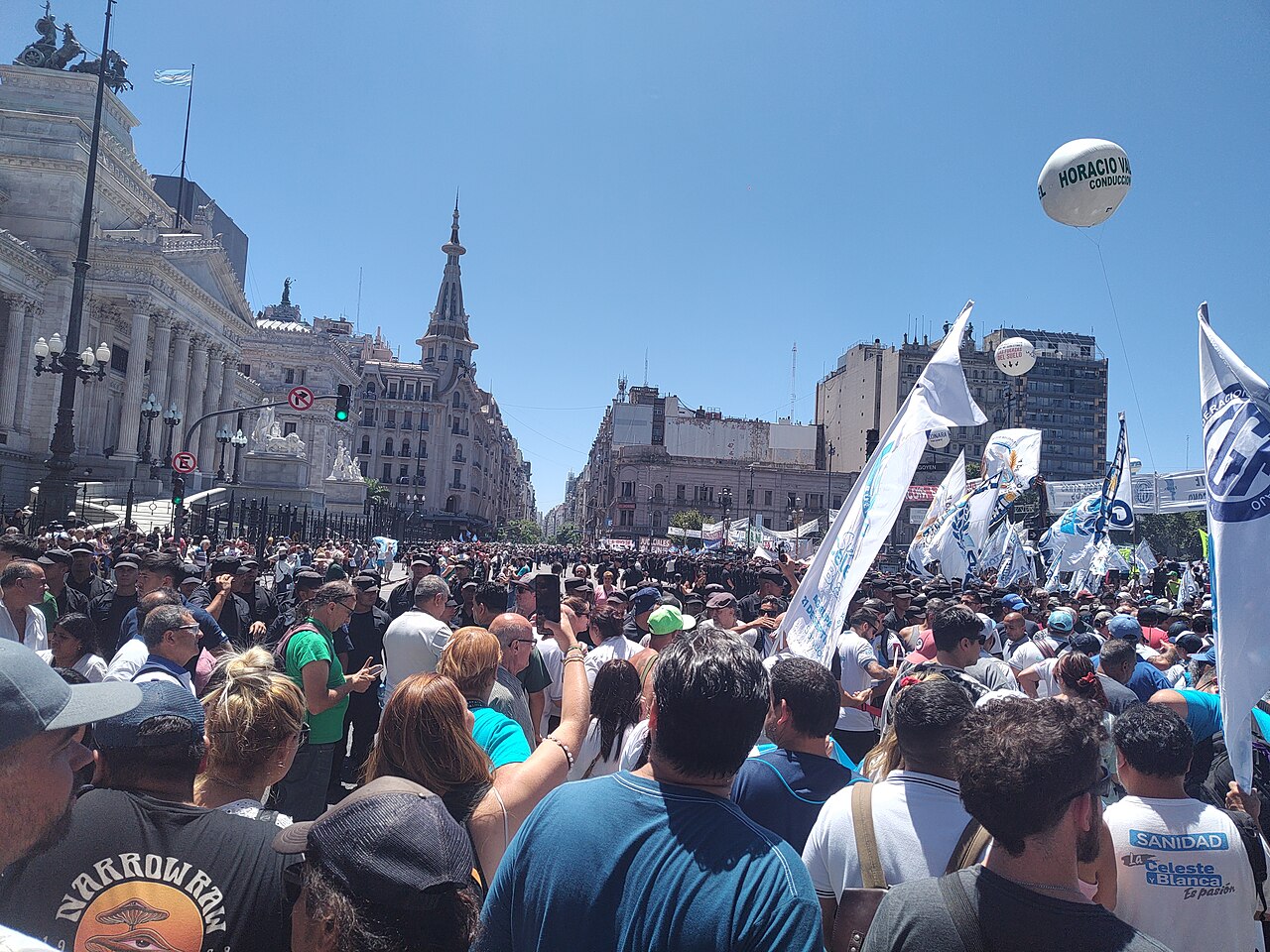
The trade union movement has been conspicuous by its absence at most demonstrations against Milei’s policies. And in Congress, a large portion of the Peronist parliamentarians have been miserably aligned with the government’s policies.
All the above highlights the lack of a working-class party that can lead a fight against the brutal attacks on living standards.
The global capitalist system is in crisis, and all measures to find a solution are aimed at stripping away social rights achieved through decades of struggle.
If we are unable to build a revolutionary organisation aimed at changing the capitalist system, humanity will continue to be in danger, wars will continue, and deaths from hunger will continue.
Only a socialist society, which focuses on social wellbeing and not on individual accumulation, can solve the problems of education, healthcare, lack of housing, jobs, and care for nature.
It is the system that is in permanent crisis, and many governments in the region face the same challenge. If there is no real alternative for the working class, Argentina will continue to go from crisis to crisis.
Only a revolutionary, class-based organisation can provide a solution to the current crisis, raising the banners of socialism and a true workers’ democracy.
What is Peronism?
Peronism is a populist, nationalist political movement peculiar to Argentina. It draws inspiration from the presidencies of the late Juan Perón.
Perón was an army general who headed the labour ministry in the country’s fascist-sympathising military dictatorship between 1943-46, where he embroiled the trade union tops into the state machine.
He was elected president in 1946, against the declared interests of US imperialism, and moulded his vision of a corporatist state with ‘new deal’ social reforms.
These included popular measures such as nationalisation of transport and public utilities, promoting trade unions, raising wages, and implementing progressive social programmes – set against a very favourable economic background.
This pro-worker and anti-imperialist stance bolstered his political reputation among sections of the working class.
Perón’s radical reputation was further enhanced following his overthrow in 1955 by military chiefs, backed by the capitalist ruling class. In exile, he courted the revolutionary left, however, he also maintained links with far-right and fascist groups.
Perón went on to briefly become president again during a period of massive political instability in Argentina. During the struggle between the left and right wings of Peronism, he led a brutal clampdown on the urban guerrillaist Monteneros and the left wing.
Perón died in 1974 and was succeeded by his third wife Isabel Perón, whose presidency was overthrown in 1976 by a brutal US-backed military coup d’état.
Perónism, at its height, was a form of ‘bourgeois bonapartism’; a regime where the machinery of the capitalist state temporarily elevates itself above the contending social classes in society, striking blows against one another, while ultimately representing the overall interests of capitalism. In recent decades, the Peronist opposition has moved significantly to the right.