


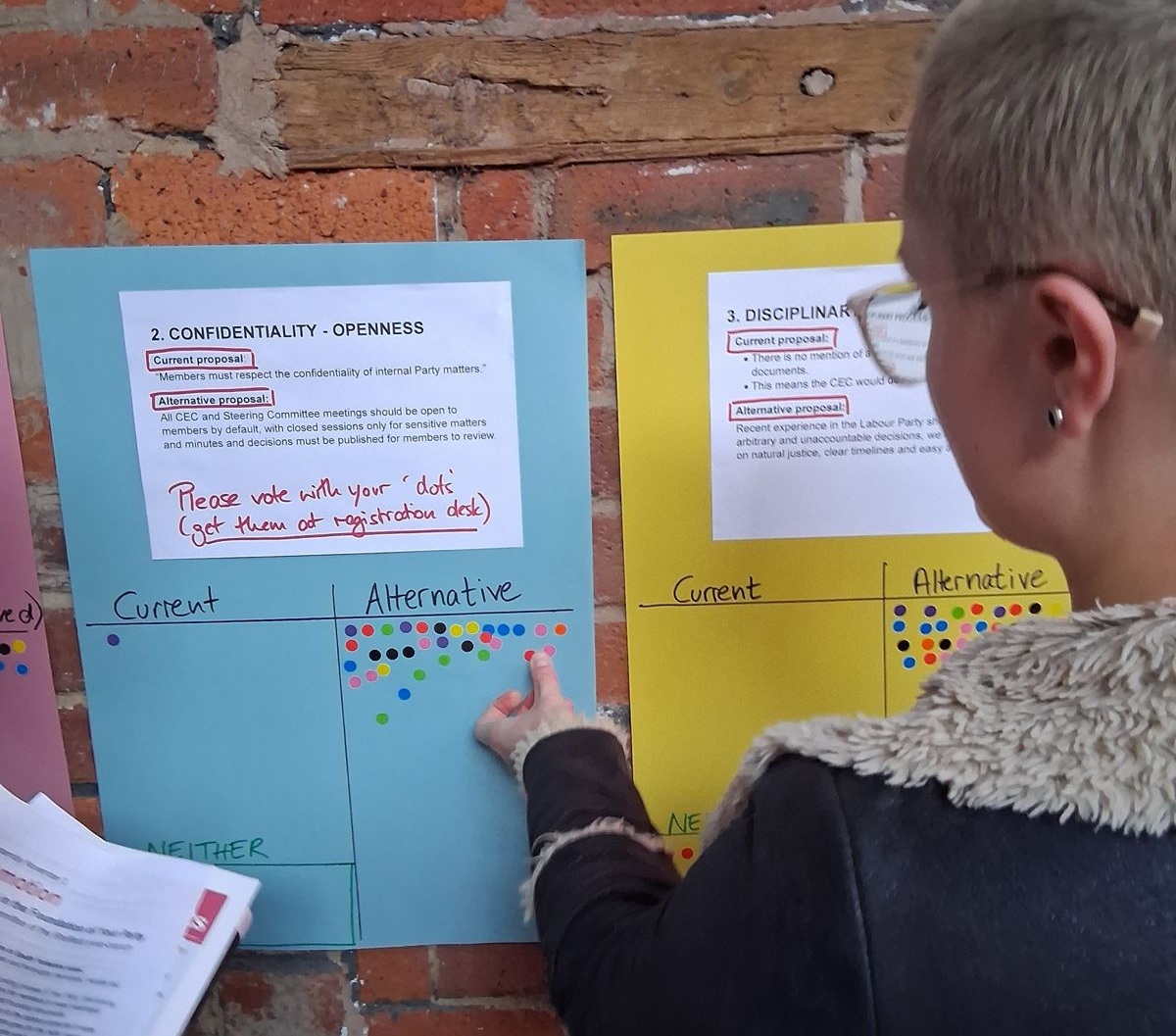
South Yorkshire – critical ‘dot-ocracy’
Alistair Tice, Yorkshire Socialist Party
Around 200 members attended, including from East Midlands where no regional assembly is planned. Whilst most were from an older layer of activists and ex-Labour Party members, there were some people attending their first Your Party meeting since signing up to the website in the summer, including some younger people.
Unlike others so far, our assembly was run entirely by local activists because, for reasons not explained, no national facilitators attended. Whilst largely sticking to the Your Party HQ agenda of debating 11 sections of the four founding documents, it allowed more flexibility for breakout groups to decide what they wanted to discuss. It also meant consultative votes were taken during the closing plenary session, on the founding documents and on alternative proposals put forward by the recently elected Sheffield proto-branch interim steering committee.
There was also an innovative use of ‘dot-ocracy’, whereby participants voted on the proposals and alternatives by sticking coloured dots on prepared voting charts, which were reported on in the final session.
In 8 out of 9 cases, the Sheffield alternatives to the founding documents were overwhelmingly supported. There was strong opposition to sortition and the lack of representative democracy. There was support for a “party of the whole left” and against bans and proscriptions. There was a strong demand for official branches to be set up immediately, for standing widely in the May council elections to counter Labour and Reform, and with local branches selecting their own candidates.
Unfortunately there was no discussion about no-cuts council budgets but a motion will be debated at the next Sheffield proto-branch meeting proposing that all Your Party candidates should commit to such a policy before selection.
Unfortunately, a last minute amendment that “trade unions and other bodies should not have separate arrangements or special privileges” was carried in a rushed closing session with no time for real debate.
If Your Party is to have “the working-class at its heart” then the collective voice of 6.5 million trade unionists must be its concrete expression. The battles inside trade unions to disaffiliate from Labour and establish a new workers’ party will also include the struggle for democratic control of union policies and leaderships.
Notwithstanding the limits of the regional assemblies, the Sheffield event ran smoothly, allowed members to strongly criticise the Your Party leadership proposals, and generated enthusiasm to get on with building Your Party in local areas. Most attendees left feeling more positive than when they had arrived.
Manchester – ideas exchanged but no decisions made
Martin Powell-Davies, Lancashire Socialist Party
As expected, the format of the meeting was for volunteer ‘facilitators’ to take ‘breakout groups’, of a dozen or so attendees each, through the detail of the four draft founding documents.
At the start, an attempt was made to propose that the assembly first began with a full group discussion. However, the facilitators countered that this would prevent everyone’s voices being heard in the way that small group discussion would allow. That seemed to get a certain echo, perhaps reflecting a desire to avoid discussion being curtailed and top table speakers dominating.
The rest of the day was, therefore, spent in groups. This approach does allow an easier exchange of ideas between individuals but, of course, limits that exchange only to the views within that particular group.
Structuring discussion around the constitutional documents meant there was limited opportunity to discuss concrete policies and campaigns, such as organising around no-cuts ‘People’s Budgets’ in preparation for standing as widely as possible in the May elections. It also risked getting bogged down in detail, rather than having a wider discussion on the tactics needed to successfully “build a mass party with the working class at its heart”, as set out in the draft ‘political statement’.
Nevertheless, every group engaged in serious and constructive discussion with a range of amendments and suggestions being put forward. There appeared to be general agreement across most groups over, for example, allowing members of other parties who support ‘Your Party’ to join it, for the Party’s MPs to be on a ‘workers’ wage’, for decision-making to take place through elected delegates rather than through random selection by ‘sortition’, and for the launching of formal branches without further delay. There was concern that the current draft ‘Organisational Strategy’ suggests that such local structures would still not be in place by May 2026.
Trade unionists warned that the current proposal to postpone discussion on whether unions could affiliate for another twelve months only played into the hands of those who want to keep unions tied to Starmer’s Labour.
While it was a valuable opportunity to exchange ideas, the Assembly also showed the weakness of the individualised ‘horizontalist’ decision-making seemingly favoured by those drafting these documents. Instead of the Assembly voting collectively on amendments, or electing delegates to attend conference to put forward its views, the only formal outcome was that the facilitators’ notes would be passed on to Your Party.
South London – support for no-cuts stand
Sofia Pandolfi, South West London Socialist Party
Right from the start, there was a clear mood of both excitement at the creation and potential that this party could have in addressing the crisis in Britain today, as well as doubt in how the party was being organised.
The attendees were grouped in tables to discuss sections of documents and fill out answers to specific pre-proscribed questions. Each discussion was managed by facilitators, yet the lack of facilitators for the number of people meant some groups took it upon themselves to ‘self-facilitate’.
Generally, there was scepticism on how these discussions would have any impact in influencing changes to the documents. This brought further questions on how members could have their voices heard in the upcoming founding conference of 13,500 members.
In addition, the undemocratic methods of sortition to select attendees for the conference and the voting system of ‘one member one vote’ were questioned by the majority. Instead, there was agreement that elected delegates, accountable to their communities and organisations, could more effectively represent members’ views.
Socialist Party members argued for Your Party to adopt a federal structure, explaining the role of the trade unions in building a new workers’ party. This received support, with agreement that this party needs to represent the working class and put forward socialist demands. Trade unions, bringing together the largest number of organised workers in Britain, are crucial in achieving that.
The upcoming local elections in May 2026 were another significant point of discussion. Many felt that participating in elections was an immediate need for Your Party but were unsure of how the party would prepare itself for that in time. In the party’s draft Organisational Strategy for its first year, it states that Your Party will “seek to support all Independent socialist candidates of good standing”.
Questions were raised on what is meant by ‘good standing’. Socialist Party members argued for the need for no-cuts candidates who pledge to stand for anti-austerity demands. This could ensure candidates are not simply in ‘good standing’ but are accountable to protecting services and fighting for working-class communities. In these discussions, the demand for Your Party candidates to fight for no-cuts council budgets gained support.
At the end, a few facilitators were chosen to report back on the aspects of the document they had discussed. We also had the opportunity to show whether we were in support of the draft Political Statement by using different coloured stickers.
While these ineffective methods reflected the lack of democratic building within Your Party so far, the widespread support for our demands showed the importance of continuing to campaign for Your Party to be a socialist, anti-austerity alternative to the other mainstream parties today.
