

Niall Mulholland, Committee for a Workers’ International
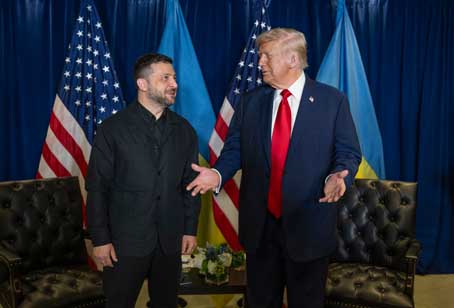
The war in Ukraine has returned to the top of global headlines following US president Trump’s latest attempt to impose a peace plan on Ukraine president Zelensky. Trump’s new “28-point Ukraine peace plan”, which was drafted “with Russian input”, would impose huge concessions on Kyiv.
The plan was conceived over the heads of the European powers and the Ukraine government. Ukraine would be required to cut its armed forces by 50% and face strict limits on future military build-up. Kyiv would have to surrender long-range missiles, heavy artillery, and parts of its defence systems. Ukraine would be obliged to permanently hand over all remaining parts of the Donetsk Oblast still under its control to Russia.
The plan corresponds to a key Russian demand that would bar Ukraine from joining Nato and would restrict deployment of Nato troops on Ukrainian soil. Crimea, which was annexed by Russia in 2014, would be internationally recognised as Russian under the plan. And Trump’s plan would see Russia welcomed back into the G8.
In private, European officials have called the plan a “capitulation”. In public, they have to be much more circumspect, given that the United States is the main funder and arms supplier to the Ukrainian army. French, German and British governments have said the plan contains “important elements” but “requires additional work” to ensure lasting peace. They note that neither the EU nor Nato were consulted about the deal plans. EU officials have added that halving Ukraine’s military would leave it vulnerable to future military attack and that conceding territory legitimises Russia’s war of aggression.
While Vladimir Putin has expressed cautious approval, he is expected to push for stricter constraints on Ukraine’s military and to reject any proposed Nato-like security guarantees for the country.
There are major economic benefits for the US should Trump’s plan see the light of day. By forcing Ukraine to reduce its armed forces and limiting Nato involvement, the US could scale back billions in military aid and redirect resources to other parts of the world. Sanctions relief for Russia would stabilise global oil and gas markets. American companies would gain rights to share profits and royalties from Ukraine’s critical minerals. Reintegrating Russia into the G8 would open new markets for US firms. And the US would control mechanisms that deliver economic rewards to Russia, allowing the US to shape global capital flows.
When asked what would happen if Zelensky refused to sign the proposal, Trump dismissively retorted: “He can continue to fight his little heart out.”
The reality is Trump’s deal is hugely in Moscow’s favour. All the red lines put forward by Zelensky, other European leaders and the previous Biden administration are being crossed. It would mean losing territory, military capacity and aspirations to join Nato. And Russia would regain legitimacy and reintegration into global institutions.
This is too much for European powers to stomach. At a hastily called meeting in Geneva on 23 November, involving senior figures from the US, Ukraine and Europe, the European leaders tried to delay, dilute, fundamentally renegotiate or sabotage Trump’s plan.
For the EU and Britain, the plan signifies Trump’s wish to withdraw from the Ukraine conflict and leave European powers largely to pay for post-war economic and military costs. It signifies dramatically that the US will no longer be the superpower behind the backs of the European nations or Nato in all circumstances.
Should Zelensky unequivocally reject Trump’s proposed peace plan, Trump has threatened to cut off crucial US military and intelligence support. Facing such pressure, both Kyiv and European leaders might find themselves compelled, albeit unwillingly, to engage with the substance of Trump’s initiative and to agree to major concessions. It is also possible that the Trump peace plan cannot be agreed and unravels.
Facts on the ground
The backdrop to Trump’s plan is the facts on the ground. For weeks, Russian drone barrages have made strikes on Kyiv and against energy facilities and infrastructure, causing widespread power cuts and rationing, as winter bites.
As the grinding war now approaches four years, it is clear that Russia is winning in its ambitions, and that both sides have had to pay enormous costs in human lives, infrastructure and economically.
Facts and figures are hard to verify given the massive propaganda from both sides in this conflict. The United Nations, as of October 2025, has verified 53,000 civilian casualties, of those, 14,000 deaths. Military casualties are extremely high. Estimates vary widely but it is likely that hundreds of thousands on both sides have died.
The war has caused enormous economic destruction. Ukraine’s gross domestic product collapsed between 2022 and 2023. Infrastructure damage is in the hundreds of billions. The energy, agriculture and manufacturing sectors in Ukraine have been devastated.
The massive displacement of people in Ukraine due to the war has caused severe pressure on public finances, which are heavily dependent on Western funding.
Russia, in turn, has been hit by sanctions. Inflation has grown and foreign investment collapsed. Moscow has shifted trade towards China and India, and embarked on a huge military build-up and new military alliances, including with North Korea.
The war has represented a geopolitical turning point. It marks a major rupture in global relations and intensifies great power rivalries.
Under the presidency of Trump, a major shift in US policy quickly emerged. Trump has correctly judged that Ukraine cannot win the war and he wants to bring the war to an end so that US resources can also be redirected towards South East Asia and confronting the growing power of China.
Since he came in to office, Trump has had a very strained relationship with Zelensky. He has been consistent in arguing that Ukraine has to accept that Russia will keep significant parts of territories it occupies.
Trump’s meeting with Putin in Alaska last summer triggered panic amongst European powers. Many of them rushed to the summit to act as a buffer for Zelensky. They were terrified that the Ukrainian leader would face the same type of humiliation as he did when he visited the White House early this year, when he was hectored by Trump and Vice President JD Vance, in front of the world’s media.
European powers have acted to obstruct any meaningful negotiations; their aim has been a forlorn hope that, as the war continues, Russia can be eventually exhausted and forced into retreat. Their long-term objective is to destabilise or collapse the Putin regime. However, although many European leaders are bellicose, the European Union is divided, to some extent, on the Ukraine war.
Deep splits in Europe
Many leaders in Europe, such as Starmer in Britain, are determined to fight to the last Ukrainian’s life, to defeat Putin. But deep splits exist inside the EU. Hungary and Slovakia have broken with the EU war policy.
After the collapse of an initiative for talks in Budapest in October, Trump lashed out at Putin. He announced a new round of sanctions, which were tougher and more targeted than previously. No doubt the sanctions are painful, but they are far from decisive blows against the Russian economy.
For now, Putin appears relatively secure. He has defeated internal challenges during the war, including the mutiny led by the Wagner military group in June 2023. Russia’s military position has improved and is now dominant in drone warfare. Drones are responsible for an incredible 70-80% of casualties.
A massive military mobilisation process allows Russia to throw far more soldiers into the ‘meat grinder’ than Ukraine can do with a much smaller population. Nevertheless, there will have been pressures growing on Putin over the last few months. There is a growing war weariness and anger from families of dead soldiers. Putin’s position could well be shaken if the economy seriously falters or the war drags on without more decisive breakthroughs.
Ukraine’s position is far more perilous. Despite huge Western military and financial backing, Ukraine is on the defensive and losing ground. State corruption, which saps at the war effort and morale, remains rampant.
Public sentiment is shifting in Ukraine. Only about 24% think the war is worth fighting until victory. Zelensky has been forced to seek more protection and support from European powers since Trump has come to office.
But the EU is divided on war financing. Sharp debates take place within the EU on how to continue funding Ukraine’s war effort. The latest European Commission proposal is to use loans backed by frozen Russian state assets. Other ideas are a levy on EU member states. But this faces strong opposition.
Most European states face weak growth, high debt levels and high interest rates, and are unwilling to take on new economic burdens, despite their tough talk about fighting Putin to the end.
After the Alaska talks, Trump escalated threats against Russia and said he was considering sending Tomahawk missiles to Ukraine. This has long been a demand of the Zelensky government. But Trump pulled back after his military advisers warned this would be a major escalation.
The war will eventually end, formally or informally, at some point. But all the diplomatic acrobatics in Alaska and the attempts to have further talks in Budapest hide the reality that the battlefield will determine the timing and balance and outcome of any talks, fundamentally. At present, Putin holds the initiative. He can continue to gain territory and further weaken the Zelensky regime.
Zelensky, in turn, fears serious negotiations. He will enter from a position of severe weakness. Current polls in Ukraine show that he’s likely to lose an election. His stance of refusing to negotiate while losing territory is a dangerous gamble. It has the risk of a regime crisis in Ukraine. The possibility of Zelensky being removed and replaced by a figure more open to the Trump line is possible.
Whether the war comes to an end through formal negotiations at this stage or not, we can see the outlines already. Barring any military catastrophes for the Russian army, it is clear that Putin will hold large chunks of eastern Ukraine and Crimea. On this basis, Ukraine will be a divided country, heavily militarised on both sides. It will join other so-called ‘frozen conflicts’ in the former USSR; except these are not frozen, as ongoing fighting continues at different levels, with endemic instability and periodic flare-ups.
In the case of Ukraine, the risk of renewed war, with potential spill-over across eastern Europe and further afield, will be inherent in a post-war situation.
Ukraine will have lost large parts of its territory, and is left with a devastated economy. Russian workers also, of course, have to bear the cost of the war economy in Russia, and the tightening of Putin’s authoritarian regime.
Deep capitalist crisis
This disaster, which has befallen the people of Ukraine and Russia, reflects the deep crisis of global capitalism and shifting geopolitical relations. After 1991, the US acted as the sole superpower, imposing its agenda from the Middle East to Afghanistan and beyond. However, US imperialism is in relative decline. The US economy, still the strongest in the world, is also in relative decline, with China rapidly closing the gap and going ahead in some sectors. The US remains militarily dominant on the planet, but China has massively expanded its capabilities militarily. The world is increasingly unstable.
The CWI opposed the 2022 Russian invasion, arguing NATO expansion cannot justify Putin’s chauvinistic, reactionary war, which damages working-class interests.
The Ukrainian people had the right to resist Russia’s 2022 invasion. Their response forced a Russian pull-back from Kyiv to the east. Putin misjudged Ukrainians’ willingness to fight, and NATO’s willingness to support a prolonged war.
In eastern Donbas, bombarded by Ukrainian forces since 2014, the wishes of the population is unclear, but it is certain that they reject the rule of Ukraine nationalist chauvinist regimes, yet are wary, to put it mildly, of Putin’s rule.
Putin annexed Crimea in 2014, following a pro-Western coup in Kyiv. Crimea was historically transferred to Ukraine by Khrushchev in the 1950s, where many identify with Russia, though minorities like Tatars feel oppressed.
Socialists advocate for a democratic, unhindered self-determination for Crimea and the Donbas region, overseen by independent working-class organisations.
The most fundamental problem facing the impoverished masses in both Ukraine and Russia is the lack of independent workers’ organisations and strong socialist movements, creating a vacuum filled by reactionaries, ultra-nationalists, and chauvinists, fuelling the war.
The CWI has supported the demand for the immediate withdrawal of Russian forces, an end to Western arms for the Zelensky regime. We reject ruling-class ‘peace plans’ like Trump’s, made over the heads of the working people of Ukraine and Russia.
Socialists need to oppose any peace deal imposed from above by different imperialist powers and the Ukrainian capitalist government. At best, for a time, it will freeze fighting. The real solution lies in building movements from below that can permanently end the war, conflicts and divisions on the basis of allowing working people to decide their future, to defend and restore democratic rights, and work to create workers’ governments that end oligarch rule and break with capitalism. This would begin to create the basis for genuine co-operation in building a new, genuine socialist society.
To reach these goals, requires today building independent, democratic, combative trade unions and socialist organisations to challenge oligarchies and imperialism, leading to workers’ governments that can peacefully discuss their common future and fight for socialist transformation.
