


Duncan Moore, UCU NEC member, standing for re-election
The ballot of members of the University and College Union (UCU) in Further Education (FE) colleges in England closed with a 90% vote for strike action.
A special Further Education Committee (FEC) met on 21 November to discuss the outcome of the FE ballot and decide on strike days.
The national turnout was over the Tory 50% threshold (scandalously still in place more than a year after the election of Starmer’s government). Had this been an aggregate ballot, UCU members in every college would have been able to strike against the collapse in our pay and conditions, and the lack of national, binding collective bargaining agreements.
However, because the right wing of the union leadership, and those around general secretary Jo Grady, took the view that UCU could not win an aggregated ballot, members were balloted branch by branch, disaggregated.
32 branches got over the threshold. This will make for significant nationwide action which we must all build vigorously for.
The national ballot of UCU members in Higher Education closes on 28 November. Four university unions are balloting, raising the prospect of serious national action in post-16 education.
21 branches did not reach the threshold, despite the hard work of reps and activists on the ground. 17 settled local pay negotiations under pressure from the college employers, with some achieving pay rises above inflation, but many getting 4% or lower.
Debate on best way forward
I submitted a motion to the FEC calling for an automatic reballot of branches which got over 40% turnout, with branches getting 30% or more to reballot following a branch meeting to decide if they wanted to be included. This would strengthen the numbers and impact of the dispute. Seeing other branches out on strike would raise the confidence of all members and encourage them to organise to join in the action.
The right wing on the FEC argued against reballoting branches that missed the threshold. Objections were raised to the word ‘automatic’ in my motion on the alleged grounds that this impinged on branches’ autonomy to make their own decisions. But when I offered to amend it to ‘should be allowed’ this was also refused.
Some members of the ‘UCU Commons’ faction that supports Grady argued openly that branches should not reballot, and had effectively missed their chance! Others claimed to support the right of branches to reballot, but were not prepared to call for the national union to back them in doing so, leaving branches on their own. The motion fell ten votes to nine.
A motion brought by Regine Pilling, a member of the ‘UCU Left’ grouping and Vice President candidate, and backed by Socialist Party members, called for strikes to begin in December.
Strikes in the run-up to Christmas are not ideal – we had supported balloting earlier in order to take action in October. But that didn’t happen due to the timetable voted for by the right wing.
But holding off action till January risks losing momentum and could signal to employers and the government that UCU is not serious. College principals will step up efforts to pressure reps into accepting local deals. Action in December would cohere the dispute and counter some of that pressure, in preparation for more serious action in the new year.
But the right wing, again acting on advice of the senior officials, voted to delay strikes till mid-January, losing the first two months of our six-month mandate.
The right wing’s reasoning became clear in the committee secretary’s report. Discussions between UCU officials and the Labour government have yielded little movement, and the right wing do not believe progress can be achieved in the course of this parliament.
But what can be achieved will be decided by fighting for it, not by cosy meetings. UCU members have shown over and over again that they are prepared to fight. But they are suffering from the effects of a leadership which does not have any confidence, and which is not prepared to stand up to Starmer’s government.
We should now argue for regional meetings before Christmas to build up confidence.
United left stand needed for NEC elections
It’s urgent now that the left of the union agrees a single slate for the National Executive Committee elections in January, to give members the fighting leadership they need. Socialist Party members have written an open letter to others on the left to try to achieve this; as a minimum to not run candidates against sitting left NEC members.
Fighting for adult education funding: ‘We haven’t seen lobbies like this in a long time’
David Kaplan
WM College UCU, personal capacity
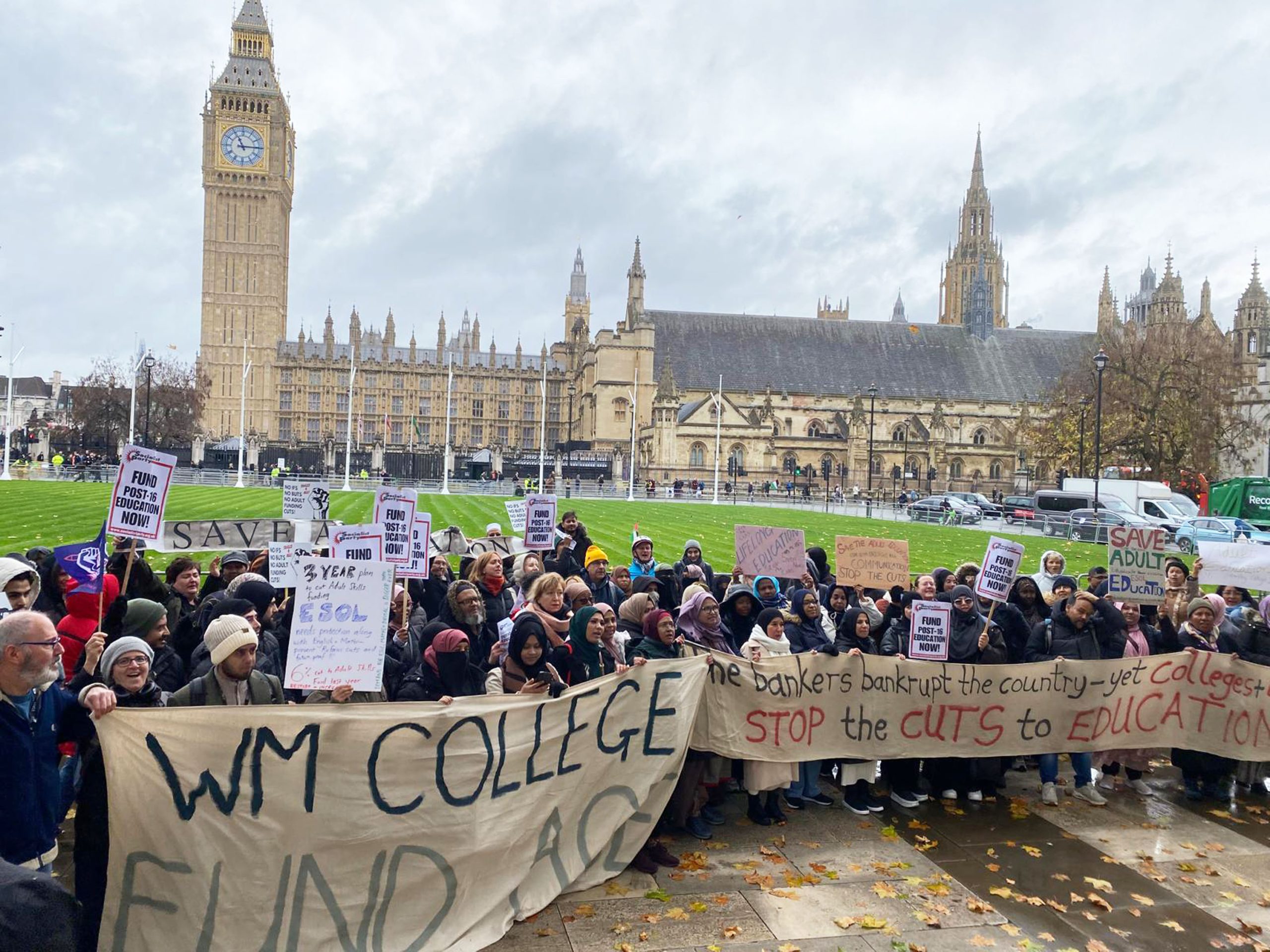
Over 300 students and teachers lobbied parliament on 19 November, calling for proper funding for adult education. The lobby was called by London Region University and College Union (UCU) in advance of Budget Day. We wanted to draw attention to the dire crisis facing adult education, and how a reversal of the cuts since 2010 could provide life-changing education for adult learners in all our communities.
The lobby was even supported by CEOs and principals of some of the London adult education colleges.
About 100 students and staff went from my college, from ESOL (English for Speakers of Other Languages), English and maths departments. I asked one curriculum manager if they were attending: “Of course I am!”
The Post-16 Education and Skills White Paper notes: “8.5 million adults have low proficiency in English, mathematics or both. 7.3 million lack the essential digital skills required for the workplace, and those without a level-2 qualification are far more likely to be out of work.”
The classroom-based adult learning budget fell from £5.1 billion in 2003-04 to £1.7 billion in 2023-24. Spending is now over 60% less than in 2010. There are an estimated 6,000 job vacancies in England’s colleges, with high levels of persistent vacancies in ‘priority’ areas such as construction, engineering, health and social care, science and maths.
Finding a voice
In the build-up to the lobby, students and staff wrote to their MPs. One adult learner described how when she first came to the UK, she did not know a single word of English. Every day felt like a struggle. When she was pregnant with her first baby, she had to ask someone to attend every appointment with her, or hope that her GP could find a translator. Then she joined an ESOL class, which enabled her to find her voice.
Braving the cold and sleet, students and staff from at least seven different colleges protested, then queued up to get into parliament to speak to our MPs. The lucky first 100 were allowed straight in, but others were left standing for more than an hour.
The committee room booked for lobbyists was full to capacity, with some having to leave to allow others to come in. UCU general secretary Jo Grady and president Maria Chondrogianni addressed the meeting. Six or seven MPs also addressed the meeting, including Labour MPs John McDonnell and Apsana Begum, and independent MP Jeremy Corbyn. Student after student spoke of the transformative value of adult education.
One of the MP’s officers said: “We just haven’t seen lobbies like this in a long time.’
