

Scrap all anti-union laws
Fight for a new workers’ party
Editorial of the Socialist issue 1352
“A landmark day for millions of workers”, is how the general secretary of the Trades Union Congress (TUC) Paul Nowak greeted Labour’s Employment Rights Act receiving royal ascent on 18 December.
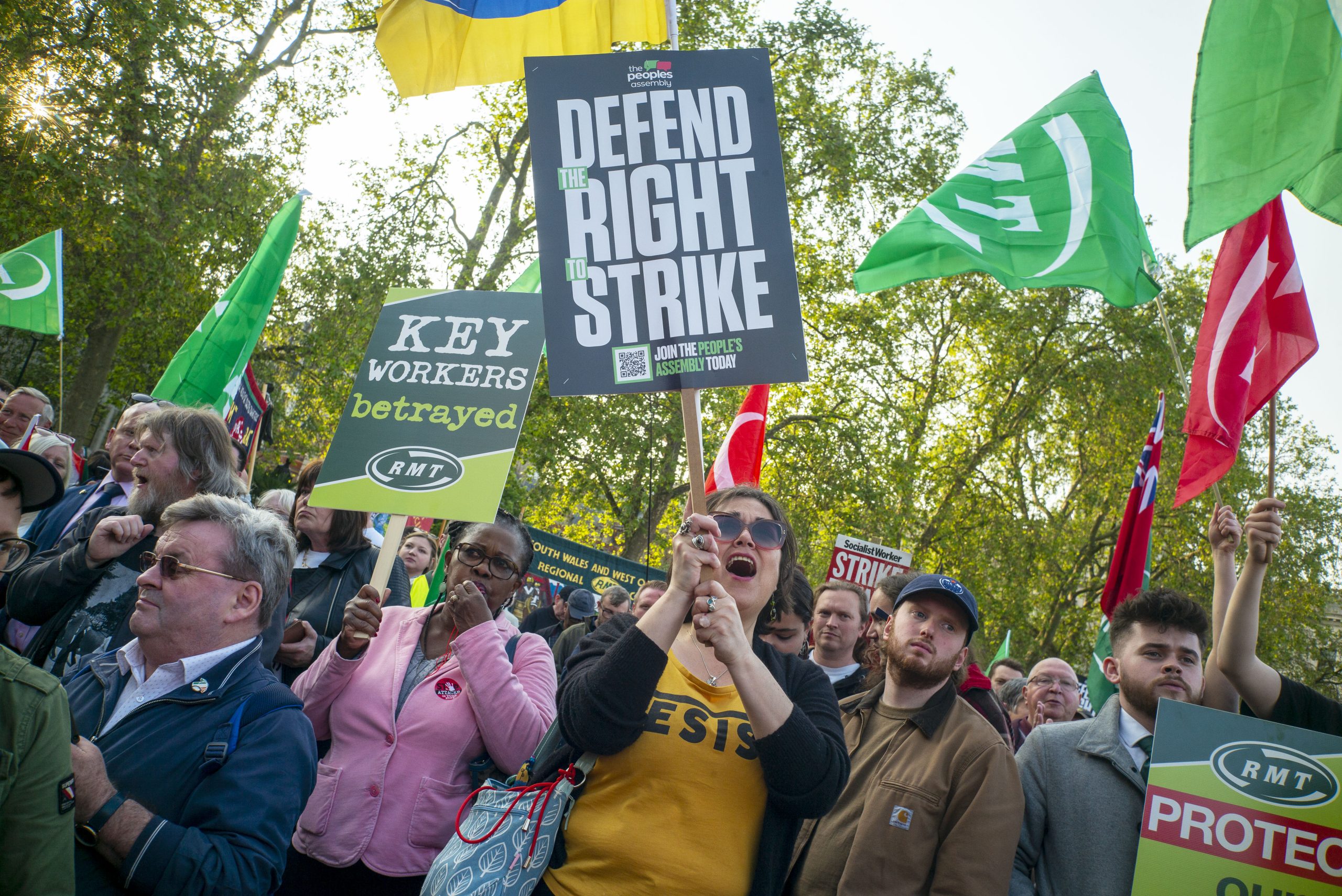
The Labour government proclaims that the vast majority of the Tories’ 2016 Trade Union Act is being repealed. What it doesn’t put in its press briefings is that the most restrictive aspect of that legislation, the undemocratic 50% strike ballot turnout threshold, remains.
A long way short
The reforms in the Employment Rights Act are a long way from the already limited policies Labour adopted in its pitch to win unions’ favour ahead of their 2024 general election victory. Since, policies have been subject to ‘review’ and ‘scrutiny’ by panels with big business bosses and a whole series of obstructions from the unelected House of Lords. The government’s own impact assessment of the legislation as it stands now puts ‘cost to businesses’ at 80% less than under previous assessments of the unamended bill.
In fact, had it wanted to, the Labour government with its 160+ seat majority could have passed emergency legislation on day one of office, abolishing not just the 2016 laws, but all the anti-trade union laws on the statute books. Their ability to pass laws so quickly was shown when, in April 2025, parliament met on a Saturday to take government control of Scunthorpe steelworks to cut across the threat of industrial sabotage by billionaire owners.
In fact, the government has set no date for the 50% threshold to be abolished. Further ‘consultation’ with big business is being discussed, there is also the suggestion that it will be linked to the establishment of the ability to vote electronically in strike ballots – something that can also be used to push the issue back further.
Undoubtedly, on top of a willingness to bend backwards for big business, Labour’s delays are also motivated by a desire to continue to use the Tory laws as a bulwark against workers’ struggles.
Starmer’s Labour is hated by wide sections of the working class. Add to that the accumulated frustration at the ongoing, grinding rise in the cost of living, and squeeze on funding for day-to-day services in the public sector.
The requirement for 40% of members in key parts of the public sector to vote in favour of a strike, an additional barrier on top of the 50% turnout requirement, has been scrapped. Why one and not the other? Because, while a potential obstruction to strikes, in the ten years it has been in law, the 40% requirement has never prevented a major nationwide strike. The 50% threshold, however, has.
The government would love to get through another round of below-inflation, unfunded public sector pay deals, with the 50% threshold still in place. Although it is also true that the misleading headlines that ‘the Tories 2016 anti-union laws are now gone’, can plant seeds in a layer of workers’ heads that there are now fewer legal barriers in the way of fighting back. The government’s growing list of U-turns lay bare its weaknesses too.
Unions debate Labour relationship
As discussions in the trade union movement develop in advance of this year’s conference season, the issue of unions’ relationship with Labour is heating up – fuelled by workers’ own experiences of a Labour government attacking our class.
One of the ways trade union leaders will try to keep heat out of that debate is to point to the Employment Rights Act. They will point to it as an example of what can be achieved with a government that is at least willing to be in the same room as the trade unions. It has to be pointed out, however, that this is a government equally willing to try to carry out attacks on trade union members. A stark example being Birmingham Labour council’s brutal ‘fire-and-rehire’ attack on its bin workers, assisted by the Labour government, its commissioners in the council, and by the courts.
A whole series of union leaders are now making the demand for an employment rights bill mark two, with the aspiration to include in it measures removed in its first iteration. But what forces will fight for it in parliament?
Starmer’s successor
Such is Starmer’s unpopularity, and the fact that it will inevitably be writ large in the May local election results, the capitalist media is in constant speculation about who will replace him as Labour leader and PM. Whoever it is, and whenever it comes, it is likely that his successor will pitch to the left, including trying to lean on support from sections of the trade unions, including with pledges to strengthen union and workers’ rights.
But how would a new Labour leader, especially one able to win support of the required 80 MPs from an overwhelmingly Blairite Parliamentary Labour Party, be any more steadfast in standing up against the demands of big business?
Trade unions taking even modest steps towards independent political representation would in fact have a far bigger effect tipping the scales in the direction of the working class.
That Unison members have elected a new general secretary who in the election pledged to review the union’s relationship with Labour, and that multiple regional bodies in Unite have put the issue of a special conference to do similarly onto the agenda of its Executive Council, shows the pressure that is there from members.
It is vital that the unions put central the demand to repeal all the anti union laws. It is also true that their existence didn’t stop the 2022-23 strike wave from being the biggest in a generation. At several points during those struggles, union leaders were forced to reject offers, and continue action, reflecting the fighting mood of their members.
On the question of political representation, and on the extent to which they are prepared to organise industrial struggles against Starmer’s Labour, union leaders will act under pressure too. Part of the application of that pressure is the struggle in the structures of the unions for a fighting programme and strategy, and for leaderships prepared to carry it out.
