

Editorial of the Socialist issue 1353
Every year a few thousand bankers, industry chiefs, media moguls and capitalist politicians gather at the World Economic Forum in Davos, a resort in the Swiss Alps, to discuss the state of their capitalist system. This year, measured in terms of the wealth of the very richest, Davos participants had every reason to be cheerful. According to Oxfam, billionaire wealth jumped by over 16% in 2025, to $18.3 trillion – its highest level in history. Not a few of those billionaires were there in person at Davos, but cheerful is the very last word that could be used to describe the mood.
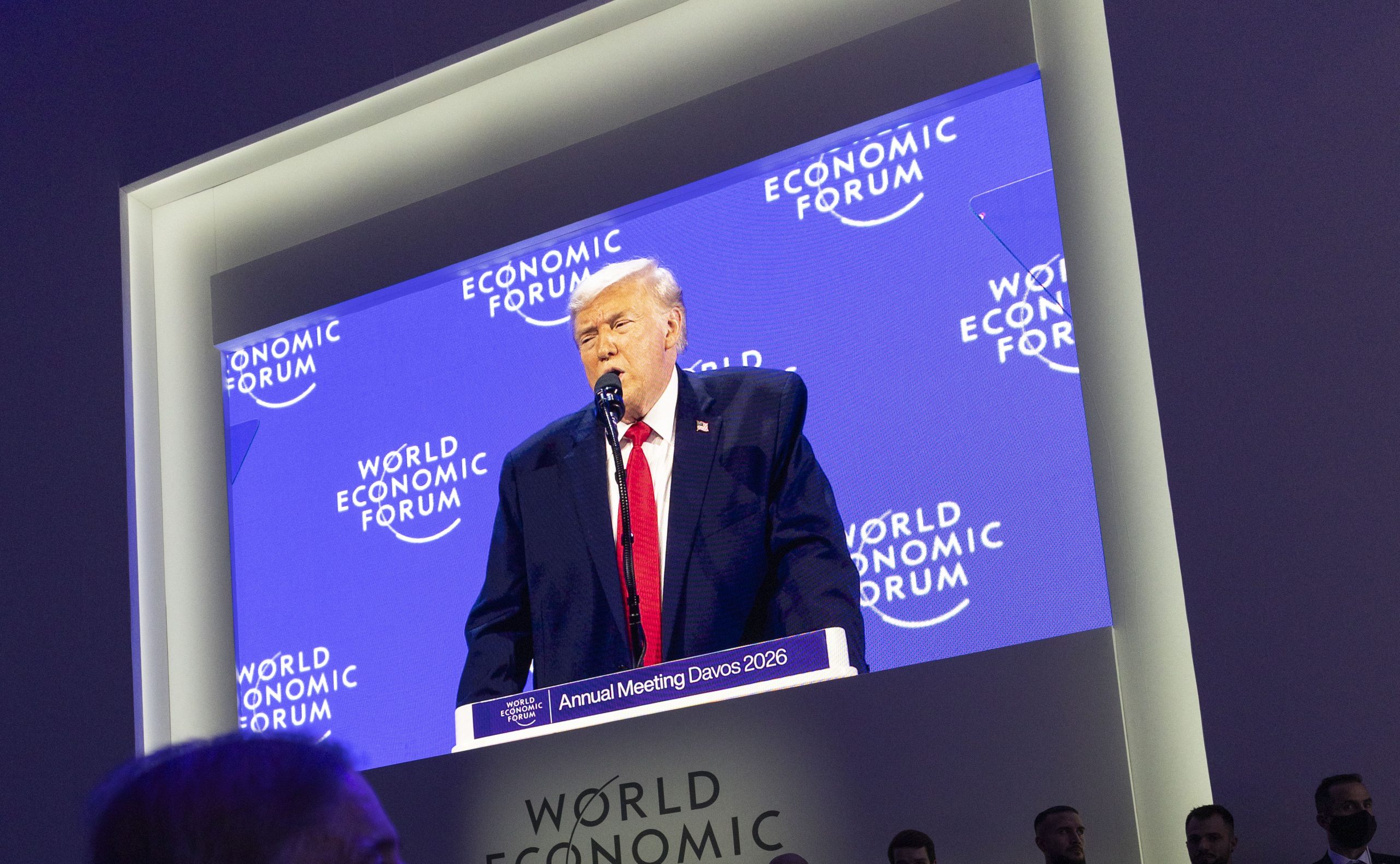
US President Donald Trump dominated the entire event. Writing in the Financial Times Howard Lutnick, Trump’s Secretary of Commerce, declared, “We’re not going to Davos to uphold the status quo. We’re going to confront it head-on. For far too long, the fate of the global economy has been decided by an international establishment who took America’s economic power and gave it to the rest of the world.” Instead, “this administration is putting America First”. He was heckled at the World Economic Forum when he put it even more crudely: “We are here at Davos to make one thing crystal clear: With President Trump, capitalism has a new sheriff in town.”
Greenland
Prior to his arrival at Davos, Trump completely dominated the global news and the minds of those already at the World Economic Forum, with his escalating and frenzied demands to ‘own Greenland’, including threatening new tariffs against ‘allies’ who dared to oppose him on the issue. The world looked on in alarm.
In Greenland itself, which has a population of less than 60,000, thousands took to the streets under banners proclaiming ‘Greenland is not for sale’. Opinion polls there show overwhelming opposition to being part of the US. Knowledge of how badly indigenous people are treated in America, given that 90% of Greenlanders are Inuit, is a factor in that mood. That did not mean, however, that demonstrators saw the US working class as their enemy. On the contrary, one protester, a nurse, interviewed by the Guardian, explained that she was marching “to give a message to the American people” to appeal for them “to stand against their own President”.
Nine out of ten Americans do oppose taking Greenland “by force”, with a sizeable majority also opposing attempts to ‘own it’ by any other means. No surprise that, as the stock markets start to get jittery at the developing crisis, Trump dialled down his rhetoric on the issue, claiming to have agreed “a framework for a future deal” with Mark Rutte, the general secretary of NATO.
In no way does that mean, however, that Davos ended with a return to ‘business as usual’. It represented a qualitative step in the ripping up of the so-called ‘world order’ of the previous era: “a rupture”, as Canadian prime minister Mark Carney described it. At the start of January, defending the US kidnapping of Venezuelan President Maduro and his wife, Steven Miller, White House Policy Chief, baldly stated the approach of this Trump regime to global relations, saying: “You can talk all you want about international niceties and everything else, but we live in a world, in the real world, that is governed by strength, that is governed by force, that is governed by power.”
US imperialism using its military and economic strength to defend the interests of US capitalism is nothing new. We do not join Carney, Starmer and the rest in crying over the ending of the old allegedly ‘rules-based order’. Set up by US imperialism in the aftermath of the second world war, it was always designed to defend US interests, and the US ruling class was always happy to break ‘the rules’ whenever it suited them. In alleged defence of that ‘ruled-based order’, US President George W Bush, backed by Tony Blair’s New Labour government in Britain, invaded and occupied Afghanistan and Iraq. More than 600,000 died in Iraq alone and it led not to the peace and prosperity promised, but to civil war and social disintegration. There has been widespread condemnation of Trump’s suggestion that non-US NATO troops in Afghanistan avoided the front line. The biggest crime, however, are all those who died – around 170,000 Afghans and 3,500 NATO troops (just over 1,000 not from the US) – during the twenty-year occupation.
Changing role of the US
Nonetheless, Trump and his coterie’s crude attacks on the ‘international institutions’ do reflect profound changes in the role of the US, and of the global geopolitical situation. Fundamentally, they reflect the decline of US imperialism, summed up in Trump’s retreat to try to police the ‘Western Hemisphere’, rather than the whole world. At this stage it is still the strongest power on the planet by some distance, but it is on its way down. Back at the start of the century when Republican President George W Bush was in the White House (see ‘Socialism Today editorial: Behind Trump’s imperial delusions’ for more background) US imperialism was the single world hyperpower, confident of its ability to mould the whole world in its interests.
That enormous confidence – hubris in reality – flowed from events just over a decade earlier, when the Cold War ended with the collapse of the Stalinist regimes in Russia and Eastern Europe. Brutal totalitarian regimes, they bore no resemblance to genuine socialism but were nonetheless not capitalist, based as they were on very distorted planned economies, and were therefore outside the domination of US imperialism. In the Cold War era the US had dominated the capitalist world; now for a while it bestrode the whole planet under the banner of ‘globalisation’.
But that seemingly unlimited power is long gone. The disasters of Iraq and Afghanistan (the legacy of which in the US still leave Trump very cautious about committing ground troops to foreign interventions), the 2008-09 financial crash and the Great Recession it triggered, and above all the rise of China as a powerful rival which now dominates global manufacturing – all have left US capitalism weakened and its elite increasingly split on how best to defend their interests. Much of the American capitalist class is alarmed by Trump’s reckless approach, but his anger at the international institutions represents a real mood among a section of them, because international institutions that US imperialism set up are no longer serving their interests.
Davos then was full of leaders of second tier global powers bewailing a reality that has been obvious for some time, but is now completely unavoidable. Regardless of the international institutions that still exist on paper, the US is no longer going to ‘police the world’ but only crudely defend its own narrow interests, as it attempts to take a bigger share of the spoils, hitting out at foes and ‘friends’ alike. Bart de Wever, the right-wing Belgian prime minster, pathetically summed up the European capitalists’ miserable situation saying, “Being a happy vassal is one thing, being a miserable slave is something else.” The European capitalist powers are prepared to crawl on their bellies before Trump, but this ‘strategy’ is no longer working.
Trump’s approach is particularly crude, but whoever is in the White House it is clear that the decline of the US means there is now a multipolar world, more comparable to the era between the first and second world wars than anything since. Every national capitalist class is struggling to defend its own interests, increasingly outside of any stable framework. And the European capitalist powers are in a greater relative decline even than the US. Growing pressure is therefore on the ruling classes of all European countries to ‘club together’, economically and militarily, in order to try and maximise their strength.
However, they cannot overcome the fact that Europe is a series of individual nation states, each with its own interests. Less than one-fifth of military procurement – much of it buying US-made kit – in the EU is done jointly, the rest is by individual countries. And it is not only the pressure to club together that is increased by the international situation, so too will the centrifugal forces, particularly in the face of a new global economic crisis. British capitalism – outside of the EU trading bloc, and always the most Atlanticist European power – is in a particularly acute dilemma.
Military spending increases
One thing that every capitalist class agrees on, however, is ramping up military spending. Across the EU it increased by 17% in 2024, and another 10% in 2025. So while living standards and public services continued to be squeezed, spending on weaponry rockets. Starmer has also promised increased military spending, but is under pressure from the generals to hike it much more.
Looking on in horror at Trump, and the increasingly unstable global situation, some who consider themselves on the left have naively supported Britain increasing its military expenditure. But this is based on the completely false premise that Britain’s capitalist class – and its political representatives and state apparatus, including the army tops – have the same interests as the working-class majority.
Have they forgotten the generals who indicated they would not obey orders from a democratically elected Jeremy Corbyn-led government? This government and its predecessors act on behalf of the capitalist class, not the majority, and they have played their part in making the world a more dangerous place. By, for example, backing the Israel Defense Forces’ slaughter of Palestinians in Gaza; or by taking part in the US-led occupations of Iraq and Afghanistan; or by countless other measures including recently helping Trump grab an oil tanker in the Atlantic.
Capitalism today is a system wracked by crises. Its rotten character is summed up in the abhorrent figure of Trump. We do not face world war, but wars and conflicts are clearly on the rise. The only way to bring that to an end is to overturn capitalism and begin to build a new socialist world based on peace, planning and cooperation. To achieve that requires the cohering of potentially the most greatest ‘superpower’ on the planet: the working-class majority worldwide. It is still at a very early stage, but the working class as an organised force is beginning to re-enter the scene of history. Rather than banging the drum to arm one capitalist class against another, the workers’ movement internationally needs to urgently fight to build its own independent strength as a first step to building a new world. The Socialist Party is part of the Committee for a Workers’ International (CWI) which is fighting for every possible step in that direction.
Increasing opposition to Trump
Trump is facing increasing domestic opposition. Less than a third of voters think the country has improved under his rule. There have been a serious of massive protests against him. Last Friday, in Minneapolis, with a population of half a million, up to 100,000 took to the streets in freezing temperatures to demand ICE left their city. Strikes took place in support, despite a lack of lead from most of the trade union tops. That day the second horrific ICE killing in Minneapolis took place. In response, the protest movement is continuing to develop. The force that can defeat Trump, and beyond him the US capitalist system he defends, is above all the US working class.
For the working class in Minneapolis and in the US as a whole, and every country come to that, the most important assistance they could see from the working class in Britain is not to back up our own elite, but on the contrary to build a mass movement against Starmer, Badenoch, Farage, and all of the capitalist politicians. Central to that is fighting for the creation of a workers’ party – giving a political voice to the trade unions, independent of all the rotten capitalist elites and fighting for a socialist programme: for power to be taken out of the hands of the major corporations and banks that dominate the economy, so society can be run democratically in the interests of the majority, instead of capitalism’s ruthless pursuit of profit which is leading to evermore poverty, environmental destruction, and war.