


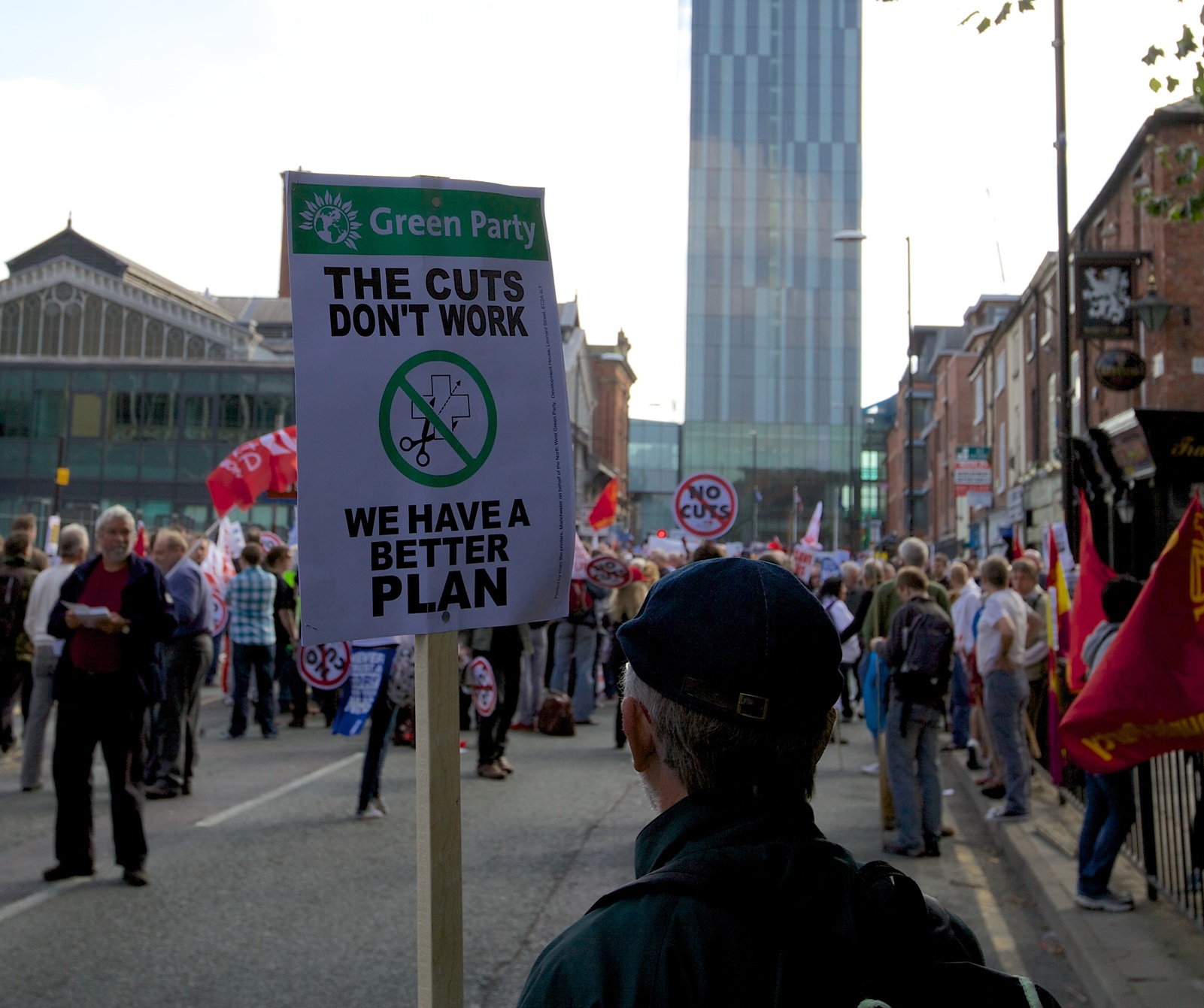
A recent exchange between the Green councillors group in Sheffield and TUSC and Your Party supporters in the city has again raised the important question – what can councillors actually do to resist the austerity agenda facing local public services?
Sheffield council provides over 500 public services to the city’s half-a-million plus population – ranging from housing, schools, social care, libraries, parks, youth services and culture, to pest control, waste disposal, street maintenance, 16 cemeteries, and more. It employs over 8,000 workers, including those in its capacity as a local education authority. Since 2022 it has been run by a coalition of the Labour Party (with 36 of the 84 councillors), the Liberal Democrats (27 councillors), and the Greens (14 councillors). There is one Reform councillor and no Tories, in the fifth-biggest city in England.
In the run-up to setting this year’s council budget, the Sheffield Your Party ‘proto-branch’ organised a no-cuts people’s budget conference to discuss a ‘needs budget’ for the city, and invited the Green councillors to participate. Now that Zack Polanski has been elected as the Green Party leader, the letter of invitation said: “We appeal to you to consider taking the bold stand of proposing a legally balanced no-cuts needs budget by using reserves and prudential borrowing powers.
“Such a people’s budget”, the letter went on, “could mobilise support from local trade unions and local communities to pressure the Labour government into restoring lost funding and, by your example, inspire other councils facing the same or worse budget situations to follow the same course of action.
“This government has already made several policy U-turns under the threat of parliamentary revolts; how much more pressure would be several large councils standing up for local people refusing to implement any more cuts? Set a no-cuts budget and demand the government fund it”.
To their credit, the Green councillors discussed the issue at a group meeting and, on their behalf, the Gleadless ward councillor Alexi Dimond replied. Unfortunately, however, it was to confirm that the Greens would not be proposing a no-cuts budget.
Why take responsibility for a Labour-Liberal Democrat budget?
The arguments raised by the Sheffield Greens against a no-cuts stand are not new. They have been answered by extensive guidance material produced by TUSC, based on the real experiences of presenting alternative budgets by TUSC-supporting councillors in Lewisham, Southampton, Hull, Leicester and Warrington – as minority councillors sitting in opposition to the ruling parties.
And, similarly, the 14 Green councillors are a minority on Sheffield city council against a combined Labour and Liberal Democrat majority. So the first and obvious question is: why on earth would they vote for – and thereby take responsibility for – a budget that they apparently don’t agree with? Are they really saying that just by 14 opposition councillors out of 84 presenting an alternative People’s Budget it would “hasten bankruptcy”, lead to “a freeze of all non-essential spending”, “central government intervention”, and other alleged horrors?
Or is the comment, “we don’t think it would be responsible” – a search for ‘respectability’ – a more honest reason for their failure to fight? If so, how are they any different to other establishment politicians lamenting the impact of cuts to services from the Labour Party, the Liberal Democrats, and now often even the Tories? And how will it help the fight to expose Reform’s posing as ‘anti-establishment’ outsiders if alleged ‘radicals’ turn out to be the same as all the others? If there were 14 socialists on the council of the fifth-biggest city in England they would not vote for austerity, full stop.
Scaremongering and reality
Is there any truth though in the Greens’ scaremongering claims? Firstly, it is a red herring to talk about “setting an illegal budget” and, in fact, councils going ‘bankrupt’.
Unlike in the US a council in Britain cannot go bust in the same way as a private company can. Only an act of parliament can dissolve a local authority; council services, and the financing to provide them, are implicitly underpinned by central government.
That’s why, to maintain some control by central government of council spending, local authorities are legally required to set a ‘balanced budget’ each year before they can issue council tax bills, set service charges etc. That is why TUSC does not advocate presenting deliberately ‘unbalanced budgets’ to council budget-making meetings or using the meetings to not set a budget at all.
But presenting a no-cuts People’s Budget that is formally ‘balanced’ by the use of prudential borrowing powers and reserves, to buy time to build a mass campaign for government funding while still maintaining the functioning of the council, is a different matter. This is the strategy that has been pioneered by TUSC.
Yes, this would not avoid a potential clash down the line with council chief finance officers (CFOs) or the government. The alternative budgets that were presented by TUSC-supporting councillors were not positively recommended by council officers. But neither could they be ruled as ‘illegal’, or ‘deliberately unbalanced’. The use of borrowing powers and reserves to meet projected deficits – including reserves previously ‘earmarked’ for other purposes – is, by statute, a ‘matter of judgement’ for councillors to make.
Fundamentally, to say that the technical means cannot be found to avoid making cuts is wrong. But it is not, above all, a technical question. The key ingredient to fighting back is the political will to do so.
If you don’t fight, you’ll always lose
The Sheffield Greens’ reply completely avoids the points in the letter of invitation of what impact an anti-austerity stand could have in mobilising public support, in the city and outside – including on the other 800 or so Green councillors up and down the country. Instead it asks for ‘evidence’ that a fight wouldn’t lose – proof of a negative – which the Greens might take to the £100k plus-a-year CFO or the cross-party (but currently Labour-led) Local Government Association to “get advice”. As if they are the impartial arbiters on what public services working-class people should have and how they should be fought for!
Are the Green councillors really saying that it would not be possible to force Starmer to retreat on local council funding? TUSC doesn’t think so. As our co-founder, the general secretary of the RMT transport workers’ union the late Bob Crow, used to say: “If you fight you might not always win. But if you don’t fight you’ll always lose”. And hopefully there will be many working-class community campaigners, trade union fighters and socialists who will come forward with that spirit to take up the fight against council austerity as candidates at the ballot box in May.
- Read the article in full, including the full correspondence with the Green councillors at tusc.org.uk
Sign the Greens Must Pledge: No Cuts To Services petition
At the end of January over twenty current and former trade union executive members launched a petition – now backed by Zarah Sultana MP – appealing to Zack Polanski “to ensure that in this year’s local council elections no candidate shall appear on the ballot paper on behalf of the Greens who has not made a public commitment to vote against all cuts and closures to council services, jobs, pay and conditions should they be elected as a councillor on May 7th”, in the first set of elections being fought since he became the party’s leader.
The petition has already had an impact in giving confidence to some Green Party members to make a stand. One Green candidate in North London has not only signed it but taken the petition to others in his borough group to do so too.
