


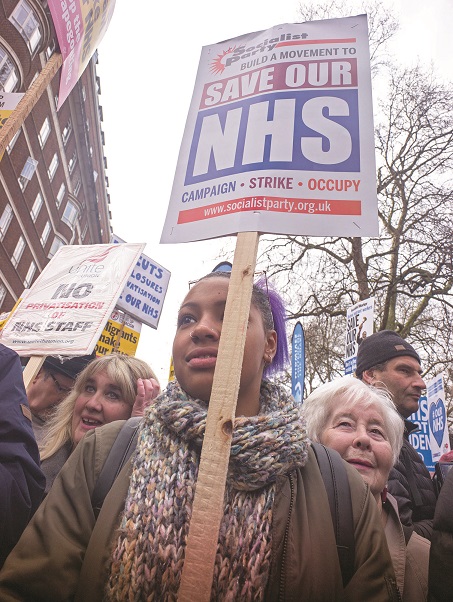
Fight for a fully funded, publicly owned NHS, democratically controlled by the working class
Mary Finch, Waltham Forest Socialist Party
Many women, if not most, have been ignored, dismissed or belittled by healthcare services at some point in their life. ‘Hysteria’ is no longer considered a legitimate medical diagnosis – but the underlying attitude that women cannot be trusted to accurately describe their symptoms remains. Debilitating pain is downplayed as part of a normal period. A whole range of physical health concerns are often explained away as “just anxiety”.
These inequalities, including in access to treatments, funding and outcomes, are described as the gender health gap, and it isn’t new. But in the past few years, there has been a shift in consciousness; a survey found it to be the number one issue for women under 25. More and more women understand it as a political issue instead of an individual one. It’s part and parcel of living under a sexist system.
Sexual harassment used to be viewed in a similar way – an individual experience that women just had to put up with. The #MeToo movement, which started by women sharing their experiences of harassment and violence online, highlighted just how widespread sexual harassment is in society. One effect of this was to increase women’s confidence to challenge abuse, a contributing factor to broader mobilisations of people of all genders against sexism, in some countries in mass demonstrations.
It seems a similar process is now taking place around women’s experience of healthcare. Growing numbers of women have been emboldened to demand an end to the gender health gap. A movement is developing, and already capitalist politicians have been forced to respond.
The previous Tory government launched the first ‘Women’s Health Strategy’ and the current Labour government has similarly pledged to prioritise women’s health.
But neither Labour or the Tories actually have any solutions – in fact, they are part of the problem! Labour continues to preside over a deeply underfunded NHS, a crisis which often hits women’s services the hardest. Waiting lists for gynaecological care have doubled since 2020, for example, leaving many women in pain for months before seeing a specialist. Even then, it’s often another long wait for treatment – if they are referred for treatment at all.
Very little research is done into these conditions or how to treat them, which compounds the problem. Women are also often excluded from general medical studies because hormonal differences present too much of an ‘outlier’. We know very little about many essential aspects of women’s health.
A recent CQC (Care Quality Commission) survey found that one in five women feel their concerns were dismissed or ignored during childbirth. Undoubtedly, that is partially due to extremely stretched NHS services, which are often literally unable to provide safe levels of staffing on maternity wards. Almost a third of newly qualified midwives are struggling to find a job, despite chronic staffing shortages.
But funding cuts alone aren’t sufficient to explain it. The same survey found evidence of discrimination against birthing women from working-class backgrounds, and racism. Black women are 2.8 times more likely to die during pregnancy or childbirth than their white counterparts. Asian women are 1.7 times more likely to die.
Struggles to highlight and address the gender health gap and social attitudes that fuel it are absolutely necessary and can have an impact, as similar struggles have. However, misogyny, sexism, and gender stereotyping and discrimination, are all rooted into the framework of capitalist society and its institutions. The cause of underlying discriminatory and prejudiced ideas isn’t the ‘NHS culture’ but capitalism. And so to succeed, the struggle to end the gender health gap has to extend to the need to struggle for an end to the capitalist system through socialist change.
NHS bosses, who have often covered up scandals in maternity units and elsewhere, can’t be trusted to close the gender health gap. Nor can the capitalist parties, including Labour, who will likely try to use these scandals to justify further privatisation in the NHS. They starve public services of essential funding, and when they inevitably fail, claim that the private sector can do it better.
A democratically controlled, fully funded NHS would allow workers and service users to discuss and collectively decide what change is needed. Women would be given genuine recourse if they feel dismissed or ignored; most who make a complaint to the NHS under the current system may receive an apology, if they’re lucky, and nothing else. They’re still stuck on an endless waiting list, or left to advocate themselves for essential treatment.
It would also mean trade union oversight of the training provided to healthcare professionals before they enter the workforce – and this is critical to closing the gender health gap. Conditions which primarily affect women, such as endometriosis, are often little more than a footnote. Healthcare workers can’t diagnose and treat without knowing what symptoms to look for.
Democratic control of the medical and pharmaceutical industries would allow workers to decide what research is prioritised, according to need, not profit.
Women and all working-class people urgently need a party that will stand up for us and fight for the changes necessary to close the gender health gap. The explosion of initial interest in Your Party shows that ordinary people are looking for a political alternative. A new workers’ party with the might of the organised trade unions behind it could easily harness that anger and enthusiasm. Workers want to fight back – they just need a lead.
- Birmingham: Monday 9 March, 7pm, Top Floor Wellington, Bennetts Hill, Birmingham City Centre, B2 5SN
- Bristol: Tuesday 10 March, 7:30pm, Horfield Quaker Meeting House, 300 Gloucester Road, Bristol, BS7 8PD
- Camden and Haringey: Wednesday 18 March, 6:30pm, St Mary Hornsey Rise, Purple room, Ashley Road, N19 3AD
- Cardiff: Sunday 8 March, 4pm, Cathays Community Centre, 36-38 Cathays Terrace, Cardiff CF24 4HX
- Enfield and Lea Valley: Saturday 14 March, food from 12:30pm, meeting starts at 1:30pm, Ponders End Methodist Church, 378 High St, Enfield, EN3 4DG
- Essex: Sunday 8 March, 2-4pm, George Hurd Centre, Audley way, Basildon SS14 2FL
- Leicester: Saturday 7 March, 2:15pm, Secular Hall Humberstone Gate Leicester LE1 1WB
- London Red Line (Socialist Party rail workers): Sunday 8 March, 12:30pm, Lucas Arms (Upstairs), 245A Gray’s Inn Road, London, WC1X 8QY
- Newham and East London: Wednesday 11 March, 7:30pm, Sylvia’s Corner, 95 Aldworth Road, Stratford, E15 4DN
- South East London: Sunday 8 March, 5:30pm, AAJA Music, Comet Pl, Deptford, SE8 4EP
- South West London: Thursday 5 March, 7:30pm, Bonnington Centre, 11 Vauxhall Grove, SW8 1TD
- Swindon: Saturday 7 March, 3-5:30pm, Central Community Centre, Emlyn Square, Swindon, SN1 5BP
- Plymouth: Monday 9 March, 7pm, Quaker House, 74 Mutley Plain, Plymouth, PL4 6LF
- Teesside: Monday 9 March, 7:30pm, Tipsy Turtle pub, Stockton, TS18 1EF
- Tower Hamlets: Thursday 12 March, 7:30pm, Pelican House, 144 Cambridge Heath Road, London, E1 5QJ
- Waltham Forest: Thursday 12 March, 7pm, Bakers Arms, for venue details call Martin on 07813501648
- West London: Thursday 12 March, 7:30pm, West London Trade Union Club (upstairs), 33-35 High St, Acton, W4 6ND
