

Chris Moore, Gloucestershire Socialist Party
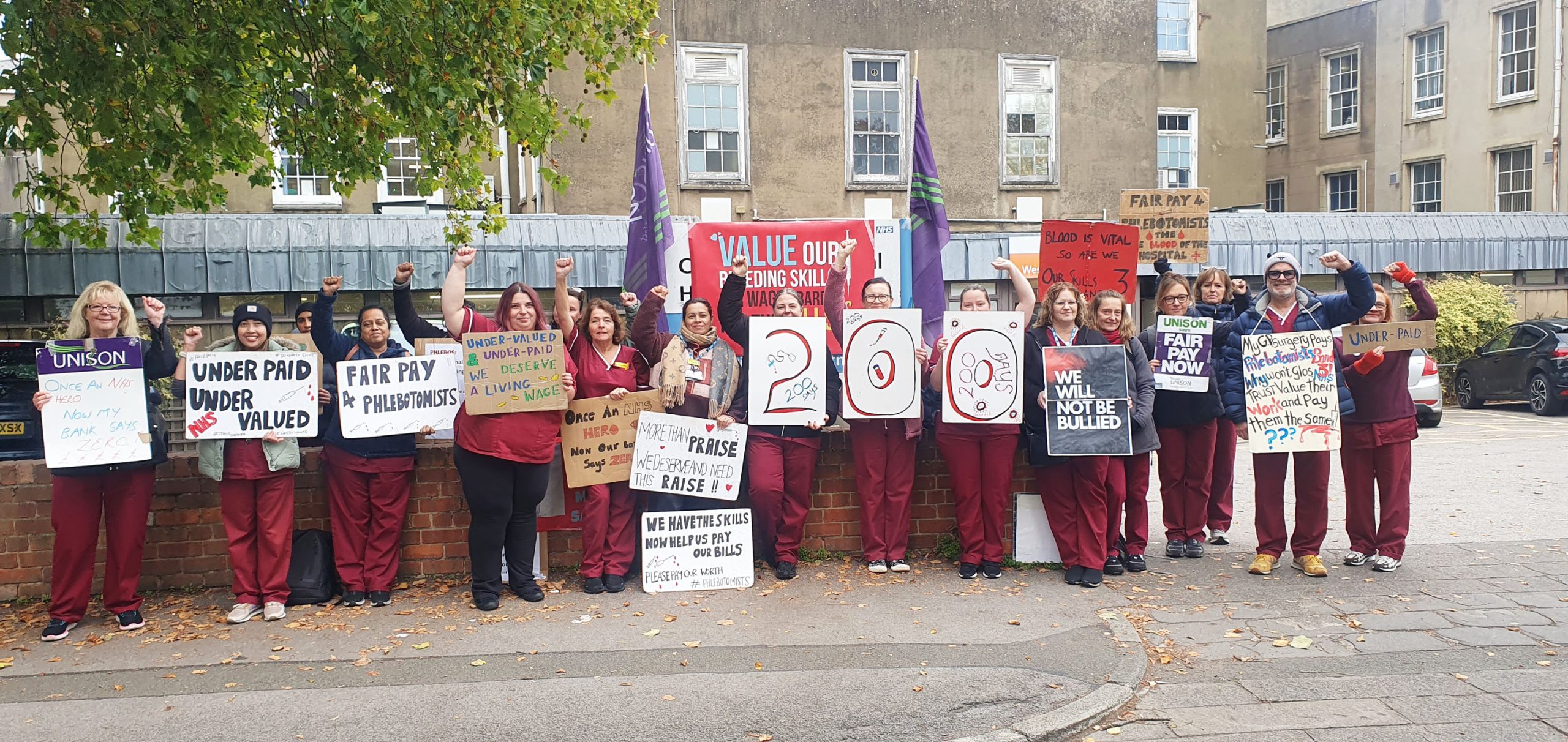
On 17 March it will be a year since Unison’s Gloucestershire hospitals phlebotomists started strike action, after years of being underpaid and ignored. It is the longest-ever strike of contracted NHS workers. As specialist blood takers they need months of training followed by shadowing to deal with over 300 complex blood test procedures, vital to patient care. Nationally, phlebotomy is still on the lowest pay band, just a few pence above the minimum wage. The position of this injustice has been shifting with successful challenges by phlebotomists in several trusts, such as recently Unison at Homerton Hospital in Hackney winning a banding increase with just the threat of strike action.
But the heroic Glos ‘Phleboes’, initially nicknamed the ‘Magnificent 37’, have been met with a vicious, intransigent management. Their initial request for a banding review was ignored by the trust, followed by months without meaningful negotiations. What started as a strike over pay has developed into a battle to defend phlebotomy in Gloucestershire hospitals. If the trust get away with diluting phlebotomy other trusts may be tempted to follow suit as a cost-cutting venture.
A couple of weeks ago, the trust put two options to the strikers. Either return to work as Health Care Support Workers (HCSW’s) on Band 3 with at most a 50% phlebotomy role, with some compensatory pay; or go to the National Job Evaluation Group (JEG) for a review of the pay banding, with back pay only on the table if a Band 3 was awarded. But the trust made clear, whichever option was chosen, it intends to replace phlebotomists with HCSWs. Dedicated phlebotomist training would be replaced by a half day in-house venepuncture course. As co-lead steward Caroline Hayhurst said: “The trust was saying we’re not wanted or needed”. The anger among the strikers at these proposals was shown by the refusal of all but one phlebotomist to vote at all!
During the dispute the phlebotomists have felt increasingly confident to challenge the process themselves. Despite being told there was no option to continue the strike, that’s exactly what they were determined to do. As Caroline said: “We’ll continue to fight so low-paid workers, who are leaving the NHS to pay their bills, feel empowered to take on these corrupt execs on ridiculous six-figure salaries”. Such a fighting approach forced the trust to make concessions. An offer to wipe out a mistaken overpayment of wages to strikers was previously only on offer if the HCSW role was accepted now it was linked to both options. Phlebotomy would now be protected for six months after the end of the strike. At present, many hospital staff are unaware of the trust’s intention to dispense with a stand-alone phlebotomy team. So giving time to rally support to oppose these plans. And ‘no to both options’ was added to the new ballot.
The election of the new Unison General Secretary, Andrea Egan, has offered a more fighting national approach, more support for members and a reappraisal of the Labour link. The government intends to increase NHS private provision by 20%. As co-lead steward Dawnie Elliott says: “Drastic change is needed to keep our NHS. There is a growing need for a political voice that represents working-class people and public sector workers”.
Andrea has been in contact with the phlebotomists and injected some confidence. Health Secretary Wes Streeting has said the dispute is a local trust issue. But Unison could take a different view and start to campaign among phlebotomists nationally for a pay upgrade. Streeting also said the NHS will have to get used to money being tight. Health unions need to prepare for bitter battles ahead, including balloting over the recent 3.3% NHS pay offer.
Stop press: Workers vote to undergo job evaluation and return to work
As the Socialist goes to press, the union has reported results of the ballot with 83% voting in favour of ‘A joint referral to the national job evaluation group for an assessment’. Caroline told the Socialist: “We’re not defeated, we return to work as phlebotomists with heads held high. The battle to keep phlebotomy will continue”