


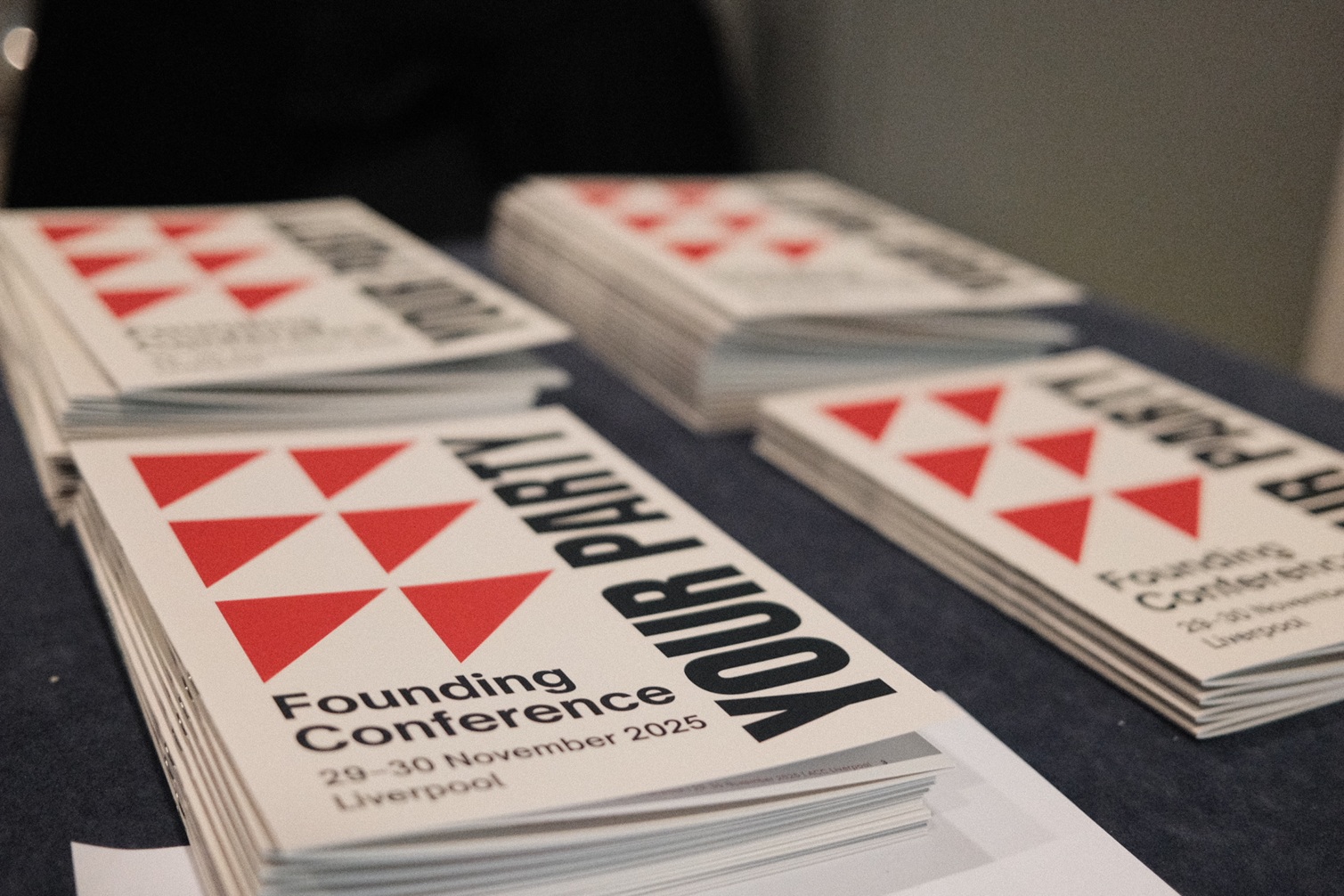
At the meeting of the Your Party Central Executive Committee that took place on 12 April 2026 a decision was taken to exclude members of a list of organisations, including the Socialist Party, on the grounds that their “internal organisational models and strategic objectives are distinct from and incompatible with the values and constitutional framework of Your Party”. In response the Socialist Party has written to the Your Party Officers. We publish the letter below:
Dear comrades,
I am writing on behalf of the Socialist Party to you to ask for an urgent discussion on the participation of our party and its members in Your Party, and other related issues. I, along with other Socialist Party members, received the 12 April, 2026 email to Your Party members from Jenn Forbes which reported the Central Executive Committee (CEC) had that day taken a decision that “members of other national political parties that do not align” with Your Party’s “are ineligible for membership of Your Party”, which, we understand includes the Socialist Party. You will not be surprised to know that we think this decision is a serious mistake. It does not reflect, we believe, the views of the majority of Your Party members, who voted for dual membership at the founding conference last November.
Unfortunately, it is also not a surprise, as this decision is a continuation of the approach to establishing a new party taken up until now. I previously wrote on behalf of the Socialist Party to the then interim leadership of Your Party on 7 January 2026 to ask for a discussion to clarify your approach to dual membership weeks before the CEC elections got underway. We received no reply. Given the lack of response, Socialist Party members, including Dave Nellist and April Ashley, went ahead and put their names forward for the CEC. Dave Nellist is a former Labour MP and chair of the Trade Unionist and Socialist Coalition (TUSC). April Ashley had been re-elected in 2025 as the female black members’ rep of Unison’s National Executive Council, topping the poll with 28,792 votes, more than the numbers who voted in the whole CEC elections. And yet both were ruled out of order on the grounds of their Socialist Party membership. This most recent CEC decision is a continuation of that mistaken approach.
However, as unlike then there is now an elected CEC, which Jenn Forbes’ letter states wants Your Party “to stand alongside” other left forces on “the many issues on which we agree”, I hope that you will take the time to meet and discuss the question of how the Socialist Party and its members could participate in Your Party, as well as to explore how we can develop future collaboration if you are unwilling to reverse your decision.
Some arguments against the decision
We have seen copies of a CEC Governance Paper on ‘Dual Party Membership Eligibility’, which we assume is a broadly accurate representation of what was agreed at the CEC meeting. It states that “formal membership of another national political party or political organisation operating with its own ideology, programme and system of internal discipline is incompatible with membership of Your Party”. But why? Obviously, we agree that pro-capitalist parties should not be eligible for dual membership. But why exclude those, such as ourselves, who wholeheartedly agree with Your Party’s aspiration, summarised in the founding statement, to build a “democratic, member-led socialist party” with the “working class at its heart”? The Socialist Party has a sizeable base in the trade union movement, and also plays a lead role on the university campuses. Collectively we have more than six decades experience in class struggle, first as Militant and now as the Socialist Party, including in leading two mass struggles which successfully defeated the Thatcher government, in Liverpool City Council and the poll tax. For decades we have been campaigning for a new workers’ party, and we wholeheartedly welcomed Your Party as a possible step towards such a party. How on earth could it aid the struggle to build a mass party based on the working class to exclude us?
True Jenn Forbes letter appeals to individuals to leave their existing parties and join Your Party. But we would never insult the intelligence of Your Party members by claiming experienced fighters for the working class had suddenly ‘renounced’ their history and ideas to join Your Party only as individuals. Dave Nellist did not do so in 1991, when it was a matter of remaining as a Labour MP, a stand supported by Jeremy Corbyn at the time. Nor did many other Militant supporters with positions in the Labour and trade union movement.
The Governance Paper argues that any party or organisation which operates on the basis of democratic centralism, “maintains its own national political membership structure” and “requires political discipline and accountability to an external leadership and programme”, would “automatically fall within the scope of the ineligibility rule.” But what is the problem of the existence of socialist organisations within Your Party that argue for their point of view? The Socialist Party currently has around 2,000 members. There is no question of us, or any of the other organisations on the proscribed list, being able to dominate Your Party via weight of numbers, even with Your Party’s current size, which is far below its original potential. Nor can it be argued that Socialist Party members don’t abide by the democratic decisions of broader workers’ organisations of which we are part. On the contrary, we have demonstrated that we do so consistently in our long history in the trade union and labour movement, working alongside other forces to further the interests of the working class.
For example, in a trade union strike ballot where our members argue to accept or reject a deal, they clearly abide by the decision of the majority if they lose the vote. To give another example, in the past the Socialist Party, then the Militant tendency, was part of the Labour Party. Of course, we argued and voted for constituency parties to select council and parliamentary candidates who agreed with our programme, but our supporters still went and canvassed for whichever candidate the membership selected, even if we disagreed with them on many issues.
Jenn Forbes’ letter argues that “transparent democratic decision making” is “only possible where every member is able to trust that “whatever differences of opinion arise, all members put Your Party’s interests first” and that this trust cannot be built when some members “vote according to a line set elsewhere”. But what does this mean? In any left party members, and leaders, are subject to huge outside pressures which – unlike membership of a socialist organisation – are aimed at wrecking the left party. Remember the battles that took place in the Labour Party under Jeremy Corbyn’s leadership, and the gigantic pressures that were exerted by the capitalist press and right wing media, as well as the Blairite wing of the party, to ditch Corbyn for someone more ‘moderate’, that is safe for capitalism? There are many lessons to be learnt from that period, but a key one is that it is impossible to have a party sealed off from ‘outside’ influences. Instead, a mass membership organised in a democratic structure, and based on the working class, is the only effective way to counter the pressures of the capitalist class. In our view, Marxist organisations also have a crucial role to play. It is not an accident that expelling Militant from the Labour Party was a prerequisite step on the long road to its transformation into ‘New Labour’.
When Socialist Party members have argued for Your Party to oppose cuts in local services, or for the party to be built on a federal basis, with the trade unions playing a central role, we have been putting ‘Your Party’s interests’ first, as we see them. Others clearly have different ideas for what is in the best interests of Your Party, but that is inevitable. It is not possible to create a new mass workers’ party without different views and trends within it.
Of course, we understand the urge to unity, and sometimes the frustration with different left organisations who appear incapable of seeing their own individual priorities in proportion to the interests of the movement as a whole. Such problems will never, however, be successfully overcome by top-down or bureaucratic measures that try to ‘impose unity’ from above. Instead, as we warned in our letter on 7 January, 2026, despite the enthusiasm of the 800,000 who initially responded to the call for a new party, such an approach would fail as was the case with Arthur Scargill’s Socialist Labour Party, The same fate is unfortunately clearly posed for Your Party.
Affiliates, federalism and the trade unions
In addition to agreeing dual membership, the constitution agreed at the founding conference also proposed to look at a proposal on affiliations, including from trade unions, over the following year. As far as we are aware, no further progress has been made on that issue. Nonetheless, we would like to discuss how you see this crucial question, including how you envisage affiliates having a democratic say in Your Party.
Achieving that would require looking at some kind of federal aspect to Your Party’s structure. Our experience in the Trade Unionist and Socialist Coalition (TUSC) is an example of how different forces have, despite many differences, been able to successfully collaborate together over fifteen years in order to help provide an inclusive electoral banner under which workers’ candidates, from different organisations and from none, can contest elections on an anti-austerity programme without any way being ‘dominated’ by other organisations within the TUSC umbrella. TUSC’s federal approach, on a bigger scale, is how the Labour Party was first formed. The first conference of the Labour Representation Committee had delegates from 41 trade unions, plus various socialist and Marxist organisations.
In our view such a federal approach, recognising the existence of different left organisations, and involving all those who were willing in a structured way to collaborate to develop a new party, would have been the best starting point to get Your Party off the ground. However, we have never seen the development of a new party as being primarily about cooperation between different left forces. For us the pressing need is for the working class to develop a new party, and therefore the battle in the trade unions is key. Nor can that battle just be about which party trade unions give money to; rather it should be about the working class creating its own party. Had Your Party given unions a central place in its structure from the start, and begun with an energetic campaign aimed at the base of the trade unions, it could already have won some union affiliates which would have transformed its character.
As things stand, however, Your Party is not about to win trade union affiliates. Nonetheless, anger at the Labour government is creating political ferment in the trade unions, and discussions are heating up on how the workers’ movement can create a political voice. As you know Socialist Party members are playing key roles in these debates. Our members helped to instigate the ‘trade unionists for a new party campaigns’ in different unions after the thousand-plus launch meeting last summer organised by Dave Nellist, and addressed by Jeremy Corbyn and Zarah Sultana. At the moment the Trade Unionist and Socialist Coalition steering committee, in which we participate, is helping to coordinate this campaign but its aim is not to win trade union affiliates to TUSC, but rather to push the debate forward in the trade unions. We hope you share this aim. To give one example last year Unite, a union of 1.2million, voted to reassess its relationship with Labour. If the union was to vote for the next steps – above all starting to stand candidates itself – it would represent a huge step forward. We would like to discuss with you how we could take forward this vital work.
Yours in Solidarity,
Hannah Sell
Socialist Party general secretary
On behalf of the Socialist Party