

Editorial of the Socialist issue 1364
Far-right thug Tommy Robinson has called a Unite the Kingdom (UtK) march and rally on 16 May, aiming to exceed the 100,000 he reportedly mobilised in September last year.
This is purposefully provocative, in opposition to a demonstration marking Nakba Day, the annual day which commemorates the displacement of millions of Palestinians in 1948 when the state of Israel was formed.
The Palestine Solidarity Campaign had already called a demonstration on Saturday 16 May – a yearly event, but this year with increased significance given Trump and Netanyahu’s war on the Middle East, following the over-two-year-long onslaught on Gaza by the Israeli government and ongoing attacks on Palestinians in the West Bank.
The UtK rally is set to march from Waterloo to the southern end of Whitehall. The police have granted the centre of London to Robinson, but refused the chosen route of the Palestine demonstration. As far as we are aware, an alternative route is still under negotiation.
The organisers of the UtK march clearly intend to exploit the idea propagated by all the capitalist parties – Tory and Labour – that pro-Palestinian protesters are ‘hate marchers’ – anti-democratic, antisemitic, and enablers of terrorism.
Many driven-down, angry working-class people, with lives ruined by austerity, privatisation and the cost of living, feel they have lost control of their lives. Some will be misled and attracted to this march. They will find themselves marching alongside violent racist thugs.
In Muslim communities around London, community leaders are advising people not to travel into central London on that day, a fear that could be particularly felt in areas near central London. The fact that Robinson himself is calling on his marchers not to get drunk and be violent illustrates the risk that many people fear.
From the end of March, it was announced that Stand Up to Racism (SUTR) is calling a counter-demonstration to Unite the Kingdon – the planned route reported in the press was from Russell Square to the northern end of Whitehall. The advertising of SUTR is to “fill the streets” against the far right.
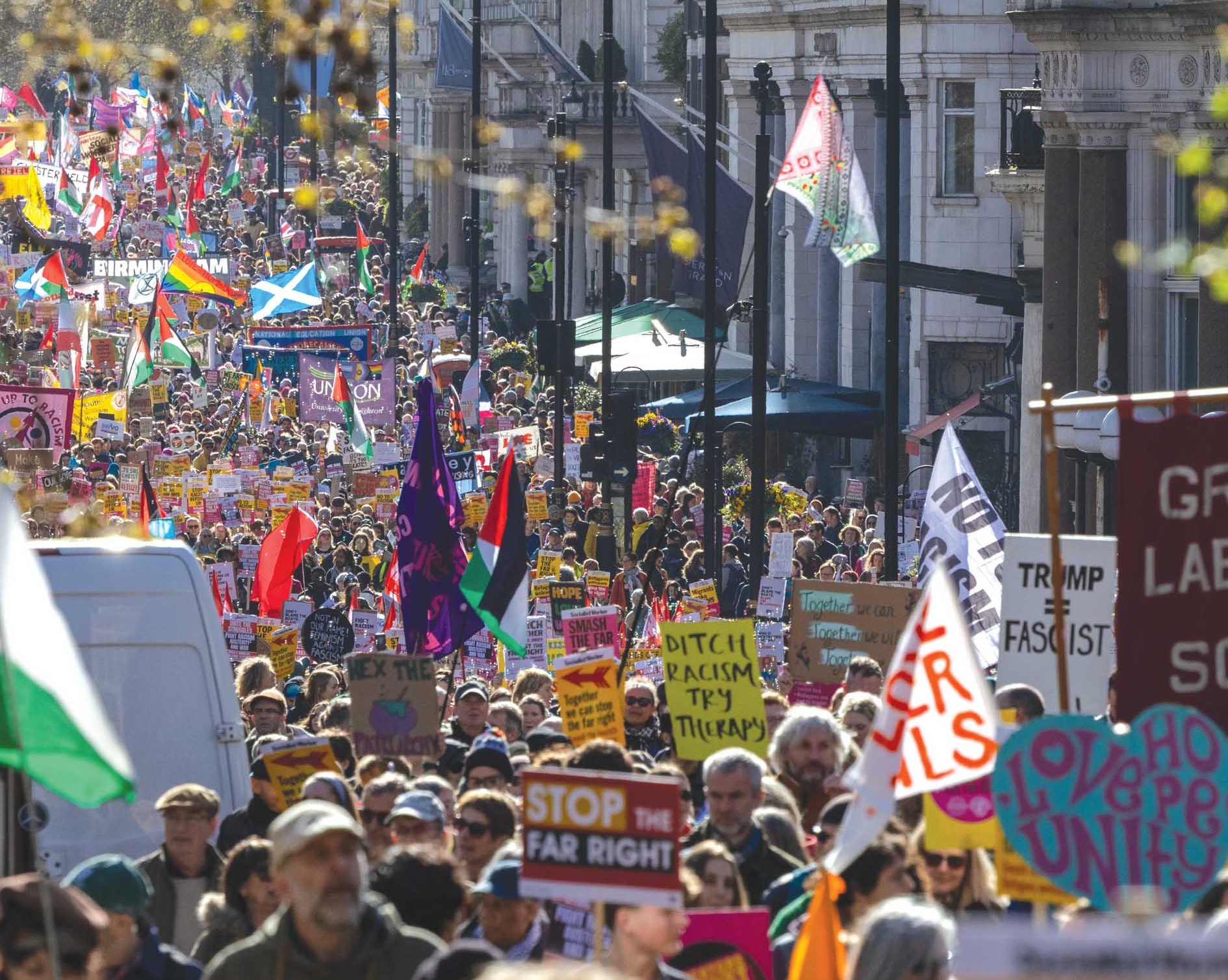
The Together Alliance is made up of the trade unions alongside celebrities and charities, with prominent politicians linked to it, including pro-austerity Starmerite Labour politicians such as London Mayor Sadiq Khan and Walthamstow MP Stella Creasy. The demonstration was very big, following months of mobilising and a large amount of expenditure by the trade unions, especially the National Education Union. That is a small reflection of the real balance of forces in society, and the overwhelming opposition to racist ideas.
The Socialist Party argued that instead of the trade union leaders putting their union demands to one side in the name of ‘unity’, the demonstration should have been called under the banner of fighting Labour austerity and racist division. That could have mobilised many thousands more trade unionists and their families.
And crucially it would have had a greater impact in starting to undercut potential support for right-populist Reform and the far right among people suffering austerity and facing another cost-of-living crisis. That would especially have been the case if it had been a launchpad for a widespread national stand of anti-austerity trade union and socialist candidates in the May elections.
Even despite those limitations, however, the Together demonstration was big. As things stand though, the counter-demonstration on 16 May is not called by Together, or by the trade unions.
Lessons from 2024
Two years ago, when Tommy Robinson called his first London demonstration, it was on the same day as a trans-rights demonstration. SUTR organised a separate counter-demonstration to Robinson’s march. The Socialist Party argued at the time that the trade unions and all of the counter-demonstrators should have marched together on the trans-rights march, and the trade unions should have offered stewarding.
15,000 marched with Robinson, but 50,000 marched for trans rights. That was by far the biggest display against the divisive ideas of the far right on that day, and would have been made stronger by being joined by trade unions and anti-racist campaigners, with defensive stewarding. Instead, SUTR led a smaller protest towards the UtK march with inadequate stewarding, risking confrontation with far-right thugs and relying on the police for protection. The experience of anti-racist demonstrators in Bristol recently, where protesters have been beaten by the police, has shown that the police cannot be relied on.
Socialist Party members are arguing strenuously that the idea of opposing Tommy Robinson on 16 May should combine with the Palestine demonstration. But that still leaves open where the demonstration should assemble and march to, and what its goals are in relation to the UtK demo.
The trade union leaders, along with anti-racist, anti-war, Palestinian solidarity campaigns, need to say clearly now: we are all marching together to oppose racism, war and austerity: to oppose war on the Palestinians, to stand alongside Muslim and all other communities that feel vulnerable on that day, and to fight for a decent future for all of us – for jobs, homes and services.
Socialist Party trade union members will be arguing that the trade unions should take a lead on ensuring that happens – and, crucially, organise defensive trade union stewarding.
That must involve a proper discussion, with trade union and community involvement, about the route. Will young people in Muslim communities around the edges of central London – such as around the Regents Park mosque or around Somers Town in Camden – be feeling the need to defend their communities against potential attack?
Instead of shadowing the Tommy Robinson demonstration, potentially in confrontation with the reported 1,600 police being mobilised on the day, who may well be looking for their own confrontation, a demonstration would be more effective in uniting and defending working-class communities if it were to march by and with those areas.
Taking that approach would give confidence to many more people to march together. It would be a concrete display of working-class people standing together, undermining attempts by the right – including the right-wing press and capitalist parties – to try to divide us, to present pro-Palestine demonstrators, Muslims and other communities as the problem.