

Adrian O’Malley
Standing for re-election to the Unison Health Service Group Executive, personal capacity
NHS workers receiving their wage slips at the end of April will barely notice the 3.3% pay rise that has been imposed on them by the Labour government.
3.3% was barely keeping up with inflation when it was announced in February. But now, following Trump’s war on Iran and the resulting sky-high fuel increases, it is lagging behind the real inflation rates that working-class people are experiencing. Increases in fuel and heating costs are expected to continue to rise throughout the year.
NHS workers are rightly asking what are the unions going to do about it? Earlier in April, Unison’s health conference unanimously agreed to fight for more pay, alongside the other NHS trade unions, through the ‘structural talks’ that are to take place by the end of April.
The talks, which were intended to deal with problems within the NHS pay band structure, were supposed to take place as part of last year’s pay rise. But due to Labour health secretary Wes Streeting’s contempt for the NHS unions, they didn’t take place.
Unison’s Head of Health Helga Pyle announced the talks last week: “Unions have been calling for talks to fix pay for months. Getting these in place is a step forward, albeit a year and a half after they were promised.”
“NHS workers have been deeply disappointed by this year’s 3.3% pay award, which has already been overtaken by inflation. There’s a lot riding on these talks. Real money on the table from the government will be key”.
One thing is certain. If we are to get “real money” from the government we are going to have to fight for it.
Unison’s position of joint action with the other unions is a welcome step forward. Health conference heard that the joint union letter, ‘3.3% is not enough’, had been signed by over 40,000 members of all unions in the first few days. There is clearly large support for joint union action around a common claim.
Limiting talks to discussions around the pay structure is potentially divisive, as it limits discussions to the small numbers who are impacted by the changes to their particular pay band or increment. Tying the pay spine to the real living wage, or Unison’s policy for a £15-an-hour minimum wage with corresponding rises throughout the pay spine, would keep the unity necessary to deliver action if or when it becomes inevitable.
We must also avoid the trap of becoming involved in discussions over a multi-year pay deal, unless above-inflation pay rises are agreed in principle at the beginning of talks.
If the structural talks are to deliver more pay for all NHS staff they need to be entered from a position of strength by the trade unions. The Unison Health Service Group Executive missed an opportunity when it voted against lodging a national dispute over pay, moved by Socialist Party members, when the 3.3% was imposed back in February.
Nevertheless, with the backing of Unison health conference and with thousands of NHS workers from every union demanding more pay, we are in a prime position to demand more and, if it is not forthcoming, plan for nationally coordinated strike action.
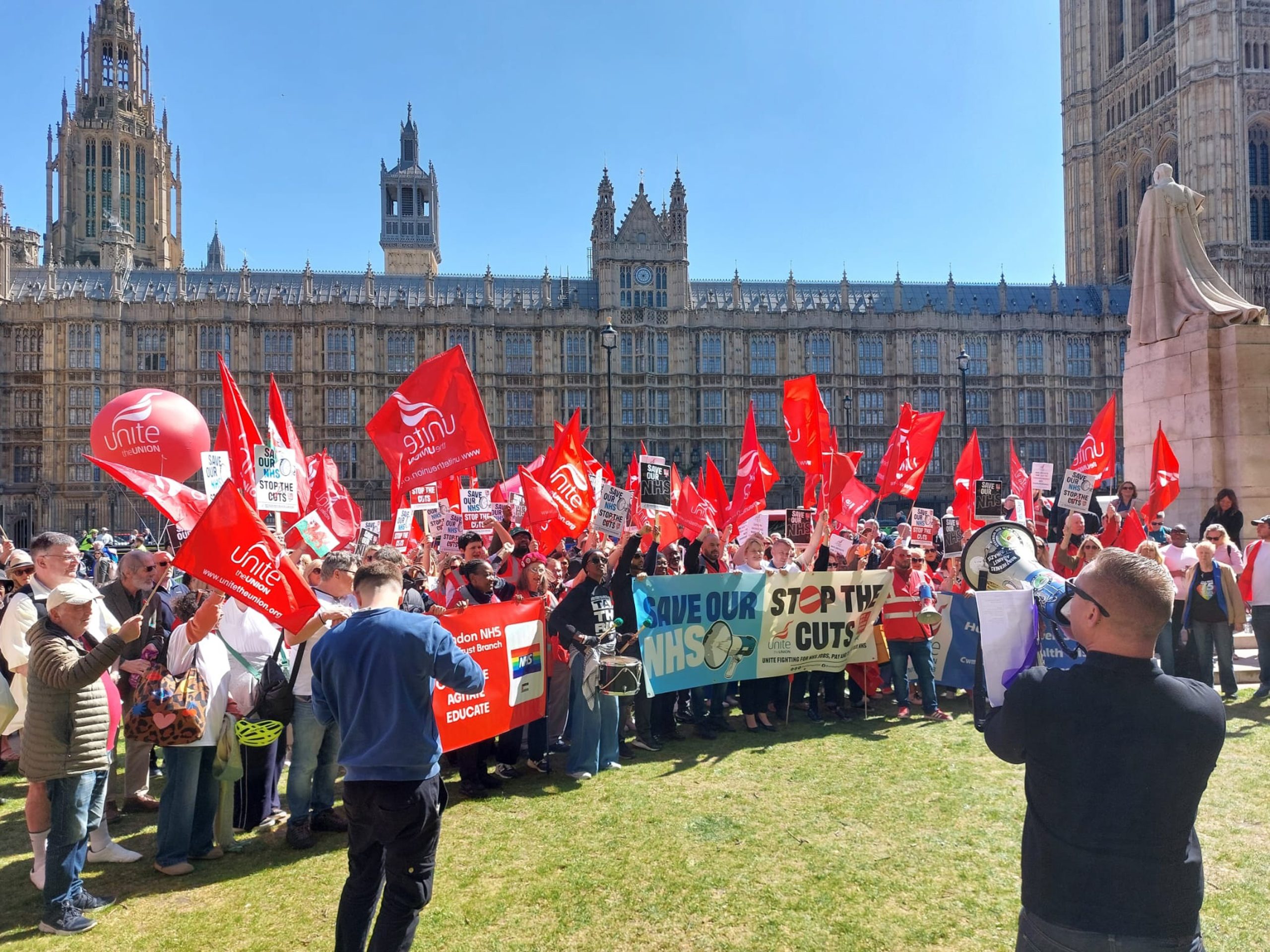
NHS workers and campaigners lobby parliament
Jon Dale, Secretary, Unite Nottinghamshire health branch
On Wednesday 22 April, health workers from across the UK protested outside parliament, outraged at Labour’s attacks on the NHS. Organised by Unite the Union, the protest brought together workers in current disputes with campaigns defending health workers and the services we provide.
Unite’s general secretary, Sharon Graham, made a blistering attack on Labour’s NHS record: jobs and services cut, while patients face lengthening waits for appointments and treatment. “Shame on you, Labour.”
Travelling from South Wales, the biggest contingent at the rally were health visitors on strike at Cwm Taf Morgannwg. These highly skilled workers have been underpaid for five years – and they have had enough!
David Ward, a rep from Nottinghamshire, exposed NHS management’s lies over the East Midlands Cancer Alliance (Centre for Psychosocial Health) which provides vital mental health support to cancer patients across the region.
“You cannot remove the staff, close the referrals and dismantle the service, and then claim nothing has changed,” he said. “That is not reassurance. That is spin. And the consequences of that spin are real.
“Longer waiting times. Reduced access. Cancer patients in crisis left without support. People already dealing with fear, pain, and uncertainty – now being told to wait, or go without.”
An NHS England worker told the rally that almost 1,300 redundancies were being made, particularly affecting lower-paid workers, a higher proportion of whom are women and Black.
After the rally, Unite members attempted to meet with local MPs. Only John McDonnell and Rachael Maskell came to meet those of us from England (separate meetings with MPs were held for Scotland, Wales and Northern Ireland). NHS workers need a group of MPs we can rely on to take the fight to the government, just as resolute as those taking strike action and campaigning to defend the NHS. Unite’s debate on its future political representation needs urgently taking out to members for a full and wide discussion.
