


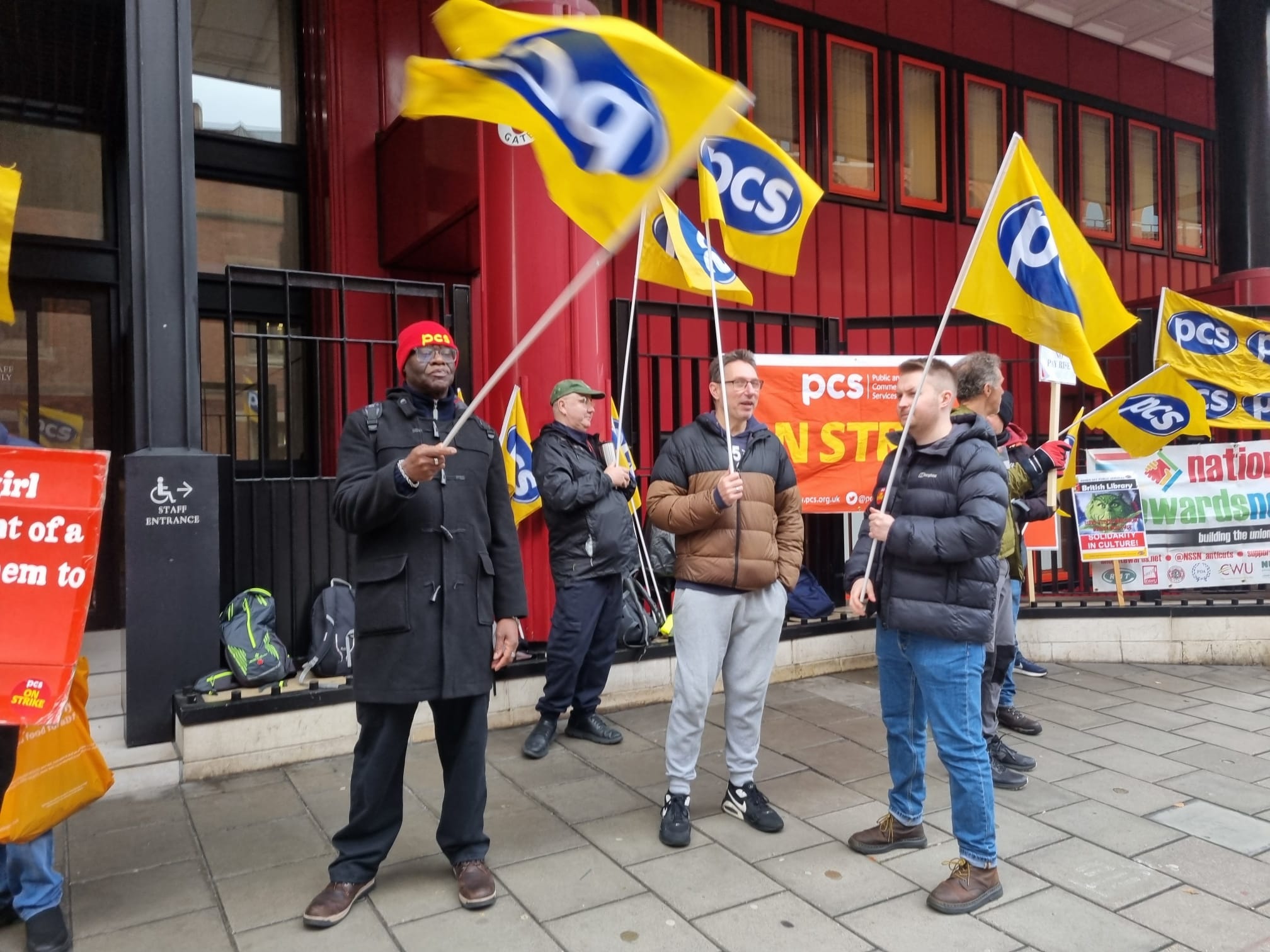
Dave Semple, PCS Deputy President
Just weeks after socialists in the Public and Commercial Services (PCS) union scored a decisive victory in the union’s National Executive Committee (NEC) elections, the union met for its Annual Delegate Conference (ADC).
Starmer’s Labour government, which has mounted huge attacks on civil service jobs and funding, has been savaged at the polls. And the PCS leadership which has covered for that government and resisted mounting a serious campaign has been ousted.
Members of PCS, representing civil service workers, workers in other national public bodies such as museums, and private sector workers on government contracts, have elected a left majority, including a new union president. This NEC majority involves the Broad Left Network (BLN – in which the Socialist Party participates) in a left coalition alongside others.
The ADC met from 18-21 May, debating vital national motions on a cost-of-living campaign, political strategy, rep victimisation, and much else.
On virtually every issue – and despite plenty of efforts to avoid it by the outgoing president of the union, Martin Cavanagh, who presided over the conference – the positions put forward by BLN supporters and the left won votes decisively. ADC closed with the announcement of a spectacular left victory in the elections to a range of other union bodies, to the National Standing Orders Committee (NSOC) and others.
The time to fight is now
Socialist Party members in PCS have been arguing for a serious fight on key industrial issues since the former general secretary, Mark Serwotka, and the NEC led by the misnamed ‘Left Unity’ (LU) group, collapsed the union’s national campaign in summer 2023.
Delegates at every conference continued to vote for a serious campaign. But at that stage, even when they lost their majority for a year in the 2024 elections, the LU grouping kept the president position, as well as the new general secretary, Fran Heathcote, who was elected with a slim majority in December 2023, and they persistently obstructed the development of any campaign.
At this year’s conference, despite opposition from the now-ousted NEC, and despite attacks by LU supporters on everything from the proposed timing of the struggle to the so-called ‘shopping list’ of demands proposed, conference passed motion A375 by 204 votes to 133. This gives the union leadership a clear instruction to move to a dispute over pay, jobs, office closures and hybrid working, allied to other unions if possible.
Fight the far right with class politics
Motion A111, in the section of the agenda on fighting the far right, was moved by Alan Dennis, national secretary of the Broad Left Network (BLN). It is unambiguous: “Conference believes… a party based on the organised working class, that fights for anti-racist, anti-war, socialist policies, is vital to prevent the far right harnessing the growing anger of working-class people with Starmer’s Labour.”
The motion instructed the incoming NEC to pick up the banner – long the official policy of PCS and the TUC, but not implemented – of ‘Workers’ unity, not division – jobs and homes, not racism’. And, should Labour not move to implement pro-worker policies, to convene a conference with other unions to discuss the building of a political vehicle for workers.
This will be a major task for the new NEC in the year ahead. The first priority is launching a cost-of-living campaign that will defend our members. But uncritically urging an ‘anti-Reform’ vote in the face of the rage of working-class people, without offering an alternative electoral programme, is likely to shipwreck any hopes of avoiding a Reform government. We must build the alternative now.
Democracy not top-down control
The conference in 2025 was a scene of controversy, as 20 motions relating to the Supreme Court judgment ‘For Women Scotland v Scottish Ministers’ were barred from the agenda. The stage looked set for a repeat, with a slew of motions being X-marked (ie refused a hearing) and others not being printed.
But at the last minute, the standing orders committee (NSOC), which oversees the conference agenda, had a change of heart. The NSOC is meant to be the guardian of the agenda to defend the rights of delegates, but for the last few years it has increasingly bent to pressure from the LU-dominated NEC. The NSOC is elected by block vote (ie branches voting as a unit) and last year two Socialist Party members – Zakk Brown and Craig Worswick – were elected to it. Though in a minority, they played a crucial role in ensuring that democracy prevailed at conference this year.
Emergency motion A348, demanding support for trans members whose rights are threatened, was put straight to the top of the equalities section of the agenda. It sailed through with a clear majority and a full-throated roar of delight from delegates, despite attempts by LU-supporting branches to repeat ‘the law, the law, the law’ – in reality attempting to avoid a debate.
Reliance upon selective interpretations of the law was a common theme of LU. How dare activists propose effective, democratic means of contacting members, for example, as this would breach GDPR! How dare they propose support for trans rights, as this would breach the Supreme Court judgement! Conference rejected all of it.
In addition to Heathcote and Cavanagh’s lack of strategy to defend members – beyond talking to the Cabinet Office without a campaign to exert pressure – there is an absence of basic support for reps.
Access to members’ data to ensure branches are well-organised, high-quality printed materials, up-to-date information so that reps know how to answer members’ queries – all are either not done, or done inadequately.
More seriously, support for victimised reps appears to be selective. LU supporters, when senior officers of PCS, appeared to do nothing beyond speeches to push back against the victimisation of Rachel, Joel and Gordon at Revenue and Customs Benton Park View. They appear to have done little to support other victimised HMRC reps this last year. Conference asserted clearly and repeatedly the need to defend our reps.
A key moment in reps becoming aware of the risks to union democracy posed by Heathcote and Cavanagh was at ADC 2023, when Heathcote was exposed for actively soliciting contributions on uncontroversial motions, in order to run out of time to debate motions LU wanted to avoid, such as on trans rights.
These tricks were at work at conference this year. In the chair, Cavanagh crammed in speakers on uncontroversial motions to talk out motion A70, which sought to address LU’s abuse of the union’s disciplinary process. Tellers were called when the vote was clear, and in one case a full card vote was unnecessarily called. During the first card vote, most of the top table wandered off, instead of continuing with other motions while the card votes were counted. All in the service of delays to block other motions down the agenda.
Cavanagh’s ousting by members in this year’s elections will hopefully mark a break – but the confirmation of this will lie in the ability of the new NEC, which includes six Socialist Party members, and on which Broad Left Network supporters make up the largest single group (13), to mount the fightback against Labour austerity that members and reps are demanding.
Civil service pay
On the final day of conference, the government announced the 2026-27 civil service pay remit of 3.5%. (This is the ballpark pay rise around which different civil service groups set increases.)
The general secretary, despite the explicit decisions just made by conference to launch a national cost-of-living campaign that picks up pay, jobs, office closures and hybrid working, immediately rushed out a statement on the PCS website and an all-members’ email, bypassing the newly elected NEC.
Heathcote’s statement that “while the outcome of talks does not represent sufficient progress to meet all our demands in a single year, it builds on the progress made in previous years and takes us further forward”, and that the NEC will “issue guidance to your negotiators”, presupposes a rush straight into delegated pay bargaining in the groups within that 3.5% remit, without any attempt to put additional pressure on the Cabinet Office to offer further concessions.
The phrase in her statement, “I commit to members that I will do all I can to ensure that the changes we have secured quickly translate into much-needed money in your pockets”, is an attempt to present herself as being on the side of members against any delays allegedly caused by the new NEC.
But the members have rejected her passive cover for Starmer’s government in both the elections and at conference.
Despite the general secretary’s press release, the NEC majority has already called an emergency NEC. There, the elected lay-led leadership will thoroughly debate the pay remit and set out a way forward to equip reps to build the campaign necessary to win and as agreed by delegates at conference.
We believe if the new NEC is able, in collaboration with the reps and members, to mount a serious campaign, we can force this weakened Labour government into retreat. Building this fight is our key work for this year.
