

This year marks the 90th anniversary of a wave of mass strikes in France, following the election of a Popular Front government. To mark the occasion, we publish an edited extract of an article by Peter Taaffe from 1978, reprinted in Socialism Today, July 2024.
The titanic sit-down strikes of May-June 1936 stand as a crushing condemnation of the policy of Popular Frontism.
Between 1931 and 1936, the French working class had seen their already meagre wages reduced by an average of 30%. Their growing radicalisation was reflected in the elections of 1936. The Popular Front [a coalition between workers’ parties such as the Communist Party and ‘liberal’ capitalist parties such as the Radical Party] received over 5.5 million votes, compared to the 4.5 million for the right-wing National government.
The revolutionary ferment among the masses was reflected in the capitalist Radical Party’s loss of half a million votes, its reduction to third place in votes, while at the same time the Communist Party (CP) doubled its vote to 1.5 million.
Throughout the election campaign, the CP leaders covered the Radicals with a revolutionary aura – in complete contradistinction to Lenin, who used elections to unmask liberal capitalists before their middle-class supporters. The Radicals openly boasted that they would be a brake on the ‘excesses’ of the socialist ministers.
The Popular Front’s programme promised important reforms such as the 40-hour week but came out only for the nationalisation of war industries and the banks. The suspicion of the masses – and their doubts about the willingness of their own leaders to implement the programme – was shown in the events which followed the election.
On 25 May 1936, half a million workers marched past the spot where the Communards (the workers who briefly took power in the Paris Commune of 1871) were shot “carrying red banners and wearing red flowers, and including many women and children…” The procession was nearly two miles long and lasted from early afternoon till late evening.
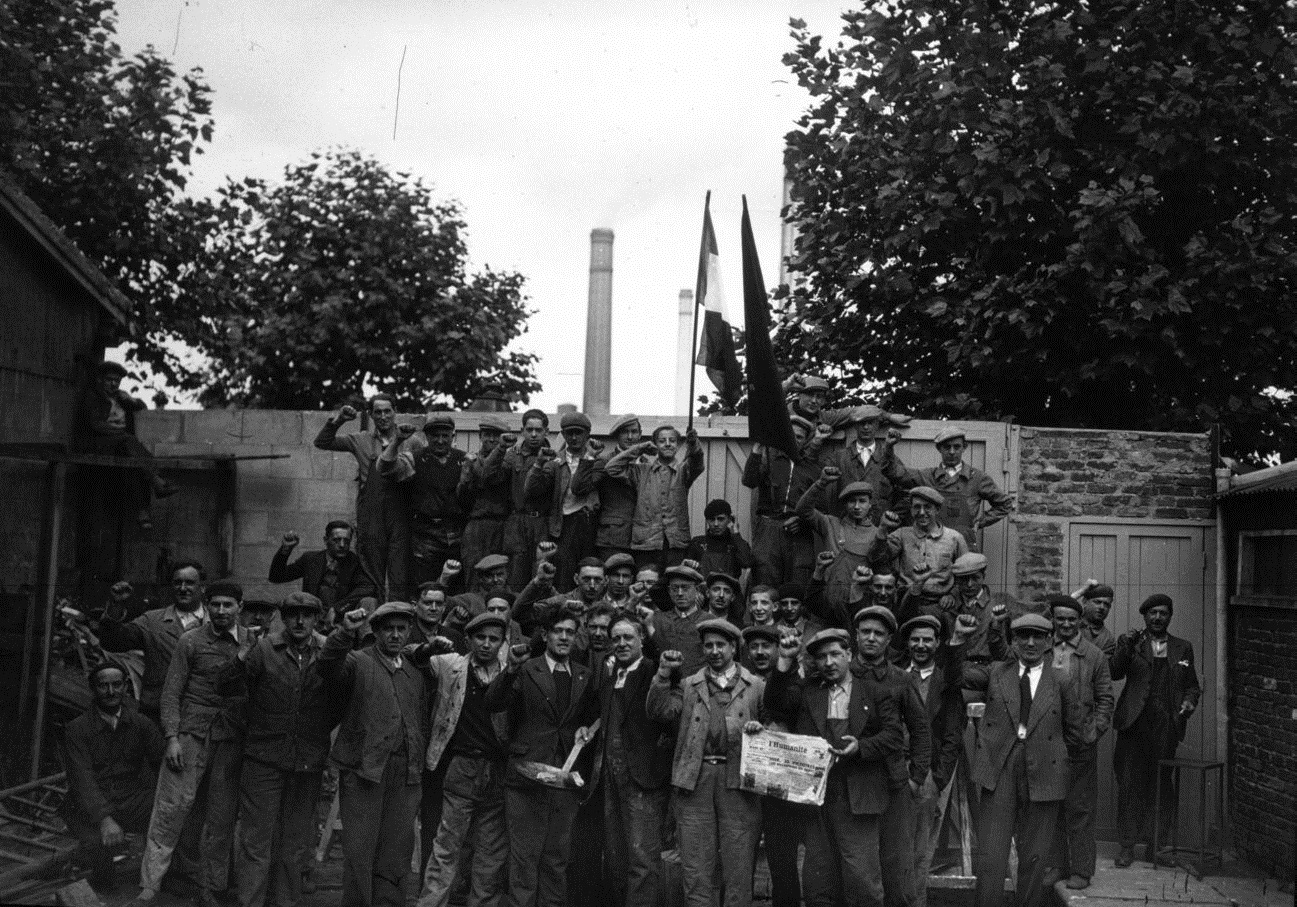
Then, in the last week of May and the first two weeks of June, a mighty wave of sit-in strikes was begun by the French working class. Beginning with the metal workers in Paris, all corners of France and all layers of the working class joined in. On the eve of the strike, trade union membership stood at 1.2 million – just 20% of the labour force. Yet upwards of three million joined the strike.
Occupied
The Manchester Guardian reported on 11 June: “Coachwork factories in Paris, several cinemas and two or three dressmaking firms which were ‘occupied’ by the ‘midinettes’ who went on strike today… the stable lads have ‘occupied’ the racing stables and several hundred undertaker societies and tombstone manufacturers have joined in the movement… The syndicate of concierges has asked for holiday with pay and automatic buttons for opening front doors at night”!
The loss of production was bad enough, but the occupations and strikes began to affect the stomachs of the rich: “The rather abrupt manner in which the waiters’ strike began in some of the restaurants while some of the customers were in the middle of lunch was rather unpleasant.”
The Times reported: “The lifeboat men on the Seine have put up a notice to say that they are on strike and forbidding passers-by to throw themselves into the water.”
In the ports, sailors marched through the towns with arms linked singing the ‘Internationale’, and the police fraternised with the workers. Here was a unique opportunity for the French working class to have taken power peacefully! The forces of French capitalism were completely paralysed.
The French working class was looking in the direction of power. One picket commented to a reporter from the Manchester Guardian: “‘Our boss has been treating us as dictators. Well I told him that we preferred this sort of dictatorship within the framework of a democratic regime to the dictatorship of Hitler and Mussolini.’”
The leaders of the French workers’ parties were terrified by these developments, which had taken them by surprise and were threatening to get out of control: “Several Communist deputies to whom I spoke were visibly embarrassed and alarmed. They declared the strike to be ‘untimely’, described it as an uncontrollable mass movement, and declined all responsibility for it.”
The French army was a conscript army. Demonstrations and upheavals were sweeping through the barracks, with the conscripts demanding, among other things, the reduction of army service to one year. Any attempt by the French ruling class to use the army against the working class would have resulted in it splitting in their hands.
In a much less favourable situation than this, with the actual armed intervention of imperialism, Lenin and the Bolsheviks were not deterred from taking power in Russia in 1917.
The British Communist Party’s Daily Worker, speaking of the effects of the French events in Germany, reported: “The Nazi press at first ‘played up’ the strikes saying they were an example of the ‘chaos’ from ‘Bolshevik’ influence in France. After a few days it became noticeable that workers were beginning to say they saw the huge gains won by the strikers as an example it might be a good one to follow.”
Overthrown
If the German workers were inspired just by wage increases gained by their French brothers and sisters, imagine the effect on them of socialist revolution. Both Hitler and Mussolini would have been overthrown. The Spanish workers, who rose and were initially victorious in four fifths of Spain just one month later, would have joined, as would the working class throughout Europe.
The ruling class of France, and of Europe, together with their shadows within the labour movement, were paralysed by fear, some of them believing that the hour of their downfall had arrived. For instance Prime Minister Léon Blum remarked: “I am being spoken of as a Kerensky who is preparing the way for a Lenin.”
But there was no Lenin to be found in the ranks of the French Communist Party leaders. The methods, the programme and the tactics of Lenin were a book sealed with seven seals so far as the French CP leaders were concerned. They bent every effort to derail the movement of the masses. In the process, enormous suspicion and hostility towards these leaders developed, at least among the advanced workers.
The Manchester Guardian reported: “The revolutionary temper… is undeniable as may be seen by the extraordinary incident that occurred at Renault yesterday. The local Communist deputy who urged the strikers to resume work on the basis of Monday’s agreement… was howled down and driven out of the works. There is no doubt that not only the CGT (trade union federation) but even the Communist leaders have no control and no authority over the strikers of several engineering concerns.”
Seeing power slip from the hands of his class and no doubt gnashing his teeth, one worker commented: “It is strange to think that in a few days everything may go back to ‘normal’ and Renault will come into their own again; and the posters and drawings and flags and wireless set and everything will be gone. Foremen will be able to order you about and glare.”
The French capitalists were forced to concede the 40-hour week, at least in words, as the price of getting the strike called off. But what the capitalists gave with the left hand they took back with the right later on. The wage increases were gradually cancelled through inflation. No sooner was the ink dry on the agreement than the individual employers began to resist the implementation of the reforms.
But The Times urged the French capitalists to bide their time: “The general terms of Monday’s settlement are being resisted in detail, with the risk that disappointment following apparent victory may produce a fiercer temper in the working class than a period of waiting would have done.”
Power for the French working class was there for the taking in 1936, but for the treacherous role of the workers’ leaders, particularly the Communist Party leaders.
Hiding behind the Popular Front, the French capitalists prepared their revenge. Later, thousands of militants were victimised. In October 1936, further sit-ins took place and this time the police were used to evict the strikers.
The French capitalists, moreover, heaped on the shoulders of the working class the responsibility for inflation, thereby alienating the middle class from the workers. This shows the futility of attempting to win the middle class on a programme which does not go beyond the framework of capitalism.
By taking power, by taking over the assets of the ruling 200 families and establishing a planned economy, the French working class would have shown in action that it was the only force capable of solving the problems of the middle layers. A planned economy would have allowed for cancellation of the debts of the small people in town and country and the extension of cheap credit and aid.
Instead, Léon Blum was forced out of the premiership of the Popular Front government in 1937 and the Socialists were completely excluded in 1938. The French working class, as with their Spanish brothers and sisters, were thus delivered into the arms of Fascism. The French Popular Front prepared the way for the enslavement of the working class by the Nazis and their French collaborators in the Vichy regime.
In the immediate post-war period, the European capitalists used the Communist and Socialist Party leaders through the medium of coalition government to save themselves from the wrath of the masses. When the danger had passed, however, the CP and socialist leaders were unceremoniously booted out.
The legacy of the Popular Front is one of defeats – sometimes bloody and terrible, as in Chile in 1973.
Stronger
But the 1970s are not the 1930s, or even the 1940s. The Italian, French and Spanish working class are immeasurably stronger than in the past. Stalinism no longer exercises a mesmeric effect on the rank and file of the Communist Parties. On the basis of the great events which impend in Europe, the rank and file will see that only disaster lies at the end of the road of the ‘Popular’ or ‘National’ Fronts.
The workers in these organisations will seek a return to a programme capable of giving them victory in the struggle to eliminate capitalism. As a step towards this, the advanced workers must absorb the lessons of past popular fronts in order to prevent catastrophe in the struggles which are now opening up.
Popular Frontism
The capitalist establishment in 1930s France faced deep political crisis, based ultimately on the deep crisis of world capitalism. In February 1934, mass discontent found its expression in the form of riots, with the involvement of authoritarian and far-right forces – and in the context of fascism on the rise in Europe.
Writing in November 1934 (Whither France?), Leon Trotsky describes how across Europe, at different rhythms in different countries, capitalism’s complete bankruptcy was being revealed. The working class taking power was posed or, where the working class – as a result of faulty leadership failed to do so – the capitalists were resorting to fascism. He put it: “The historic function of fascism is to smash the working class, destroy its organisations, and stifle political liberties when the capitalists find themselves unable to govern and dominate with the help of democratic machinery.”
“The fascists find their human material mainly in the petty bourgeoisie [middle class layers]. The latter has been entirely ruined by big capital… Fascism is the act of placing the petty bourgeoisie at the disposal of its most bitter enemies.”
For the Stalinist leadership of the Communist International, acting according to the narrow self-serving interests of the Soviet bureaucracy, had swung from its disastrous ‘third period’ in which it denounced social democratic organisations as ‘social fascist’ to support for ‘popular frontism’, an uncritical alliance of all the workers’ parties with the liberal capitalist parties ‘against fascism’.
In France, the Radicals were the liberal capitalist party “with whose aid the big bourgeoisie preserve[d] the hopes of the petty bourgeoisie in a progressive and peaceful improvement of its situation… only so long as the economic situation of the petty bourgeoisie remained supportable and tolerable.” But under the blows of capitalist crisis, support for the Radicals was collapsing.
Trotsky said: “The working-class party must occupy itself not with a hopeless effort to save the party of the bankrupts. It must, on the contrary, with all its strength, accelerate the process of liberation of the masses from Radical influence.”
“To bring the petty bourgeoisie to its side, the proletariat [working class] must win its confidence. And for that it must have confidence in its own strength. It must have a clear programme of action and must be ready to struggle for power.”
90 years later, we are in a very different situation. Fascism coming to power is not currently posed. Nonetheless, there are many lessons from this period for today. Under the blows of capitalist crisis, British capitalism is faced with the collapse of its establishment parties. Faced with the threat of a right-populist Reform-led government, leaders of the trade unions speak of the need to support Labour to keep Reform out. Green Party leader Zack Polanski, seen by many as an anti-establishment left winger, has spoken of being willing to take part in a future ‘progressive alliance’ with Labour to stop Reform.
Such developments could succeed temporarily in limiting the number of Reform MPs elected, for example. However, a popular alliance – with support from the leaders of the trade unions – of the Greens with Labour, even potentially involving the Lib Dems, would in fact only prepare the ground for further future growth of Reform and the right.
The Socialist Party fights for independent working-class politics, including for the trade unions to lead in the building of a mass workers’ party. By showing a lead in fighting to defend the working class from the bosses’ attacks, armed with a programme for the socialist transformation of society, the workers’ movement can cut across support for the right.